
Guna Score 17 Out of 36 — Should You Worry?
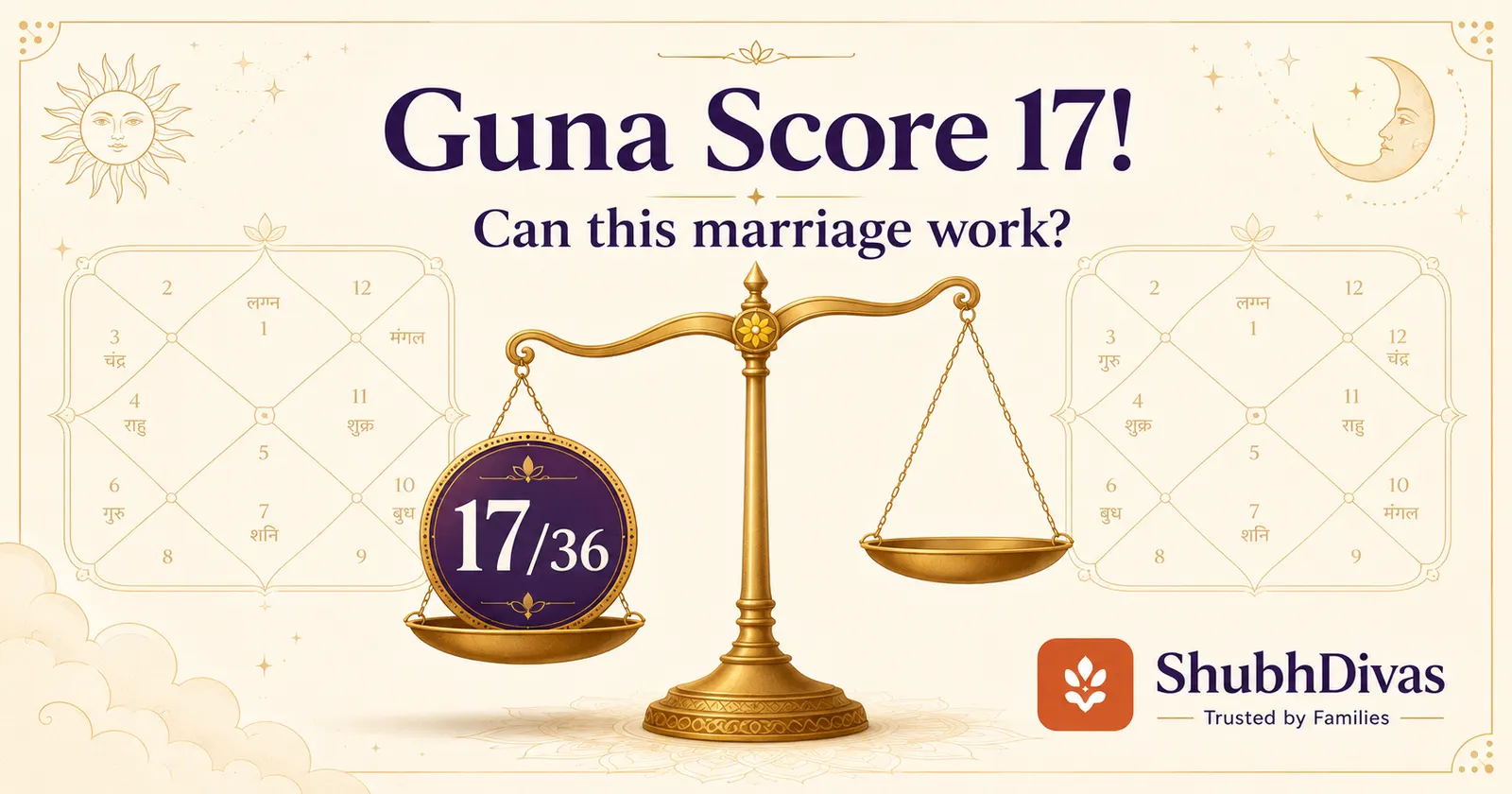
The short answer is: 17 is the traditional minimum, and it does not automatically mean the marriage will fail. What matters more is which kootas are scoring low, whether any major doshas are present, and the strength of the individual charts.
Here is a complete breakdown of what a score of 17 means and how to assess it properly.
Why 18 is the Traditional Minimum
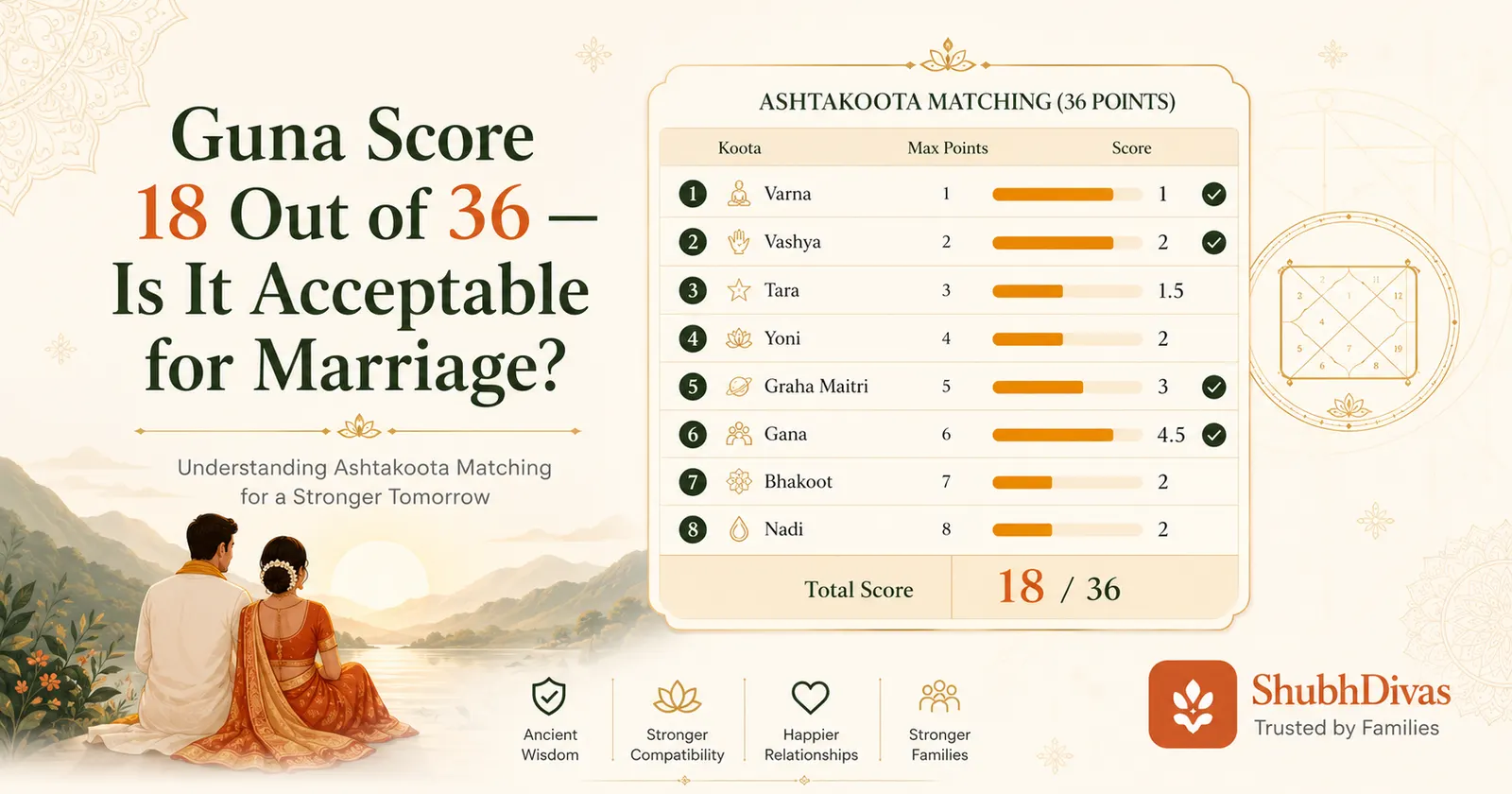
The Ashtakoota system distributes 36 points across 8 compatibility categories. The traditional minimum of 18 is exactly half — the idea being that a couple should be compatible in at least half the parameters for the marriage to be considered viable.
A score of 17 falls one point below this threshold. Many families treat this as a hard cutoff — if the score is below 18, the match is rejected outright. However, this mechanical application misses the nuance that the original system intended.
Not all 36 points are equal. A score of 17 where the low points come from Varna Koot (1 point) is very different from a score of 17 where Nadi Koot (8 points) scores zero.
Breaking Down a Score of 17
To assess a score of 17 properly, you need to know exactly where the points are coming from and where they are lost.
If your score of 17 includes full marks on Nadi and Bhakoot: Nadi Koot: 8/8 ✅ Bhakoot Koot: 7/7 ✅ Gana Koot: 0/6 ❌ (Deva-Rakshasa mismatch) Graha Maitri: 2/5 ⚠️ Yoni Koot: 0/4 ❌ Tara Koot: 0/3 ❌ Vashya Koot: 0/2 ❌ Varna Koot: 0/1 ❌ Total: 17/36 This is actually a reasonable match despite the low score — the two most important kootas (Nadi and Bhakoot) are perfect, and the losses are spread across less critical categories.
If your score of 17 includes zero on Nadi: Nadi Koot: 0/8 ❌ (Nadi Dosha present) Bhakoot Koot: 7/7 ✅ Gana Koot: 6/6 ✅ Graha Maitri: 4/5 ✅ Total so far: 17/36 This is a more concerning score of 17 — the zero comes from Nadi Koot, which is the most heavily weighted parameter and associated with health and progeny.
The Three Kootas That Matter Most
When assessing any guna score, focus first on these three:
Nadi Koot (8 points) — Most important. Zero here means Nadi Dosha. If uncancelled, this is a serious concern regardless of the total score. A match with 25/36 but Nadi Dosha may be more problematic than a match with 17/36 without Nadi Dosha.
Bhakoot Koot (7 points) — Second most important. Zero here means Bhakoot Dosha. Associated with financial problems (2-12), child issues (5-9), or health conflict (6-8). Check if the dosha is cancelled by same rashi lord before worrying.
Gana Koot (6 points) — Third most important. Zero here means a Deva-Rakshasa temperament mismatch. This affects day-to-day compatibility and is harder to work around than the other doshas since it is about fundamental nature rather than specific life events.
When 17 Can Work
A score of 17 is acceptable when:
No major doshas in the low kootas: If the score is 17 because Varna, Vashya, Tara, and Yoni are all low — but Nadi, Bhakoot, and Gana are strong — the match is fundamentally sound. The lower kootas govern secondary compatibility factors.
Strong individual charts: If both individuals have strong 7th houses, strong Venus, and no major afflictions in their natal charts, the marriage foundation is solid regardless of the guna score.
Dasha compatibility: If both individuals are entering positive dashas at the time of marriage — Jupiter dasha, Venus dasha, or their own strong planetary periods — this provides an auspicious start that can carry the couple through initial friction.
Mutual understanding and compatibility: In modern Jyotish practice, many astrologers weigh the couple's actual compatibility — shared values, communication, mutual respect — alongside the numerical score. A couple who knows each other well and has demonstrated compatibility in real life gets more latitude on the guna score.
When 17 is a Concern
A score of 17 warrants careful attention when:
Nadi Dosha is present and uncancelled: If the 8 missing points come from Nadi Koot and there are no cancellation conditions (same nakshatra different pada, or same rashi lord), consult a qualified Jyotishi before proceeding.
Both Nadi and Bhakoot are zero: A score of 17 where both these kootas score zero means the total without these two doshas would have been 32/20 — the doshas are dragging the score down significantly. This combination needs careful examination.
Weak individual charts: If either person has a weak 7th house, afflicted Venus, or challenging dashas at the time of marriage, a low guna score adds to the risk rather than being offset by individual chart strength.
What to Do With a Score of 17
Step 1 — Identify which kootas scored low This is more important than the total number. Get the full breakdown.
Step 2 — Check for major doshas Is Nadi Dosha present? Is Bhakoot Dosha present? If yes to either, check cancellation conditions.
Step 3 — Check individual charts Look at the 7th house, 7th lord, and Venus in both charts. A strong individual chart significantly compensates for a low guna score.
Step 4 — Check dasha at time of marriage What dasha is each person running? Marrying during Jupiter or Venus dasha with mutual goodwill is considered auspicious regardless of guna score.
Step 5 — Consult a qualified Jyotishi Not a computer report — a human astrologer who examines both full charts together. Many experienced astrologers approve matches below 18 after a full assessment.
You can start with your kundali compatibility check on ShubhDivas to get the full koota breakdown and dosha analysis before consulting an astrologer.
The Realistic Perspective
Guna matching is a screening tool, not a verdict. It was designed to quickly filter obvious mismatches in an era when people had no other way to assess compatibility before meeting.
A score of 17 flags that compatibility needs closer examination — it does not predict an unhappy marriage. Many couples with scores well above 18 have difficult marriages, while couples with scores below 18 live happily together for decades.
The guna score is one input. Use it as a starting point, not an ending point.
Frequently asked questions
Get a complete Kundali Milan Report
Ashtakoota Guna Milan, Nadi + Mangal + Rajju Dosha with cancellations, Navamsa compatibility, overall score 0–100, and 5 auspicious wedding muhurat dates. ₹199.
₹199 · Delivered within 24 hours
 Acharya Suryakanth Subramaniam | Parashari Jyotish
Get Your Personalised Reading
Reviewed by Acharya Suryakanth Subramaniam | Classical Parashari Jyotish
Nadi Dosha Report — ₹99 →