
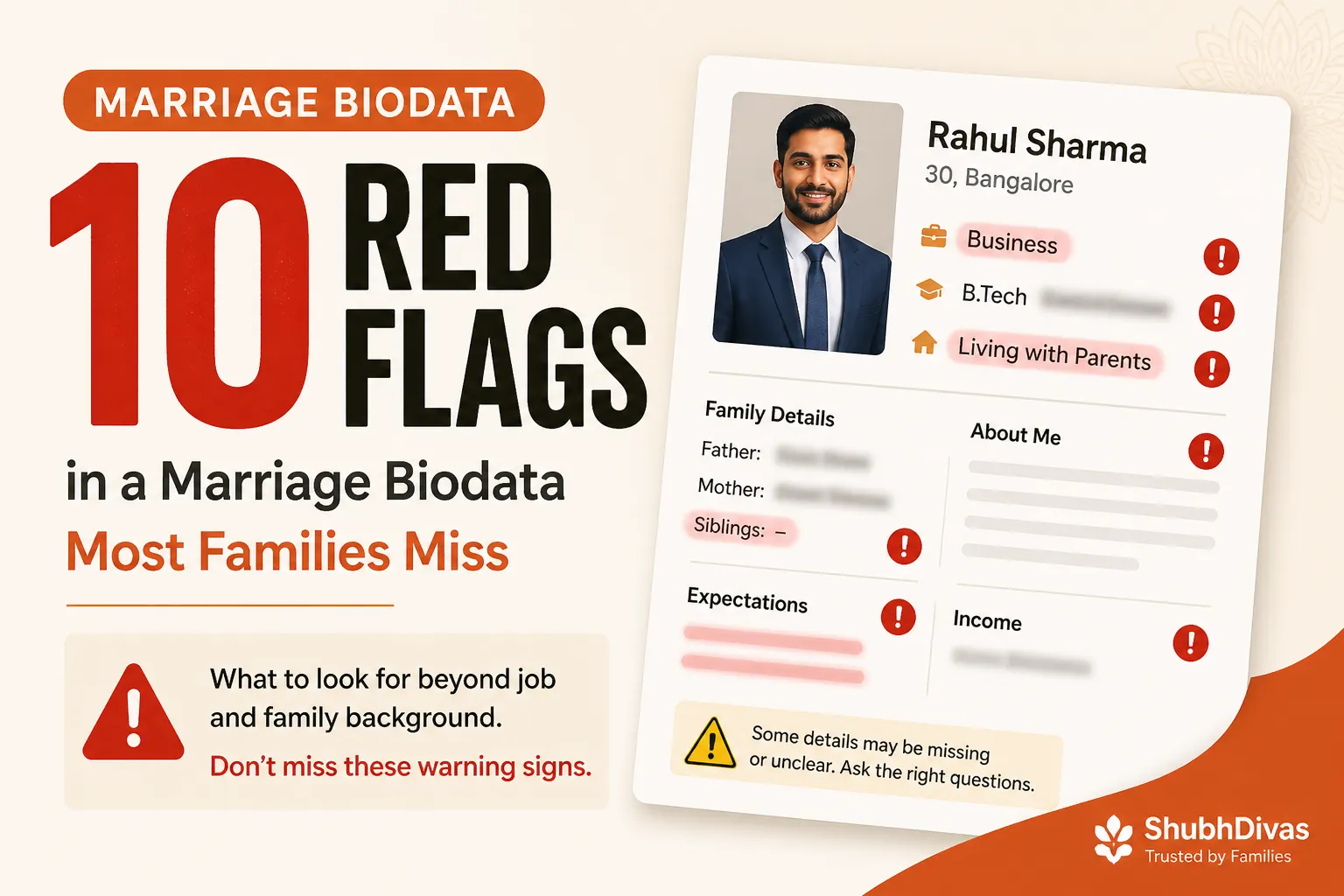

Most families spend five minutes reading a biodata. They check the photo, scan the job title, note the hometown, and move on. Five minutes to begin a process that could shape the next fifty years.
That is not a criticism — it is just how it works. A biodata arrives, there are fifteen others in the inbox, and you are looking for quick signals. The problem is that the signals most families look for — good job, respectable family, pleasant photo — are exactly the things that are easiest to present well. What slips through the polish is more useful.
This is a guide to what slips through.
Why Biodata Red Flags Matter
A marriage biodata is a marketing document. The person who wrote it, or the family member who wrote it on their behalf, was trying to make a good impression. They chose what to include, what to leave out, and how to phrase everything. That is not dishonest — it is what everyone does.
Red flags in a biodata are not proof of anything. They are gaps, inconsistencies, or patterns that deserve a question. Every single item on this list has an innocent explanation. The goal is not to assume the worst — it is to notice the thing and ask.
The families who spot biodata red flags early have better conversations. They go into the first meeting knowing what they want to understand. That is a significant advantage.
Red Flag 1 — Vague Employment Details
"Business" as a job description is the most common one. No company name, no industry, no role. Sometimes it is genuine — a family business that is hard to summarise in one line. Often it is a placeholder for an employment situation that is more complicated.
The same goes for job titles without context: "Manager" (manager of what, where?), "Self-employed" (doing what?), or a company name that returns nothing on a Google search.
What to ask: What does the business do? How long has he/she been in the current role? What is the approximate annual income? These are standard questions and no reasonable family will object to them.
Red Flag 2 — Extreme Age Gaps
A 7-8 year age difference is not automatically a problem. Plenty of couples with significant age gaps have excellent marriages. But it is worth examining — particularly if the older party is considerably older and the biodata does not acknowledge it.
The more important question is life stage. Someone who is 34 and wants children soon is in a very different position than someone who is 34 and still figuring out their career. Age gap + mismatched life stage is where the actual problem lives.
What to ask: Where does she/he see themselves in five years? What is their timeline for starting a family?
Red Flag 3 — Too Many Job Changes
Four or more jobs in five years is a pattern worth noting among biodata red flags. Sometimes there is a perfectly good reason — a career pivot, an industry downturn, a toxic workplace that anyone would leave. These reasons exist and they are valid.
The concern is financial instability, or a pattern of difficulty getting along with colleagues or management. You cannot tell which it is from the biodata alone.
What to ask: Ask about the career journey directly and warmly. "How did you end up in your current role?" is an easy opener. Listen for whether the person takes any ownership of the transitions, or whether every previous employer was unreasonable.
Red Flag 4 — The Living Situation Gap
In India, living with parents well into your thirties is normal and often admirable. It is not the living situation that is a red flag — it is an unexplained return to it.
If someone lived independently for several years and has moved back, that is worth understanding. It could be a parent's health (completely understandable), a financial setback, or something else. The biodata usually will not say. The question will.
What to ask: "Is she/he close to her/his family?" tends to open the conversation naturally.
Red Flag 5 — The Photo Problem
A biodata photo that looks like it was taken ten years ago — formal studio lighting, a hairstyle from a different era — is a small but real signal. It may mean nothing. It may mean the person is uncomfortable with how they look now, or that the family is presenting an older, more flattering image.
Heavy editing is a similar flag. Filters that soften features to the point of unrecognisability do not serve anyone — including the person being presented.
Why it matters: This is specifically about trust. If the first impression is managed this carefully, what else is being managed? It is a small thing, but small things compound.
What to ask: Request a recent candid photo — a family function photo works well and feels natural to ask for.
Red Flag 6 — Missing Information That Should Be There
The absence of information is often more telling than the presence of it. Common examples among marriage biodata red flags:
- A "family details" section that mentions parents but is silent on siblings, despite the biodata otherwise being detailed
- Education listed without years or institutions
- A timeline that jumps from college to current job with an unexplained gap of several years
- Income left completely blank when every other field is filled
None of these are automatic disqualifiers. But they are questions.
Red Flag 7 — The Expectations Section
Almost every biodata has one. "Looking for a homely, educated, working girl who respects family values." Fine.
The version that deserves a closer look: expectations that are internally contradictory ("wants a working wife who will be available full-time for family"), or so specific they suggest a checklist built over years of disappointment ("must be from X city, must be below X height, must have studied in a particular type of institution").
Extremely rigid expectations signal inflexibility. That is a trait that will matter in a marriage — not just in a biodata.
Red Flag 8 — Family Section Omissions
"Father — Late" is common and needs no explanation. What deserves a follow-up is vague language around family situations that seem incomplete: a joint family mentioned without any sibling details, or parents described in glowing terms but no mention of where they live or who they live with.
This matters because the family situation a person comes from shapes who they are — and who you are marrying into. Understanding it clearly before proceeding is not intrusive. It is sensible.
Red Flag 9 — Rushed Timelines
Pressure to meet within days of sending the biodata, or urgency around making a decision quickly, is one of the more consistent biodata red flags in practice. "We have another good match and need to know soon" is a classic.
Good matches do not require artificial urgency. A family that is genuinely interested will allow both sides the time they need to make an informed decision. Pressure tactics — even gentle, polite ones — are worth noticing.
What to do: Decline to be rushed. If the other family withdraws because you asked for reasonable time, that tells you something important.
Red Flag 10 — Refusing to Share Recent Photos
In 2026, with everyone carrying a camera in their pocket, declining to share recent photos of the person is unusual. It happens, and there are occasionally cultural reasons for it. But as a general matter, if families on both sides are serious about proceeding, seeing recent photos of each other is a reasonable expectation.
Refusal, combined with any of the other flags above, multiplies the concern.
How to ask without being awkward: "Could you share a few recent photos — even a family function photo would be lovely" is warm, specific, and gives an easy out if the formal studio photos are all they have.
A red flag is not a dealbreaker — it is a question. Every item on this list has an innocent explanation. The goal is to ask the question, not assume the worst. The families who ask clearly and early have better outcomes than those who ignore concerns and hope for the best.
What To Do When You Spot a Red Flag
The most effective approach is to ask directly but warmly, framing questions as curiosity rather than interrogation. "We noticed the biodata mentions X — could you tell us a bit more?" is almost always received better than pointed silence or an indirect probe through a mutual contact.
If the answer satisfies you — great. If it raises more questions, that is also useful information. If the other family becomes defensive or evasive in response to a reasonable question, that defensiveness is itself a data point.
The rishta process exists precisely to surface this kind of information before a commitment is made. Use it.
Frequently asked questions
Get a complete Kundali Milan Report
Ashtakoota Guna Milan, Nadi + Mangal + Rajju Dosha with cancellations, Navamsa compatibility, overall score 0–100, and 5 auspicious wedding muhurat dates. ₹199.
₹199 · Delivered within 24 hours
 Acharya Suryakanth Subramaniam | Parashari Jyotish
Get Your Personalised Reading
Reviewed by Acharya Suryakanth Subramaniam | Classical Parashari Jyotish
Nadi Dosha Report — ₹99 →