
The kundali matching report shows Nadi Dosha. But when you look at the details, something stands out — you and your partner share the same Nakshatra, say Mrigashira, yet one of you has Vrishabha Rashi and the other has Mithuna Rashi. Your family pandit says this might cancel the dosha. Your cousin says it doesn't. The online calculator says something else entirely.
You want a clear, honest answer. Here it is.
First — Understanding How Nadi is Determined
Before addressing whether nadi dosha same nakshatra different rashi situations are exempt, it helps to understand what Nadi actually is.
In the Ashtakoota system of kundali matching, each of the 27 Nakshatras belongs to one of three Nadis — the three biological constitutions from Ayurveda:
| Nadi | Nakshatras |
|---|---|
| Adi (Vata) | Ashwini, Ardra, Punarvasu, Uttara Phalguni, Hasta, Jyeshtha, Mula, Shatabhisha, Purva Bhadrapada |
| Madhya (Pitta) | Bharani, Mrigashira, Pushya, Purva Phalguni, Chitra, Anuradha, Purva Ashadha, Dhanishtha, Uttara Bhadrapada |
| Antya (Kapha) | Krittika, Rohini, Ashlesha, Magha, Swati, Vishakha, Uttara Ashadha, Shravana, Revati |
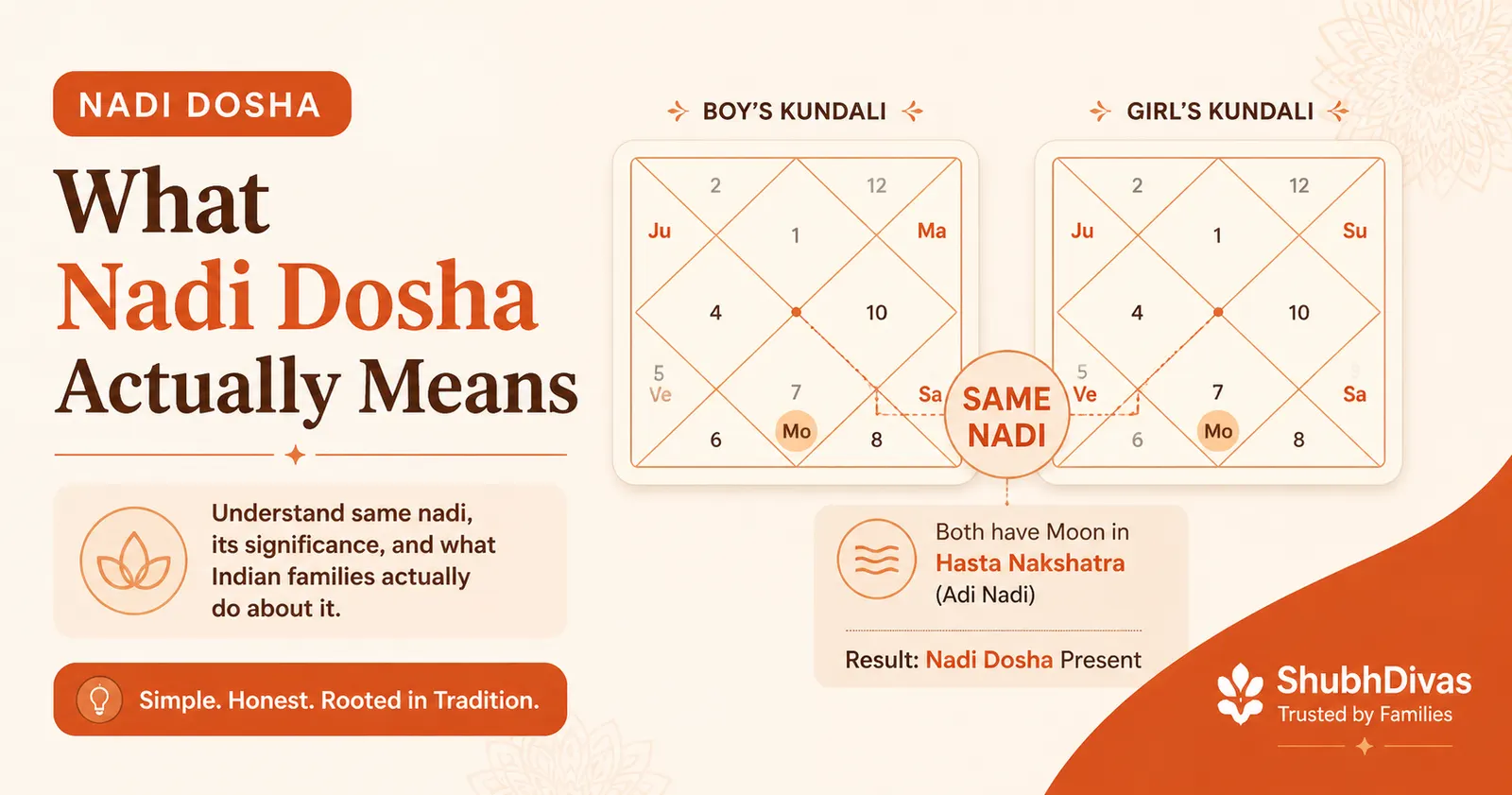
Nadi Dosha arises when both partners belong to the same Nadi — both Adi, both Madhya, or both Antya. The Nadi koota carries the maximum weight of eight points in Ashtakoota, making it the single most heavily weighted factor in kundali matching. A Nadi match scores full marks; a mismatch scores zero.
Notice one critical point: Nadi is determined entirely by Nakshatra. Your Rashi — your Moon sign — does not directly determine your Nadi. Two people can share a Nadi without sharing a Nakshatra, and two people can share a Nakshatra without having the same Rashi.
That last possibility is exactly what this article is about.
The Specific Situation — Same Nakshatra, Different Rashi
Here is where most online explanations fall short. Nine of the 27 Nakshatras span the boundary between two Rashis.
Each Nakshatra covers 13°20' of the sidereal zodiac. Each Rashi covers 30°. Because these don't divide evenly, every third Nakshatra or so crosses a Rashi boundary. Mrigashira Nakshatra, for example, spans from 53°20' to 66°40' of the sidereal zodiac — which means it straddles the boundary between Vrishabha Rashi (30°–60°) and Mithuna Rashi (60°–90°).
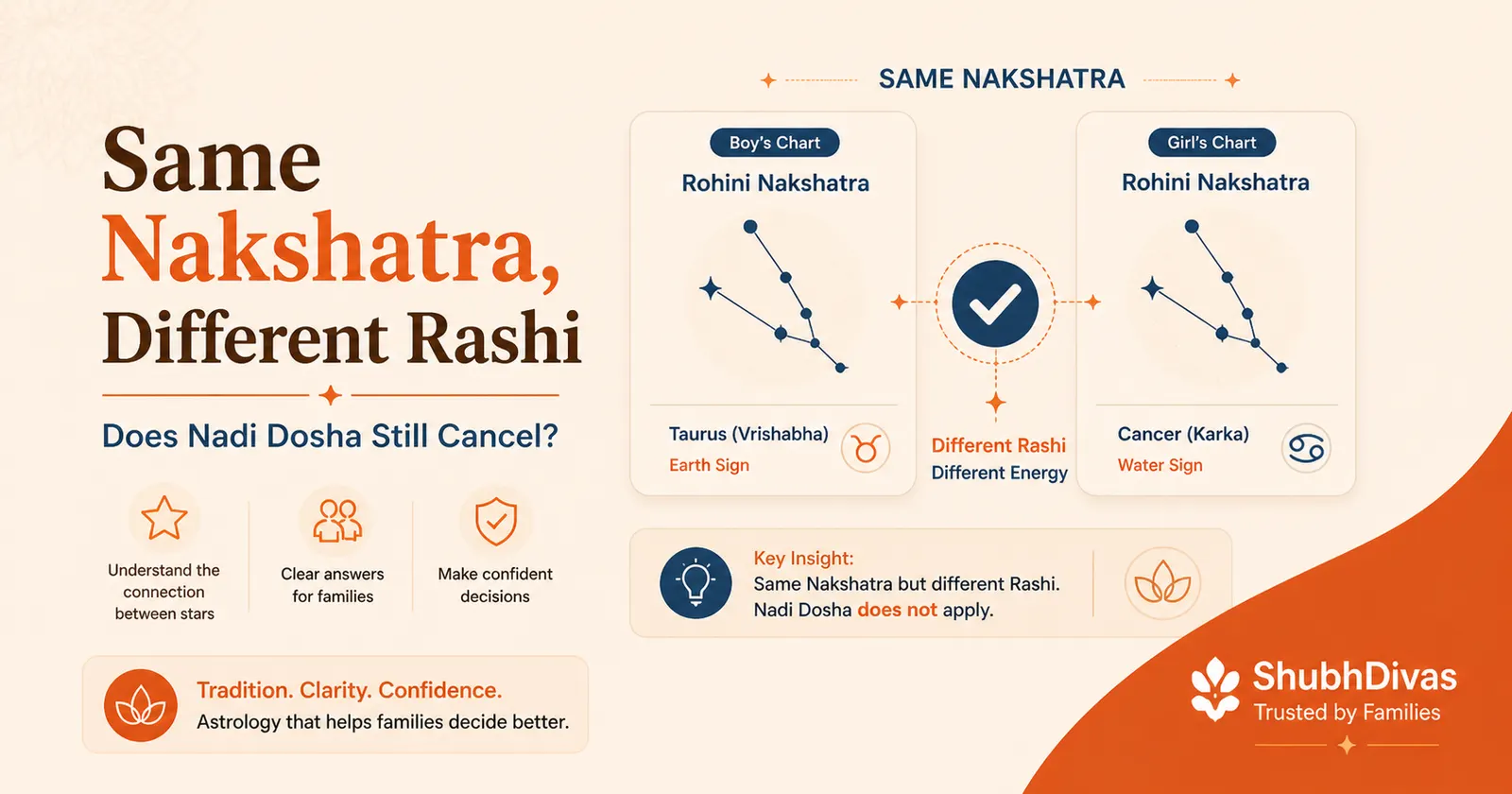
A person born when the Moon was between 53°20' and 60° has Mrigashira Nakshatra with Vrishabha Rashi. A person born when the Moon was between 60° and 66°40' has Mrigashira Nakshatra with Mithuna Rashi. Both share the same Nakshatra. Both are Madhya Nadi. Their Rashis are different.
Other Nakshatras where this comes up regularly:
- Krittika — first pada in Mesha, padas 2–4 in Vrishabha
- Punarvasu — padas 1–3 in Mithuna, pada 4 in Karka
- Uttara Phalguni — pada 1 in Simha, padas 2–4 in Kanya
- Vishakha — padas 1–3 in Tula, pada 4 in Vrishchika
- Uttara Ashadha — pada 1 in Dhanu, padas 2–4 in Makara
- Dhanishtha — padas 1–2 in Makara, padas 3–4 in Kumbha
If you and your partner share one of these Nakshatras and your Rashis fall on opposite sides of the boundary, the question of nadi dosha same nakshatra different rashi cancellation applies directly to you.
What Classical Texts Say
The Brihat Parashara Hora Shastra — the foundational text of Parashari jyotish — describes several conditions under which Nadi Dosha is cancelled or reduced. The most widely recognised cancellation rule:
When both partners have the same Nakshatra but different Rashis, Nadi Dosha is considered cancelled.
The reasoning behind this rule is precise. Nadi Dosha signals a constitutional incompatibility at the biological level. The signal is carried by the Nakshatra. But when the same Nakshatra spans two Rashis, the Moon's actual degree position at birth differs substantially between the two people. The specific lunar energy, the pada, and the Rashi lord all diverge. Classical scholars reasoned that this divergence is sufficient to neutralise the dosha.
Most pandits trained in Parashari jyotish apply this cancellation. Most reputable kundali matching software applies it too — including the calculations used by ShubhDivas, which checks both Nakshatra and Rashi before assigning the Nadi score.
If both partners have the same Nakshatra but different Rashis, Nadi Dosha is generally considered cancelled per classical Vedic astrology texts. Confirm with your family pandit, as regional traditions may vary slightly in how they apply this rule.
But There Is a Nuance
Cancellation of Nadi Dosha does not mean the shared Nakshatra is irrelevant. It is worth understanding what it actually means for a couple to share a Nakshatra.
Every Nakshatra has a ruling planet — its Nakshatra lord. Mrigashira's lord is Mars. Krittika's lord is the Sun. Vishakha's lord is Jupiter. When two people share a Nakshatra, they share the same ruling planet and, with it, a broadly similar instinctual energy. The way they initiate things, the way they respond under stress, the kind of problems they notice first — these tend to rhyme.
This is not a warning. Shared Nakshatra energy, in many regional traditions, is actively considered auspicious. It creates mutual recognition. Partners who share a Nakshatra often say the other person "just gets it" faster than anyone else does.
The nuance worth noting: the difference in Rashi shapes how that shared Nakshatra energy expresses itself. A Mrigashira-Vrishabha person is Mars-driven but grounded, patient, sensuous. A Mrigashira-Mithuna person is Mars-driven but restless, communicative, quick-changing. They recognise each other's core instinct but experience it through different temperamental filters. Most experienced astrologers consider this a complementary pairing, not a conflicted one.
One practical check: if a kundali matching report shows Nadi Dosha despite different Rashis, there is a good chance the software is matching on Nakshatra index alone without applying the Rashi cancellation. Ask your astrologer to verify manually.
The Bottom Line
Here is the direct summary of all three scenarios:
| Situation | Nadi Dosha? |
|---|---|
| Same Nakshatra, same Rashi | Yes — Nadi Dosha present, no cancellation |
| Same Nakshatra, different Rashi | Generally cancelled per classical texts |
| Same Nadi, different Nakshatra | Yes — Nadi Dosha present |
| Different Nadi entirely | No Nadi Dosha |
The nadi dosha same nakshatra different rashi question has a clear mainstream answer in Parashari jyotish: different Rashi cancels the dosha. This is the position most traditional astrologers hold and what classical texts describe.
Where confusion arises: some pandits from specific regional traditions — particularly certain schools in Karnataka and parts of Tamil Nadu — apply a stricter reading and still count the dosha even with different Rashis. If your pandit holds this position, ask which classical source they are following. This is a legitimate area of traditional disagreement. Both positions have textual basis.
What matters most in any kundali matching assessment is the full picture — the total score across all eight kootas, the health of both charts individually, the Bhakoot and Gana compatibility, and the life circumstances of both families. Nadi Dosha, even when present without cancellation, is not an automatic barrier to marriage. Many couples have married with full Nadi Dosha and lived well together, with appropriate remedies and with the overall horoscope in good order.
Frequently asked questions
Get a detailed Nadi Dosha Report
Both partners' Nadi identified, all 5 classical cancellation conditions checked, severity score 1–10, and Nadi Nivarana puja recommendations. ₹99.
₹99 · Delivered within 24 hours
 Acharya Suryakanth Subramaniam | Parashari Jyotish
Get Your Personalised Reading
Reviewed by Acharya Suryakanth Subramaniam | Classical Parashari Jyotish
Nadi Dosha Report — ₹99 →