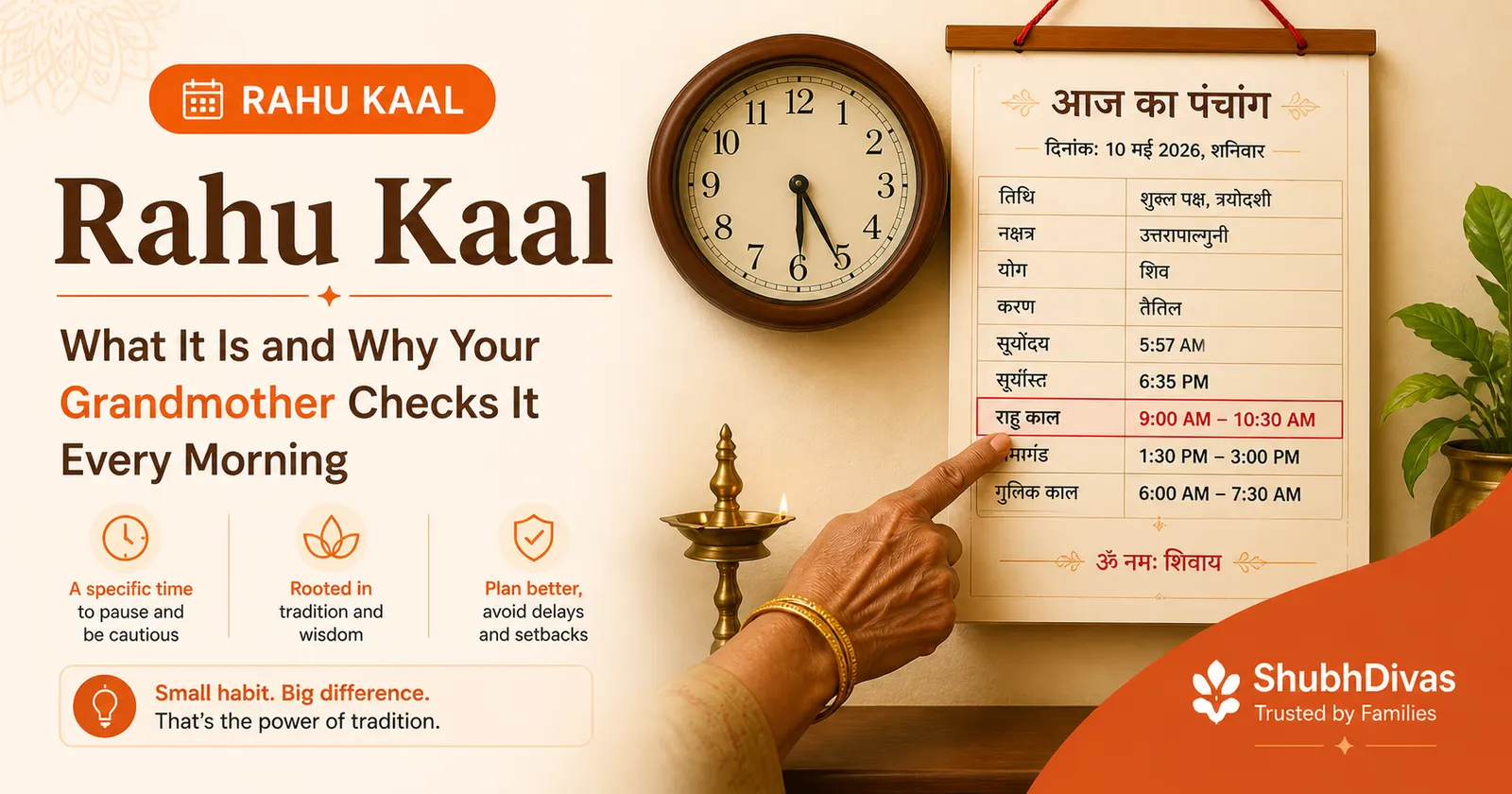

Picture a Tuesday morning in a South Indian household. Someone is about to leave for an important job interview. Grandmother glances at the wall calendar — the one with tiny numbers showing Rahu Kaal, Yamagandam, and Gulika Kaal for every day of the month. "Rahu Kaal starts in twenty minutes," she says quietly. The family adjusts. The candidate leaves a little earlier, or waits until it passes. No arguments, no lengthy explanations needed. Everyone understands.
This small ritual — checking Rahu Kaal before beginning something important — happens in millions of Indian homes every single day. But many younger people have started asking: what actually is Rahu Kaal, and does it matter?
What Is Rahu Kaal?
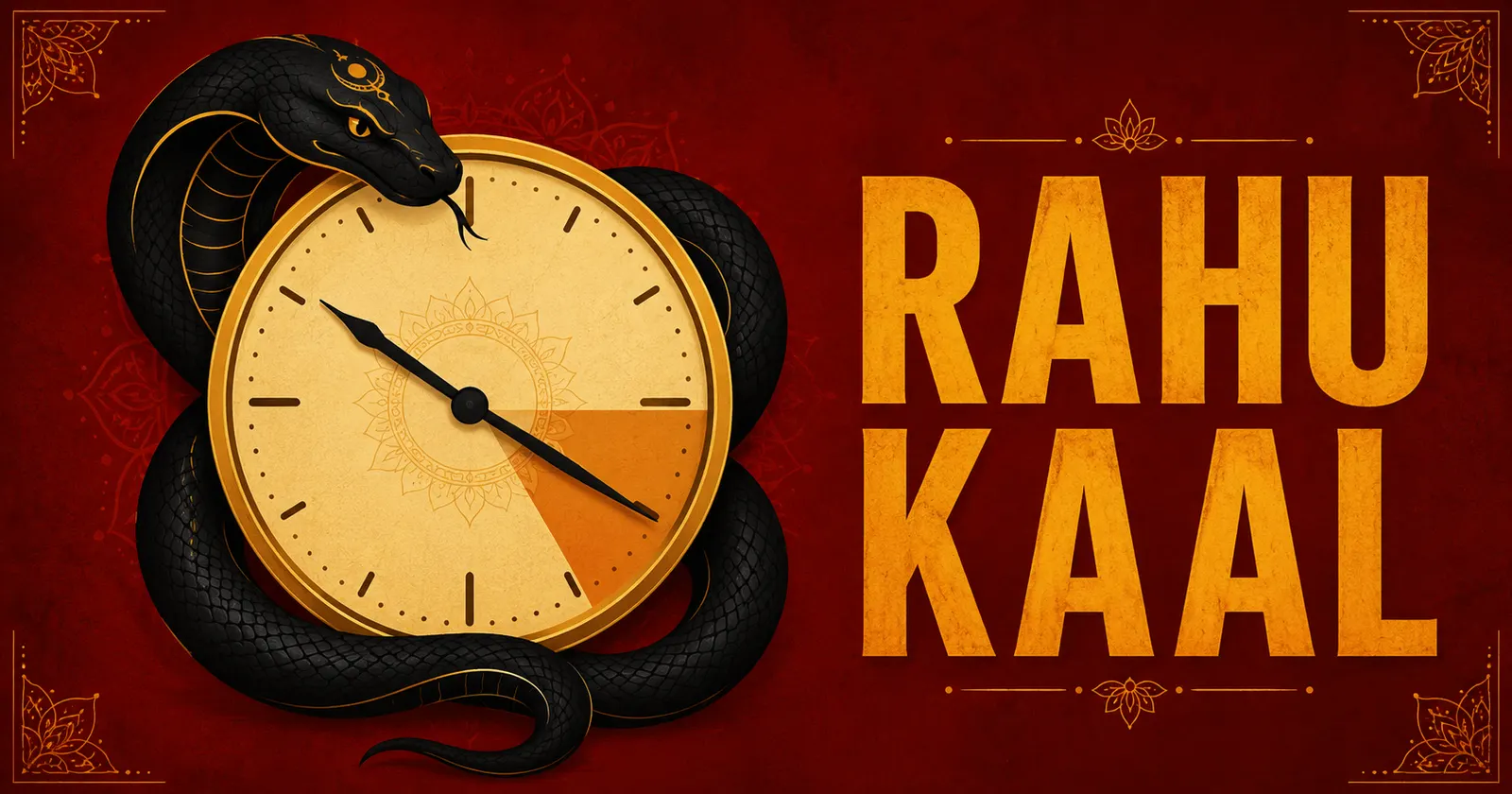
Rahu Kaal (also spelled Rahu Kala or Rahu Kal) is a roughly 90-minute period each day that traditional Hindu panchanga considers inauspicious for starting new activities. The name comes from Rahu — one of the two shadow planets (chaya grahas) in Vedic astrology, formed by the mythological severing of the demon Svarbhanu's head.
Each day is divided into eight equal portions between sunrise and sunset. One of these eight portions is ruled by Rahu. That Rahu-ruled portion is Rahu Kaal.
The tradition holds that beginning an important new activity during this window may bring complications or obstacles. Continuing an already-started task during Rahu Kaal is generally considered acceptable — the concern is specifically about new beginnings.
Why Do Families Avoid Rahu Kaal?
In Vedic astrology, Rahu is associated with sudden changes, illusions, ambiguity, and unexpected outcomes. It is considered a malefic influence — not inherently evil, but unpredictable and disruptive.
Starting something important when Rahu's influence peaks is traditionally seen as beginning under an uncertain star. The risk isn't that something terrible will definitely happen — it's that the outcome is less predictable, more prone to confusion or reversals.
This is why the avoidance is specifically for new starts: job interviews, business agreements, purchasing property, starting a journey, a medical procedure, a wedding ceremony. Routine activities — eating, exercising, continuing ongoing work — are not affected.
How Is Rahu Kaal Calculated?
The calculation is precise and varies by city.
Step 1: Find the exact sunrise and sunset times for your city on that day. This varies by location and season — sunrise in Bangalore on a December day is different from sunrise in Delhi.
Step 2: Calculate the total daylight duration (sunset minus sunrise). Divide this into 8 equal portions.
Step 3: Each day of the week has a different Rahu Kaal portion number. The system is:
| Day | Rahu Kaal (portion number) | Approximate time |
|---|---|---|
| Sunday | 8th (last portion) | ~4:30–6:00 PM |
| Monday | 2nd portion | ~7:30–9:00 AM |
| Tuesday | 7th portion | ~3:00–4:30 PM |
| Wednesday | 5th portion | ~12:00–1:30 PM |
| Thursday | 6th portion | ~1:30–3:00 PM |
| Friday | 4th portion | ~10:30–12:00 PM |
| Saturday | 3rd portion | ~9:00–10:30 AM |
Note: These are approximate times based on a typical Indian city sunrise around 6 AM. Actual times vary by city and season.
Why does Rahu Kaal vary by city? Because it's calculated from sunrise. Mumbai's sunrise is different from Kolkata's sunrise. A panchanga for Hyderabad will show different Rahu Kaal times than one for Chennai, even on the same day.
Check today's exact Rahu Kaal for your city on our daily panchanga — calculated precisely from your city's actual sunrise time. The times shown on generic calendars are approximate; your city's actual timing may differ by 15–45 minutes.
Rahu Kaal Today in Major Indian Cities
Rahu Kaal times differ across India because sunrise times differ. Kolkata (eastern India) sees sunrise earlier than Mumbai (western India), so Rahu Kaal and all other panchanga divisions shift accordingly.
For precise Rahu Kaal times today in Bangalore, Mumbai, Delhi, Chennai, Hyderabad, and 20 other cities, see our live panchanga pages.
What About Yamagandam and Gulika Kaal?
If you've seen a detailed panchanga, you'll have noticed two other inauspicious periods listed alongside Rahu Kaal.
Yamagandam is ruled by Yama, the god associated with death and dharma. It is considered particularly inauspicious for journeys and ceremonies. Like Rahu Kaal, it occupies one of the eight day-portions and shifts by weekday.
Gulika Kaal (also called Mandi) is ruled by Saturn's son Gulika. It is considered the most inauspicious of the three for starting any activity. Traditional pandits give Gulika Kaal the highest weight among the three inauspicious periods.
All three are calculated from the same sunrise-based eight-portion system, just using different portion assignments for each weekday.
The Rational Perspective
Does Rahu Kaal actually cause worse outcomes for activities started during it? There is no scientific evidence for this.
What Rahu Kaal clearly does do is create a system of mindful timing — a cultural framework that encourages people to think carefully about when they begin important things, rather than starting impulsively at any random moment. In this way, panchanga functions like a planning discipline: it asks you to be intentional.
Many modern Indians who follow Rahu Kaal describe it not as superstition but as a form of psychological preparation. Knowing you've waited for an auspicious time, or avoided an inauspicious one, creates confidence. That confidence itself may affect how you approach an interview or a negotiation.
Whether you follow Rahu Kaal literally, treat it as a cultural practice worth respecting, or simply find it interesting — it represents thousands of years of Indians thinking carefully about timing, intention, and preparation.
Frequently asked questions
Check today's Rahu Kaal
Precise panchanga for your city — Rahu Kaal, tithi, nakshatra, sunrise, and more calculated accurately.
Free · Updated daily
Find your auspicious muhurat
Personalised Vedic muhurat for your wedding, property, vehicle, or ceremony — reviewed by Acharya Suryakanth Subramaniam.
Find Muhurat →