
The moment a pandit looks up from the horoscope charts and says "Nadi Dosha hai," the room goes quiet. Parents exchange glances. The prospective match — who seemed perfect in every other way — suddenly feels complicated. If this has happened to someone in your family, you're not alone. Nadi Dosha is one of the most discussed concerns in kundali matching, and also one of the most misunderstood.
This guide explains exactly what it is, why tradition considers it important, and what families across India actually do about it.
What Is Nadi Dosha?
In Vedic astrology, every person is born under one of 27 Nakshatras (lunar mansions). Each nakshatra belongs to one of three "nadis" — Adi (first), Madhya (middle), and Antya (last). These nadis represent three different energy channels in the body.
The three nadi groupings are:
- Adi Nadi (also called Vata): Ashwini, Ardra, Punarvasu, Uttara Phalguni, Hasta, Jyeshtha, Moola, Shatabhisha, Poorva Bhadrapada
- Madhya Nadi (also called Pitta): Bharani, Mrigashira, Pushya, Purva Phalguni, Chitra, Anuradha, Poorvashada, Dhanishtha, Uttara Bhadrapada
- Antya Nadi (also called Kapha): Krittika, Rohini, Ashlesha, Magha, Swati, Vishakha, Uttarashada, Shravana, Revati
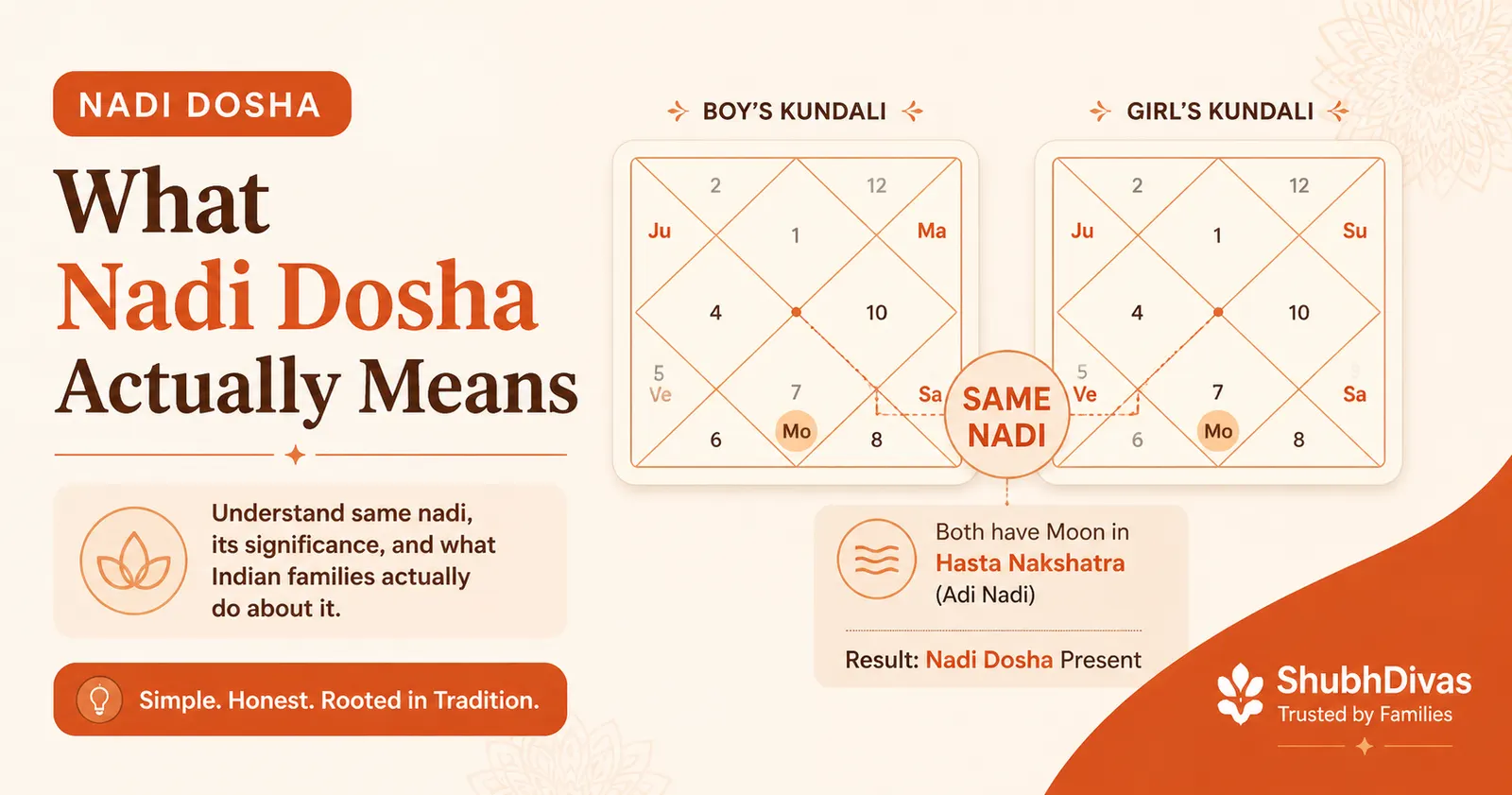
When both prospective partners are born under nakshatras belonging to the same nadi, it is called Nadi Dosha.
Low — concern area
Why Does Nadi Matter in Kundali Matching?
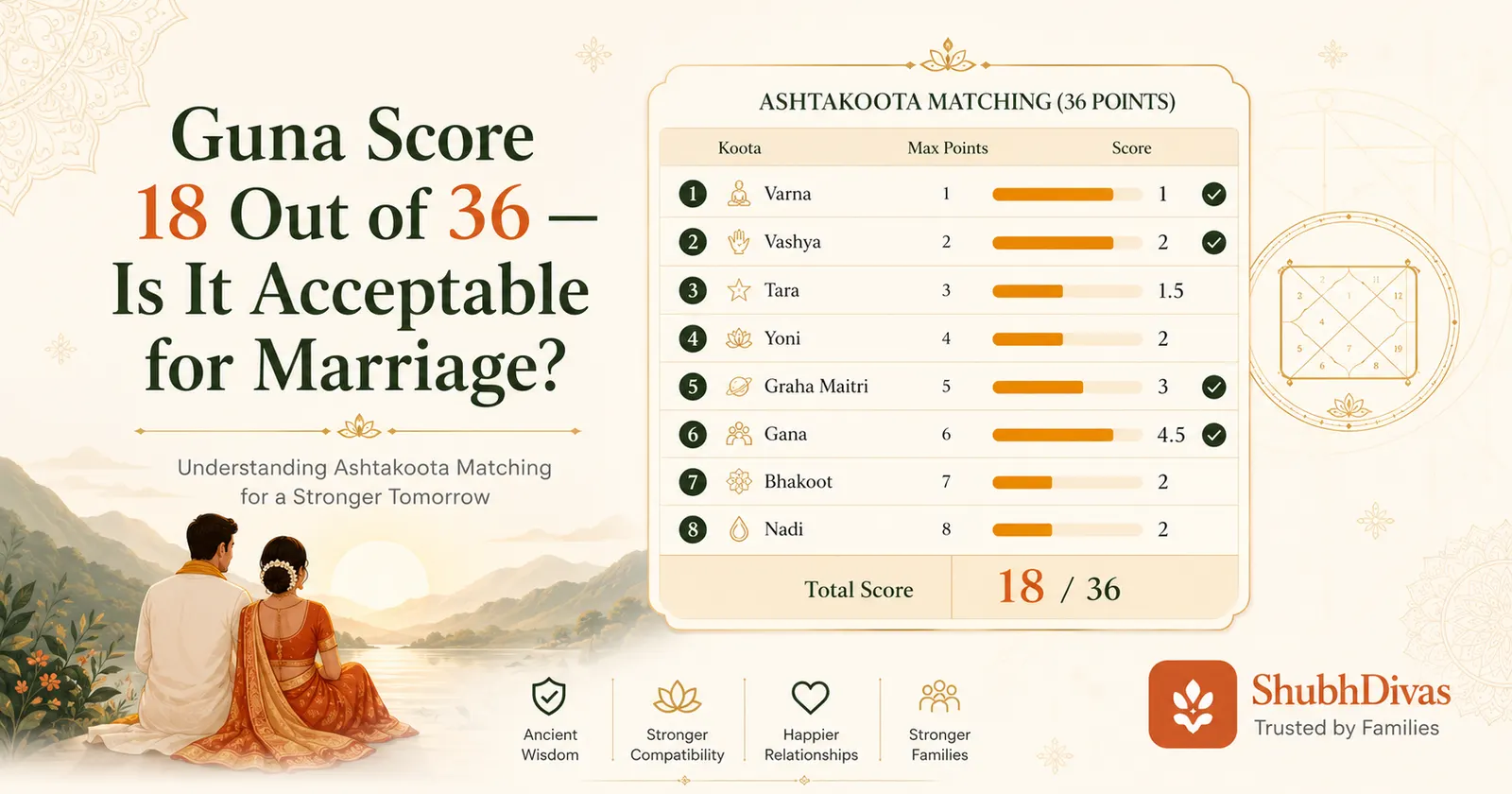
In the Ashtakoota system used across North India, eight different factors (kootas) are scored to assess compatibility. Nadi Koota carries the highest weight of any single factor — 8 out of 36 total points.
When partners belong to different nadis, they receive the full 8 points. Same nadi results in 0 points. This is not a small deduction — losing 8 points from a possible 36 is significant.
Traditional texts consider Nadi compatibility important for two reasons: physical health harmony between the couple, and — more prominently in traditional belief — concerns about fertility and progeny. Same nadi is traditionally believed to indicate a "like-energy" pairing that may create imbalance rather than complementarity.
Nadi Koota carries 8 of 36 possible points in Ashtakoota Milan — the highest weight of any single koota. Same nadi means 0 points for this factor. Many families treat this as a serious concern; others are more flexible. The significance depends heavily on community tradition and the judgment of the family's pandit.
What Families Actually Do About It
Here is the honest reality: different families respond to Nadi Dosha very differently, and both approaches are legitimate.
Families who treat it as a dealbreaker will typically not proceed with the match, regardless of how strong the other kootas are. For them, Nadi Dosha represents a fundamental incompatibility that isn't worth risking.
Families who consider it with nuance will typically consult their family pandit for a thorough reading. A pandit may look at additional factors — whether the Ascendant (Lagna) nakshatras differ, whether there are strong benefic placements in both charts, and whether the overall Guna Milan score is strong enough despite the Nadi deduction.
Traditional remedies (Nadi Dosha Nivarana) are prescribed by pandits when families wish to proceed despite the dosha. Common remedies include:
- A specific puja (worship ritual) involving Lord Shiva and Goddess Parvati
- Donation of gold, silver, or cloth to a Shiva temple
- Recitation of certain mantras, particularly the Mahamrityunjaya Mantra
- Some traditions prescribe the Vishnu Sahasranama
The effectiveness of these remedies is a matter of personal faith. Many families proceed after performing them and live perfectly harmonious lives.
The Rational Perspective
Here is what we know with certainty: there is no peer-reviewed scientific evidence that sharing a nadi grouping affects marital outcomes or reproductive health. Two people born in the same nakshatra group does not, by any physical mechanism, cause the issues traditional texts warn about.
What Nadi compatibility may have originally represented is something worth respecting on its own terms: an ancient attempt to think systematically about personality and constitution compatibility. The three nadis correspond to Vata, Pitta, and Kapha — the three doshas of Ayurveda. Two people with identical constitution might indeed have similar strengths and vulnerabilities, which could create friction in some marriages.
Whether you view Nadi matching as a deeply meaningful compatibility factor or a cultural tradition to be respected without literal belief, the right approach depends on your family and your values — not on what any website tells you.
How Different Communities View Nadi Dosha
This is one area where regional and community variation is significant.
North Indian Hindu communities (Punjab, UP, Rajasthan, MP, Bihar) generally follow Ashtakoota Milan strictly, and Nadi Dosha is treated as a serious concern. Pandits in these communities are more likely to recommend against proceeding without remedies.
South Indian communities primarily use Dasha Porutham or Tirukkanitha Panchanga matching rather than Ashtakoota. In Tamil Nadu and Kerala specifically, Nadi (called "Nadi Porutham" in Tamil) is one of ten poruthams checked — but the relative weighting and strictness differs from the North Indian system.
Urban, educated families across India increasingly treat Nadi Dosha as one input among many. They may consult a pandit, note the concern, but ultimately weigh it against other factors including how well the couple knows and respects each other.
Frequently asked questions
Our Perspective at ShubhDivas
At ShubhDivas, we provide clear, accurate information about what kundali matching involves and what it says about a match. We calculate Nadi Koota along with all other kootas, and present the results honestly.
We believe two things simultaneously: that Vedic astrology represents a meaningful cultural and intellectual tradition that deserves serious engagement, and that families make better decisions when they have accurate information rather than fear-based interpretations.
Nadi Dosha is worth understanding clearly. It is not always a reason to abandon a promising match. The decision — and the wisdom — belongs with your family and your trusted advisors.
Get a detailed Nadi Dosha Report
Both partners' Nadi identified, all 5 classical cancellation conditions checked, severity score 1–10, and Nadi Nivarana puja recommendations. ₹99.
₹99 · Delivered within 24 hours
 Acharya Suryakanth Subramaniam | Parashari Jyotish
Get Your Personalised Reading
Reviewed by Acharya Suryakanth Subramaniam | Classical Parashari Jyotish
Nadi Dosha Report — ₹99 →