
Moola Nakshatra Girl Marriage — The Truth Behind the Fear
The short answer is: Moola Nakshatra dosha is real in classical Vedic astrology, but it is heavily overstated in popular culture. Most girls born in Moola Nakshatra can marry without any special concern, particularly if they are born in specific padas or if the dosha is cancelled by other chart factors.
Here is everything you actually need to know.
What is Moola Nakshatra?
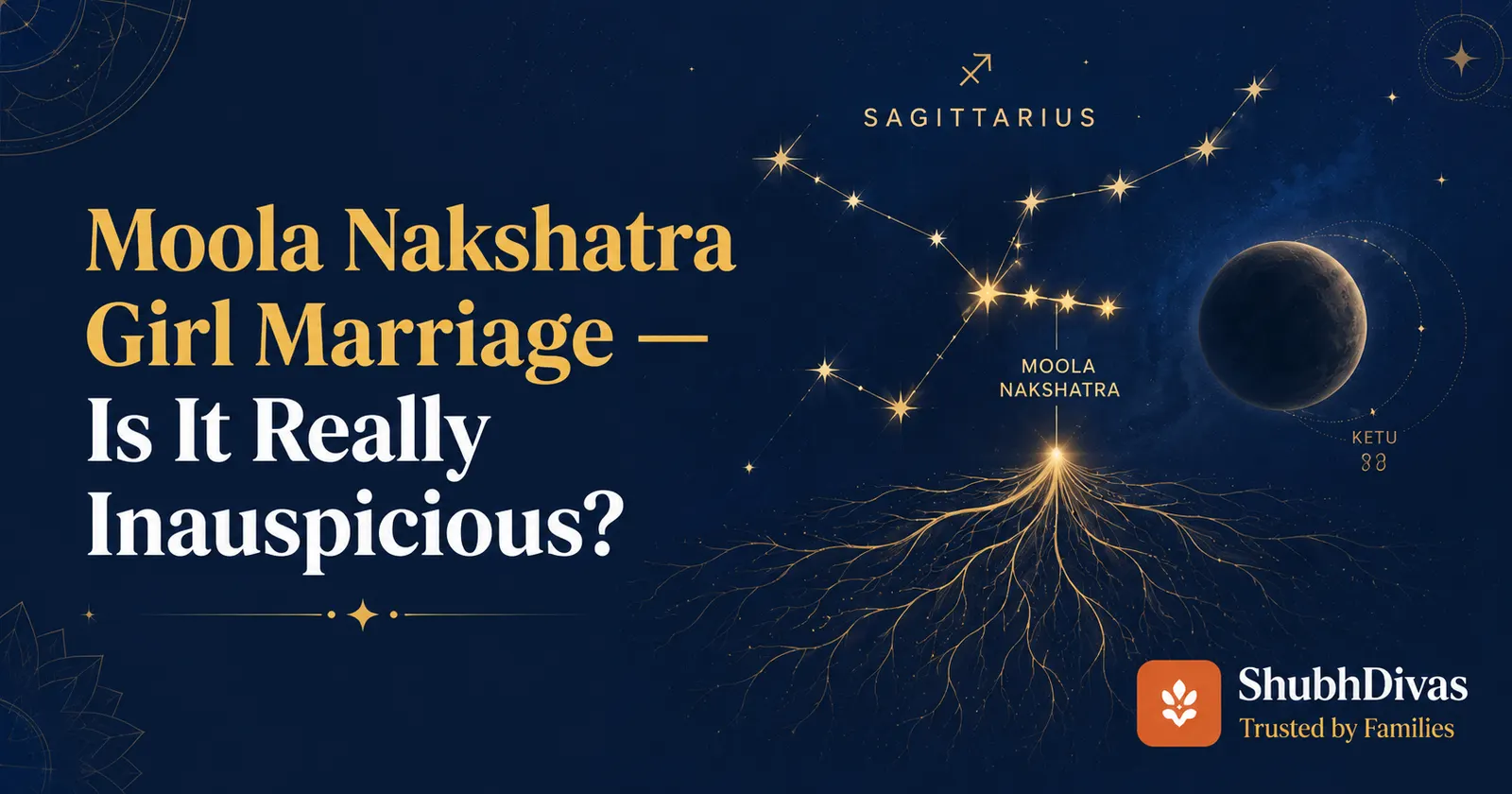
Moola (also spelled Mula) is the 19th nakshatra in the Vedic system. It spans from 0° to 13°20' Sagittarius. Its ruling deity is Nirriti — the goddess of destruction and chaos — and it is governed by the planet Ketu (the south node of the moon).
The name Moola means "root" — it represents digging to the root, transformation, and endings that lead to new beginnings. Moola is a powerful nakshatra associated with research, investigation, medicine, and getting to the bottom of things.
Where Does the Inauspiciousness Belief Come From?
The belief that Moola Nakshatra is inauspicious for the girl's in-laws comes primarily from the Brihat Parashara Hora Shastra and regional astrological traditions. The specific concern is:
A girl born in Moola Nakshatra (particularly the first pada) is said to bring difficulty or harm to her father-in-law after marriage.
This belief is most strongly held in South India — particularly in Tamil Nadu, Andhra Pradesh, Karnataka, and Kerala — and in parts of Rajasthan and Gujarat. It is less prevalent in North Indian astrological traditions.
The Pada Distinction — Critically Important
This is the most important thing to understand about Moola Nakshatra dosha:
Moola Nakshatra Pada 1 (0° to 3°20' Sagittarius): This is the pada most associated with the dosha. Girls born in the first pada of Moola are considered to have the strongest dosha affecting the father-in-law's wellbeing.
Moola Nakshatra Pada 2 (3°20' to 6°40' Sagittarius): Moderate concern in some traditions. The dosha is considered present but weaker.
Moola Nakshatra Pada 3 (6°40' to 10° Sagittarius): Mild concern. Many astrologers consider Pada 3 largely free of the dosha.
Moola Nakshatra Pada 4 (10° to 13°20' Sagittarius): In most traditions, Pada 4 of Moola is considered completely free of the dosha. Girls born in Moola Pada 4 are not considered inauspicious.
Before proceeding with any concern, verify which pada the girl is born in. Many families reject Moola Nakshatra girls without checking the pada — this is an error that causes unnecessary heartbreak.
The 27th Day Rule
A classical remedy that is widely accepted across South Indian traditions:
If the girl and the prospective groom do not meet until after the 27th day of her life (some traditions say 3 months, others say 6 months), the dosha is considered not to have transferred. This is because the dosha was believed to affect the father-in-law only if contact occurred within the first month of the girl's life.
In modern times, this rule is almost always automatically satisfied — families rarely arrange meetings within 27 days of birth. Many astrologers therefore hold that for girls born today, the Moola dosha is automatically mitigated.
Cancellation Conditions
Beyond the pada distinction, several chart factors can cancel or reduce Moola dosha:
Jupiter's placement: If Jupiter is strongly placed in the girl's chart — particularly in the 1st, 4th, 5th, 7th, 9th, or 10th house — many astrologers consider this sufficient to override the Moola dosha. Jupiter's benefic energy is considered strong enough to protect the family.
Jupiter in Sagittarius: Since Moola is in Sagittarius, which is ruled by Jupiter, if Jupiter is well-placed in the chart, it significantly reduces the negative associations. Jupiter is the natural ruler of the nakshatra's sign — its strength matters greatly.
Strong 9th house: The 9th house governs the father (and by extension, in some traditions, the father-in-law). A strong 9th house and 9th lord in the girl's chart is considered protective.
Ketu well-placed: Since Ketu rules Moola, a well-placed Ketu (in trine houses or with benefic association) reduces the dosha's severity.
Which Communities Follow This Belief Strictly?
Strong observance: Tamil Brahmin, Telugu Brahmin, Kannada families, many South Indian Hindu communities, Rajasthani Brahmin families, some Gujarati communities.
Moderate observance: Maharashtra, some North Indian communities.
Little to no observance: Bengali Hindu families, Punjabi families, most urban educated families across India who follow modern astrology.
Understanding your community's tradition is important — a Moola dosha that is a serious concern in one community may not be an issue at all in the prospective groom's family tradition.
The Reality for Modern Couples
The sociological reality is that Moola Nakshatra dosha causes significant problems for many girls — particularly in conservative South Indian families — not because of astrological merit, but because of entrenched cultural belief. Girls are rejected from matches without proper analysis of their pada or chart.
From an astrological standpoint, most experienced Jyotishis today take a more nuanced view:
For Pada 4: No concern in almost all traditions.
For Pada 3: Minimal concern. A simple remedial puja before the wedding is usually sufficient.
For Pada 1 and 2: Examine the full chart. Strong Jupiter, strong 9th house, and overall positive indications significantly reduce the concern. Consult a qualified astrologer rather than making a blanket rejection.
Remedies Commonly Recommended
For girls where the dosha is considered present and uncancelled:
Moola Shanti Puja: A specific puja performed for the girl, often around the 27th day of life or before the wedding. This is widely practiced and accepted across South Indian traditions.
Vivah puja with specific rituals: Some pandits include specific Ketu and Nirriti propitiation rituals in the wedding ceremony itself.
Gemstone: Some astrologers recommend a cat's eye (Ketu gemstone) after careful chart analysis.
Check your kundali compatibility on ShubhDivas and consult with our Vedic Expert for a personalised assessment of Moola Nakshatra in your specific chart.
Frequently asked questions
Get a detailed Nadi Dosha Report
Both partners' Nadi identified, all 5 classical cancellation conditions checked, severity score 1–10, and Nadi Nivarana puja recommendations. ₹99.
₹99 · Delivered within 24 hours
 Acharya Suryakanth Subramaniam | Parashari Jyotish
Get Your Personalised Reading
Reviewed by Acharya Suryakanth Subramaniam | Classical Parashari Jyotish
Nadi Dosha Report — ₹99 →