
If you grew up in a Hindu household, you probably remember your grandmother checking the calendar before planning anything on certain days. Ekadashi was one of those days — and her relationship with it was non-negotiable. Meals changed, the kitchen smelled different, and there was a quiet seriousness in the house that nobody quite explained. You absorbed it without understanding it. This is that explanation.
What Ekadashi Actually Is
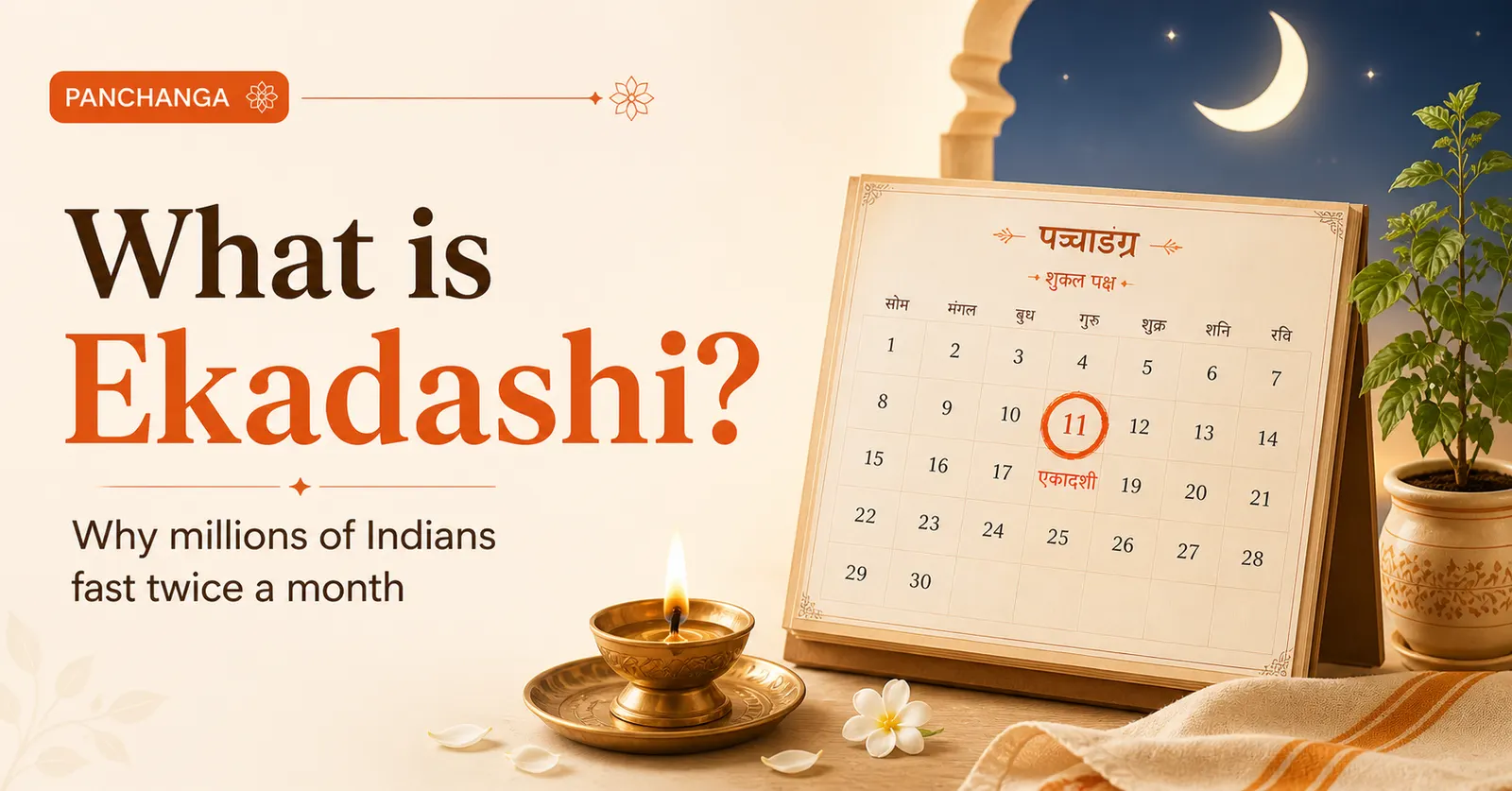
Ekadashi means "eleven" in Sanskrit — ekam (one) plus dasha (ten). It falls on the 11th day of each lunar fortnight, once during the waxing moon and once during the waning moon. Since the Hindu calendar follows the moon, Ekadashi comes twice every month, giving you 24 Ekadashis across a regular year. In a leap lunar year — when an extra month called Adhik Maas is added — you can have 25 or even 26.
The Hindu month is divided into two fortnights of 15 lunar days each. Each day is called a Tithi. The waxing fortnight, Shukla Paksha, moves from the new moon toward the full moon. The waning fortnight, Krishna Paksha, moves from the full moon back toward the new moon. The 11th Tithi of each fortnight is Ekadashi.
Think of it this way: new moon → days 1 through 10 → Ekadashi → days 12 through 15 → full moon. Then the same count begins again from the full moon. Every single month, twice, without fail. That rhythm has been running for thousands of years.
Each Ekadashi has its own name, its own story from the Puranas, and its own presiding form of Vishnu. Nirjala, Devshayani, Vaikunta, Amalaki — these aren't interchangeable. Your family may observe all 24 equally, or may have particular ones they take more seriously. Both are completely valid.
Why Ekadashi is Dedicated to Vishnu
Ekadashi is primarily a Vaishnava observance, though it has spread across traditions and regions in ways that make it one of the most universally observed fasting days in Hindu practice.
The story most commonly told in the Puranas goes like this: a demon named Mura was terrorizing the heavens, and Vishnu fought him for a thousand years. Exhausted, Vishnu rested in a cave near Badarikashram. While he slept, a radiant divine energy emerged from his body and slew the demon single-handedly. Vishnu, upon waking, was moved. He named this energy Ekadashi and granted her a boon — that whoever fasts and worships on her day would be freed from sin and attain moksha.
This is the mythological origin of the Ekadashi vrat. Whether you take it literally or read it as metaphor, what it establishes is the importance of the day — and why fasting on Ekadashi is considered one of the most meritorious acts in the Vaishnava tradition.
But here is what's worth noting: Ekadashi is not exclusive to Vaishnavas. You'll find it observed in Shaiva households, in homes where Devi is the primary deity, among Jains who follow adjacent traditions, and in communities across Kerala, Tamil Nadu, Bengal, Gujarat, Maharashtra, and Odisha. The specific story may differ, the prayers may vary, but the date — the 11th Tithi — holds across traditions.
Ekadashi is not exclusive to any one community or region. You'll find it observed from Kerala to Kashmir, Bengal to Gujarat — with regional variations in practice but the same core significance.
What People Actually Do on Ekadashi
This is the section most people actually want. What does observing Ekadashi look like in practice?
Fasting
The strictest form is a complete fast — no food, no water — from sunrise on Ekadashi to the breaking of the fast on Dwadashi, the following morning. This is rare and reserved for the most devoted practitioners, particularly on Nirjala Ekadashi.
The most common form avoids all grains and pulses. Fruits, milk, curd, paneer, nuts, dry fruits, sabudana, sweet potatoes, and singhara flour are all permitted. Regular table salt is traditionally replaced with sendha namak — rock salt — which is considered appropriate for fasting days.
The moderate form — which many urban families have settled into across generations — simply avoids rice, wheat, and non-vegetarian food. It is quieter, easier to maintain through a work day, and still carries the intention of marking the day differently from others.
The foods most families allow on ekadashi fasting: all fruits, milk and milk products, dry fruits and nuts, sabudana, singhara flour preparations, sweet potatoes, and sendha namak. What is avoided: rice, wheat, bajra, jowar, all lentils and pulses, regular salt, non-vegetarian food, and alcohol. Different families draw the line in slightly different places — what your household follows is correct for your tradition.
Other Observances
Beyond the food, Ekadashi has a wider texture. Waking before sunrise. Bathing early. Visiting a Vishnu temple, if one is nearby. Reading or listening to the Vishnu Sahasranama — the thousand names of Vishnu. Lighting a lamp in the evening. Some families stay awake through the night on major Ekadashis, especially Vaikunta Ekadashi, treating it as a vigil.
The fast is broken the next morning on Dwadashi — the 12th Tithi — within a specific time window after sunrise called the Parana time. Breaking the fast before this window opens or after it closes is considered inauspicious. Check your local panchanga for the exact Parana time for your city — it varies by location and date.
The fast is broken on Dwadashi — the 12th day — typically within a specific time window after sunrise. Breaking it at the wrong time is considered inauspicious. Check your local panchanga for the exact Parana time in your city.
The Science Angle
Many people ask whether there is a rational basis for the Ekadashi fast, and it is worth answering honestly rather than dismissing the question.
The lunar cycle visibly affects ocean tides. The human body is roughly 60 to 70 percent water. Some practitioners and researchers suggest that the gravitational pull of the moon at particular points in its cycle — including the 11th Tithi — may affect fluid dynamics and digestive function. This is not firmly established science, but it is not idle speculation either.
What is better established is what periodic fasting does regardless of its timing. Fasting gives the digestive system genuine rest. It has been associated with cellular repair through a process called autophagy — the same mechanism that has generated significant research interest around intermittent fasting. Studies have linked regular fasting to reductions in inflammatory markers, improved metabolic function, and better cognitive clarity.
The ancient rishis who codified Ekadashi didn't have the vocabulary of modern biology. But the practice of fasting twice a month, on a fixed schedule, for thousands of years, is not accidental. Whether you come to Ekadashi from faith, from curiosity about ancestral practice, or from a purely health-oriented lens, the tradition holds up.
The Most Important Ekadashis
While all 24 Ekadashis carry significance, a few stand apart.
Nirjala Ekadashi falls in June, during the peak of summer. It is the most demanding — no water, no food, from sunrise to the following morning. The Puranas say that observing Nirjala Ekadashi alone carries the merit of all 24 Ekadashis combined. People who cannot maintain the Ekadashi vrat through the year often observe this one specifically.
Devshayani Ekadashi in July marks the moment when Vishnu is believed to begin his four-month rest — Chaturmas. During these months, no auspicious ceremonies like weddings or griha pravesh are traditionally held. The wedding season effectively pauses. If you've ever noticed a gap in the wedding calendar between July and November, this is why.
Devutthana Ekadashi in November marks Vishnu's awakening from Chaturmas. Wedding season resumes. Tulsi Vivah — the ceremonial marriage of the Tulsi plant to Vishnu — is performed. The year's most auspicious period for weddings and new beginnings officially opens.
Vaikunta Ekadashi in December or January is the most celebrated Ekadashi in South India — particularly among Tamil Vaishnavas. At Tirupati and temples across Tamil Nadu and Kerala, the gates to Vaikunta — Vishnu's celestial abode — are believed to open on this day. Devotees queue for days. It is one of the most attended single-day religious events in India.
Ekadashi Across India
The geography of Ekadashi observance is wide. In Maharashtra, Ashadhi Ekadashi and Kartiki Ekadashi draw millions of Warkari pilgrims on foot to Pandharpur — a tradition that has run for nearly eight centuries. In Odisha, Ekadashi at the Puri Jagannath temple is a defining annual event. In Bengal, Ekadashi is observed through the Vaishnava tradition and is especially prominent in ISKCON communities. In Gujarat, Nirjala Ekadashi is observed so broadly that it becomes a visible social event — restaurants close, kitchens go quiet, and the rhythm of the city shifts perceptibly for a day. See the full Ekadashi dates for 2026 to know when each falls this year.
Do You Have to Fast Strictly?
The honest answer is no. No tradition mandates the precise degree of strictness.
What happens in most families, if you look closely, is a gentle gradient across generations. A grandmother who fasts completely, nothing until Parana on Dwadashi. A mother who eats fruits and milk. A daughter who skips rice and grains for the day. A son who simply avoids non-vegetarian food and eats normally otherwise. All of these people are observing Ekadashi. None of them is doing it wrong.
The purpose of Ekadashi was never to create rigid rules that generate guilt or division. It was to create a rhythm — a twice-monthly pause in the relentless forward motion of ordinary life. A day that looked slightly different. A day that acknowledged something beyond the next meeting, the next meal, the next deadline. You can find this on the Hindu calendar for 2026 and plan ahead if you'd like to begin observing.
Whether you observe it strictly or simply — whether you skip dinner or simply don't order chicken — the awareness is the beginning. Your grandmother probably couldn't have told you the story of Mura or explained autophagy. But she knew the date, she knew what not to eat, and she knew the day mattered. That knowledge, passed down without explanation, is its own kind of inheritance. Now you have both.
Frequently asked questions
Check today's Rahu Kaal
Precise panchanga for your city — Rahu Kaal, tithi, nakshatra, sunrise, and more calculated accurately.
Free · Updated daily
Find your auspicious muhurat
Personalised Vedic muhurat for your wedding, property, vehicle, or ceremony — reviewed by Acharya Suryakanth Subramaniam.
Find Muhurat →