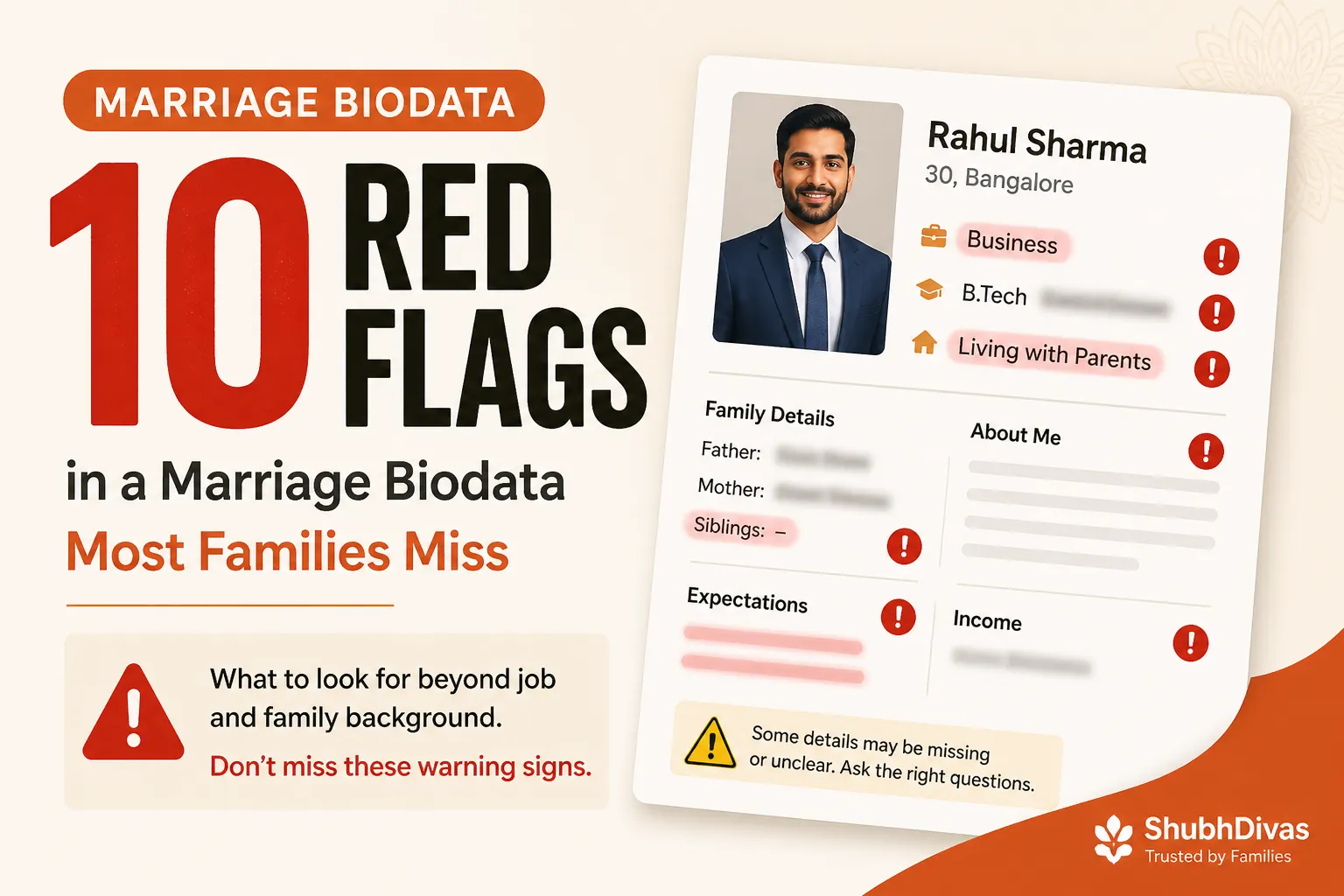
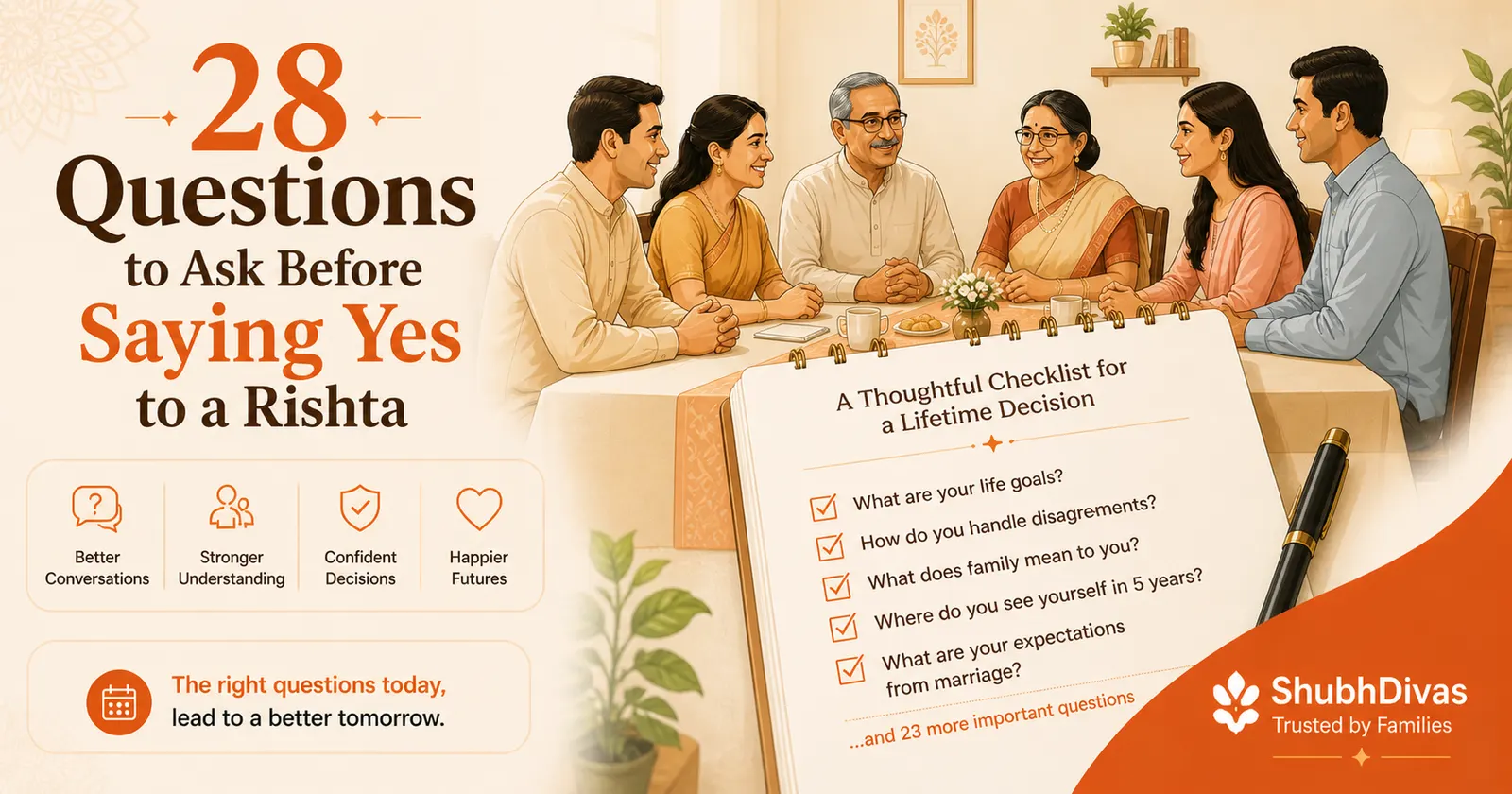

A biodata arrives. The family gathers. Someone says "achha match lag raha hai" — he has a good job, the family is decent, the horoscope numbers look fine. And then comes the silence where nobody quite knows what to ask next. Most families spend more time evaluating a flat they're renting than they do evaluating the person their child will spend their life with. These 28 questions to ask before saying yes to a rishta are here to change that — not to make the process cold or clinical, but to make it genuinely useful.
Why These Questions Matter
The typical rishta conversation covers a short list: job, salary, family background, whether they own property, and whether the photo looks like the real person. These things matter, but they are the surface. What determines whether two people will actually be happy together is almost entirely missing from that list.
Compatibility in daily life — how decisions get made, how conflict gets handled, what each person expects from family and from each other — only reveals itself through real conversation. The families who skip these questions don't avoid problems; they just discover them after the wedding, when the stakes are much higher.
Knowing the right questions to ask before saying yes to a rishta is one of the kindest things you can do for your child and for the family you are considering joining. It signals that you are serious, thoughtful, and genuinely interested in a match that will work — not just one that looks good on paper.
Section 1 — Values and Life Goals
1. Where do you see yourself living in five years?
This question reveals ambition, flexibility, and whether the two families are even operating in compatible geographies. Someone who expects to stay in their hometown and someone building toward a career abroad are not automatically incompatible — but they need to know this about each other before they say yes.
2. How important is religion and daily practice to you?
This isn't about judging how devout someone is. It is about understanding whether daily rhythms will align. One person who needs silence for morning prayer and another who finds religious observance optional will navigate daily life very differently. Better to understand this early.
3. What does a good work-life balance look like to you?
"I work hard" can mean anything from sixty-hour weeks to a nine-to-five with clear weekends. This question uncovers expectations about how much time a partner will actually be present and available — which shapes everything from childcare to how holidays are spent.
4. How do you feel about the woman continuing to work after marriage?
Ask it directly. In many families this remains unspoken until after the wedding, when it becomes a source of genuine conflict. There is no universally correct answer — but there needs to be an honest one that both families understand.
5. What are your long-term career goals?
Not just the current job, but where this person wants to go. Someone building toward entrepreneurship carries different risks and rewards than someone in a stable government position. Neither is wrong, but they require different kinds of partnership.
6. How do you feel about relocating if an opportunity comes up?
Career opportunities, family circumstances, and life change. A partner who would consider moving and one who considers it non-negotiable to stay will eventually face this question in a high-stakes moment. Understanding each other's position now is far easier.
Section 2 — Family Dynamics
7. What is your relationship like with your parents and siblings?
You're not just marrying a person — you're connecting two families. How someone describes their family relationships tells you a great deal about how they handle closeness, conflict, and obligation.
8. What role do you expect your parents to play in your married life?
This is the joint family question that every family is really asking but rarely asks directly. Some people expect parents to live with them. Others expect clearly separate lives with warm weekend visits. These expectations need to be spoken, not assumed.
9. Are there any family health conditions or responsibilities we should know about?
An ageing parent who will need care, a sibling with a long-term condition, a family financial responsibility — these are facts that shape what a marriage will look like in practice. Asking shows respect. Not asking and discovering it later damages trust.
10. How are financial decisions made in your family currently?
This tells you a great deal about how money will be handled after marriage. A family where parents are involved in every financial decision and a partner who expects total financial autonomy are starting from very different places.
11. What are your parents' expectations from a daughter-in-law?
Ask this of the family, not just the prospective match. The honest answer — whether it's "we're quite modern, she can live as she likes" or "we do expect her to be home for festivals and take part in the household" — is far more useful than a vague reassurance.
12. How do you handle disagreements with your parents?
Someone who has never once pushed back on a parental decision and someone who handles family disagreements maturely through direct conversation are different in ways that will affect married life significantly. This question is about emotional independence, not disrespect.
These questions are meant to guide conversations — not interrogations. The best rishta meetings feel like getting to know someone genuinely, not a job interview. Let the conversation breathe. Not every question needs to be asked in one sitting.
Section 3 — Finances
13. Are you currently managing any loans or financial commitments?
A home loan, a car loan, an education loan, or a responsibility to help fund a sibling's education — these are legitimate and common. They are also facts that belong in an honest pre-marriage conversation. Normalising this question saves enormous stress later.
14. What are your savings habits like?
Not the number, but the habit. Someone who saves methodically and someone who spends freely until the end of the month will find financial life together genuinely difficult unless they talk about it in advance and decide how to handle it together.
15. How do you feel about joint versus separate finances after marriage?
There is no single right answer here, and the norms are genuinely changing across Indian urban families. The important thing is that both people have thought about it and can discuss it openly. Silence on this subject usually means conflict later.
16. What are your financial goals for the next five years?
A house? A business? Saving for children's education? Travel? The financial goals people carry into marriage reveal their deeper priorities — and whether those priorities are compatible with the person they're considering.
17. Are there financial responsibilities to your family of origin that we should understand?
A son who sends a portion of his salary home every month, or a daughter whose parents will need financial support in their older years — these are facts, not flaws. But they affect household finances and need to be on the table before the wedding.
Section 4 — Lifestyle and Day-to-Day Compatibility
18. Are you a morning person or a night person?
This seems small. It isn't. Two people with strongly opposite rhythms who haven't spoken about it will spend months mildly irritated at each other before they realise what the actual problem is.
19. How do you like to spend weekends and free time?
The daily texture of a marriage is made of exactly this — what two people do when they have no obligations. Someone who recharges through quiet home time and someone who needs social plans every weekend are not incompatible, but they will need to negotiate this actively.
20. How important is travel to you?
For some people, travel is a core part of how they live and what they spend on. For others it is an occasional nice-to-have. Neither is wrong — but knowing this before saying yes to a rishta prevents surprises.
21. What are your health habits — diet, exercise, sleep?
A strict vegetarian who runs every morning and a non-vegetarian who keeps late nights are not automatically incompatible. But these differences show up every single day, and understanding them early means there are no rude surprises about kitchen rules or lifestyle expectations.
22. How do you handle stress?
Everyone handles stress differently — some people go quiet, some need to talk, some go for a run, some need support, some need space. Understanding this means knowing how to actually be there for each other when things are hard.
23. What does your social life look like — do you prefer small gatherings or large social events?
One person who needs a packed social calendar and one who finds large gatherings draining will constantly negotiate how they spend their limited free time together. This question has no wrong answer — but it has a lot of practical consequences.
Section 5 — The Harder Questions
These are the ones families skip. They shouldn't. Asking them with warmth and genuine curiosity is not intrusive — it is responsible. A marriage is a long life together. These questions deserve space.
24. What are your thoughts on having children — when and how many?
Assuming alignment here is one of the most common and consequential mistakes families make. Two people with genuinely different timelines or different feelings about parenthood will face a very difficult conversation if they only have it after the wedding.
25. Have you been in a serious relationship before?
This isn't about judging someone's past. It is about understanding their emotional experience and readiness. A thoughtful, honest answer to this question tells you a great deal more about someone's character than the answer itself.
26. How do you handle conflict? Can you give an example?
Anyone can say "I'm reasonable and I communicate well." Almost nobody has thought through a real example. Asking for one — even a small, everyday disagreement — shows you whether someone's self-image matches their actual behaviour under pressure.
27. What are your views on counselling or therapy if we face challenges?
Attitudes toward mental health support in marriages are genuinely changing in urban India, but the differences remain real. A partner who sees counselling as a failure and one who sees it as a sensible tool will handle hard periods in marriage very differently.
28. Is there anything about your life or health we haven't discussed that you think we should know?
This is the open door. It gives someone the chance to share something important that didn't fit anywhere else — and the answer, or the absence of one, is itself useful information.
A red flag is not a dealbreaker — it is a question. Every difficult answer deserves follow-up conversation, not immediate rejection. The goal is understanding, not judgment. Many strong marriages exist between people who had honest, uncomfortable conversations early.
What to Do With the Answers
Don't try to score this like a checklist. The goal of asking questions to ask before saying yes to a rishta is not to find a perfect score — it's to understand who you're actually dealing with and whether you and your family can build something genuine with them.
Ideally the prospective couple should meet at least twice or three times before any decision is made. Some questions are better asked directly between the two people. Others — finances, family expectations, health — are often better handled through a trusted family intermediary, at least initially.
When something concerns you, say so — but frame it as a question, not a verdict. "We noticed you mentioned X — can you help us understand more about that?" lands very differently from "that's a problem for us." People reveal their character most clearly in how they respond to honest, respectful questions.
Frequently asked questions
One More Thing — The Question Nobody Asks
After twenty-eight questions, here is the one that matters most and appears on no formal list: Do I feel comfortable being myself around this person?
Not on best behaviour. Not performing the version of yourself that gets approved. Actually yourself — uncertain, ordinary, tired, laughing at things that aren't particularly funny. No set of questions to ask before saying yes to a rishta replaces that feeling, or its absence.
The process works best when both people approach it with genuine curiosity rather than performance. When you check kundali matching scores and ask about careers and families, you are gathering information. But information is not the same as knowing someone. That knowing happens in small, unscripted moments — a conversation that ran longer than expected, a disagreement handled well, a moment of honesty that didn't need to happen but did.
Trust the process. And trust yourself.
Find your auspicious muhurat
Get a personalised Vedic muhurat for your wedding, property purchase, or any important activity.
Free · Takes 2 minutes
Get a complete Kundali Milan Report
Ashtakoota Guna Milan, Nadi + Mangal + Rajju Dosha with cancellations, Navamsa compatibility, overall score 0–100, and 5 auspicious wedding muhurat dates. ₹199.
₹199 · Delivered within 24 hours
 Acharya Suryakanth Subramaniam | Parashari Jyotish
Get Your Personalised Reading
Reviewed by Acharya Suryakanth Subramaniam | Classical Parashari Jyotish
Nadi Dosha Report — ₹99 →