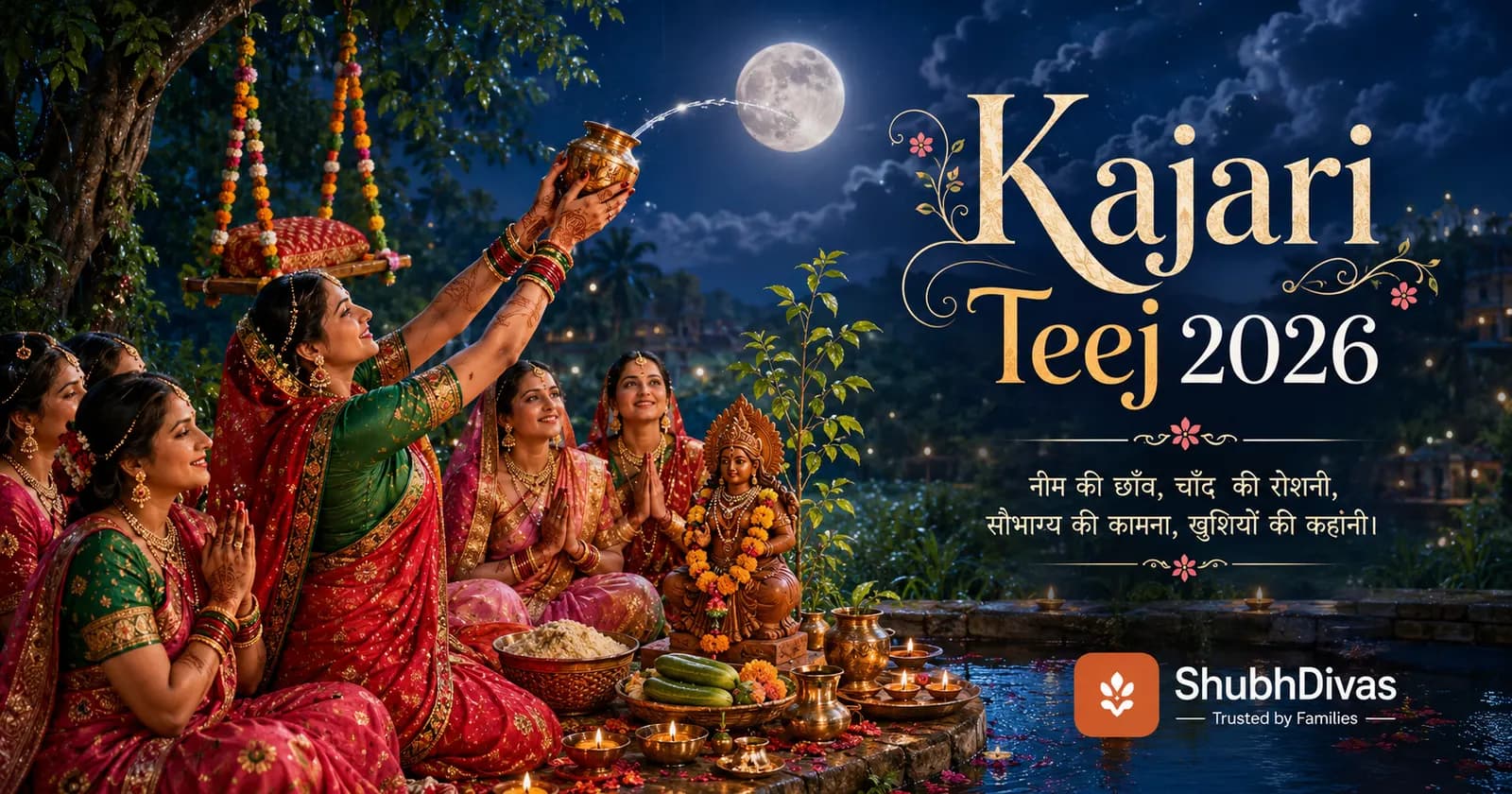

Kajari Teej 2026 falls on Monday, August 31. It is the Tritiya (third tithi) of the dark fortnight (Krishna Paksha) of the Bhadrapada lunar month — the third of the three great Teej festivals kept by the women of North India, arriving fifteen days after Hariyali Teej and a fortnight before Hartalika Teej. Like its sisters, Kajari Teej is a festival of Goddess Parvati, kept by married women for the long life and wellbeing of their husband and for marital happiness, and by unmarried girls in prayer for a good spouse.
Kajari Teej — also called Kajali Teej, Satudi Teej, or Boodhi Teej — takes its name from the Kajri, the soulful monsoon folk songs of Bundelkhand, Mirzapur, and Banaras that fill the air on this day. It is a festival of swings hung from mango and neem trees, of sattu sweets, of new clothes and bangles, and above all of a demanding fast broken only at night, after the moon has risen. Here is the verified date, the beloved Vrat Katha, and the complete way to observe it.
Kajari Teej 2026 — Key Details
| Detail | Information |
|---|---|
| Festival | Kajari Teej (Kajali Teej · Satudi Teej · Boodhi Teej) |
| Date | Monday, August 31, 2026 |
| Lunar month | Bhadrapada, Krishna Paksha (waning fortnight) |
| Tithi | Tritiya (third lunar day) |
| Deity | Goddess Parvati & Lord Shiva (Neemri Mata) |
| Fast | Nirjala; broken at night after moonrise, with arghya to the Moon |
| Observed for | Long life and wellbeing of the husband, marital happiness; a good spouse for the unmarried |
| Region | North India — Uttar Pradesh (Bundelkhand, Mirzapur), Rajasthan, Madhya Pradesh |
The exact Tritiya tithi window and your city's moonrise time decide when the fast is broken. Confirm the tithi and your city's moonrise on the ShubhDivas Panchanga before observing the vrat.
The Significance of Kajari Teej
There are three Teej festivals across the monsoon and early autumn, and together they form a cycle of devotion by which women honour the union of Parvati and Shiva — the ideal of married love. Hariyali Teej opens the season on the bright third of Shravana; Kajari Teej follows on the dark third of Bhadrapada; and Hartalika Teej completes it on the bright third of Bhadrapada. Kajari Teej stands in the middle — the deepest into the monsoon, the most folk-rooted, and, for many families of the Hindi heartland, the most cherished.
At its heart, Kajari Teej commemorates Parvati's long penance to win Lord Shiva as her husband — the austerity by which she earned the marriage that Hindu tradition holds as the very model of devotion. Married women keep the fast so that their own marriage may be blessed with the same constancy, and so that their husband may be granted a long and healthy life. Unmarried girls keep it in prayer for a worthy husband of their own.
What gives Kajari Teej its distinct character is its twofold worship — of Neemri Mata and of the Moon. Women fashion a small idol of the Goddess, Neemri Mata, beside a little tank of water and a neem branch, and worship her through the day. And the fast — kept nirjala, without food or even water — is not broken at sunset but held all the way until night, when the Moon rises. Only after the woman has sighted the moon and offered arghya (water) to it, along with reverence to the star Rohini, does she break her fast. This moonlit conclusion, sung to the strains of Kajri, is the emotional summit of the day.
The Vrat Katha of Kajari Teej
The vrat is honoured with a much-loved katha that exalts both the sanctity of the fast and the virtue of honesty.
In a certain village there lived a poor Brahmin and his devoted wife. When Kajari Teej came, the wife resolved to keep the fast as she did every year, and for the Parana she needed sattu — the roasted gram flour, mixed with ghee and sugar, that the fast is traditionally broken with. But the couple were so poor that they had nothing in the house from which to make it. The wife said to her husband, "I will not break my Teej vrat without sattu, whatever it costs. Bring me the sattu somehow."
Unwilling to see his wife's fast go unhonoured, the Brahmin went out at night and came to the shop of a wealthy merchant (sahukar). There he quietly took a measure of gram, ghee, and sugar — enough to make a sava seer (a quarter more than a seer) of sattu — and prepared it, taking nothing else at all. But as he turned to leave, the watchman seized him, crying "Thief!" and the household woke.
Brought before the merchant, the Brahmin did not lie. "I am no thief," he said. "I have taken only what is needed to make sattu, so that my wife may break her Kajari Teej fast — I have touched nothing more of your wealth." The merchant had the shop searched, and it was found to be exactly as the Brahmin said: only the sattu was gone. Moved to the depths by the wife's devotion and the husband's honesty, the merchant not only forgave him but honoured the Brahmin's wife as his own sister — sending sattu, clothes, jewels, and gifts to her home so that her fast might be kept in dignity. From that day the tale has been told at every Kajari Teej: that the fast kept in sincerity, however poor the household, is watched over by the Goddess herself.
Check today's Rahu Kaal
Precise panchanga for your city — Rahu Kaal, tithi, nakshatra, sunrise, and more calculated accurately.
Free · Updated daily
How to Observe Kajari Teej — Puja Vidhi
Before the fast. Many women rise before dawn and take a light sattvik meal (a sargi-like early breakfast) before beginning the fast. Take the sankalp — the vow to keep the Kajari Teej fast for the long life and wellbeing of your husband (or, for the unmarried, for a good spouse). The fast is traditionally kept nirjala, without food or water, through the day and until moonrise; those who cannot may keep a fruit-and-water fast according to their health.
The Neemri Mata puja. In the evening, prepare a small tank of water in a clean spot and set beside it a neem branch or a clay idol of the Goddess (Neemri Mata). Worship her and the divine couple Parvati and Shiva with roli, moli (sacred thread), sandal, flowers, incense, a lamp, and offerings of sattu, cucumber, and seasonal fruit. Married women apply sindoor and wear the sixteen adornments (solah shringar) — new clothes, bangles, mehndi — as tokens of saubhagya. Read or listen to the Kajari Teej Vrat Katha, and let the day be filled with Kajri songs and the swinging of jhulas.
Breaking the fast at moonrise. Unlike many day-fasts, the Kajari Teej vrat is held until the Moon rises at night. Once the moon is sighted, offer arghya — water poured toward the moon — with reverence to the moon and the star Rohini, then take the blessings of your husband and elders. The fast is broken with sattu first, and then a sattvik meal. It is customary to give daan — food or clothing to a needy woman or a Brahmin — as part of the day's merit.
Kajari Teej vs Hariyali Teej vs Hartalika Teej
The three Teejs are easily confused, so here is how they differ:
- Hariyali Teej — Shravana Shukla Tritiya (Aug 15, 2026). The "green" Teej at the height of the monsoon; often a lighter, more festive fast.
- Kajari Teej — Bhadrapada Krishna Tritiya (Aug 31, 2026). The folk-song Teej, kept nirjala and broken at moonrise, with Neemri Mata and moon worship.
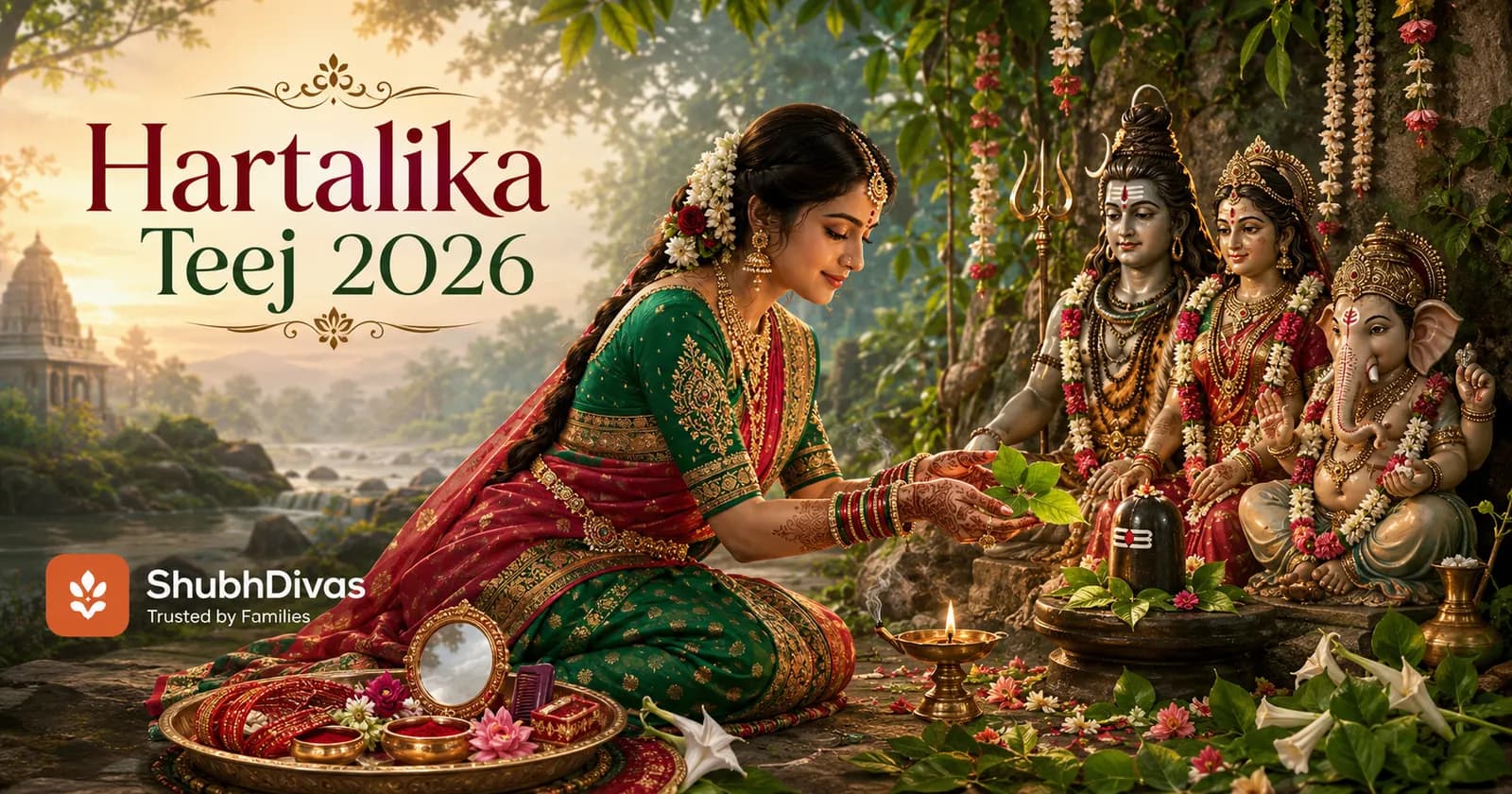
- Hartalika Teej — Bhadrapada Shukla Tritiya (mid-September 2026). The strictest of the three, when Parvati's own idol of sand is worshipped through a nirjala fast.
All three honour Parvati and Shiva and are kept for marital wellbeing; Kajari Teej is distinguished by its moonlit conclusion and its deep roots in the folk culture of the Hindi belt.
Frequently asked questions
Find your auspicious muhurat
Personalised Vedic muhurat for your wedding, property, vehicle, or ceremony — reviewed by Acharya Suryakanth Subramaniam.
Find Muhurat →