
August 10, 2026 is a public holiday in Telangana — the day the state formally honours Bonalu, the great festival of Goddess Mahakali that fills the streets of Hyderabad and Secunderabad every year during the month of Ashada. But Bonalu is not a single-day event. It is a procession of Sundays — beginning at Golconda Fort and moving temple to temple across the twin cities — each one more crowded than the last, each one carrying hundreds of thousands of devotees who have prepared their bonam offerings through the week and now walk, pot balanced on head, to lay them at the feet of the Goddess. The 2026 celebrations run across the Sundays of the season — July 19, July 26, August 2, and August 9 — culminating in the Telangana state public holiday on Monday, August 10. If you are in Hyderabad, this is the festival that stops the city. If you are observing from elsewhere, this is the tradition that explains why.
What Bonalu Is — and Why It Matters
Bonalu — from Bhojanam (meal offering in Telugu) — is a regional Hindu festival unique to Telangana, celebrated in honour of Goddess Mahakali as an expression of collective gratitude and devotion. It is also known as Ashada Jatara, after the lunar month Ashada in which it falls. The festival was declared an official state festival of Telangana in 2014, recognising what had been a living community tradition for over two centuries.
What distinguishes Bonalu from most Hindu festivals is its character — it is overwhelmingly a women's festival. Women prepare the bonam, women carry it to the temple, women enter the trance states that are one of the most striking features of the procession. The male role is secondary: drumming, supporting, making way. The Goddess at the centre of Bonalu — Mahakali — is understood in this tradition as a fierce mother who protects her children, and the women who carry food to her door are doing what daughters do when they return to their mother's home during Ashada.
Across Hyderabad and Secunderabad, Bonalu is the festival of the old city — Lal Darwaza, Golconda, Chilkalguda, Ujjaini — but it has spread far beyond these neighborhoods. In 2026, celebrations will take place at temples across the metropolitan area, with the four main Sundays each anchored to specific temples in a fixed sequence that has evolved over generations.
The History — From 1813 Plague to State Festival
The origin of Bonalu is traced to 1813, when a severe plague epidemic swept through Hyderabad and Secunderabad under the Nizams. The residents of the city, facing death on every street, turned to Goddess Mahakali with collective prayer — offering food, devotion, and the promise that if the plague ended, they would honour her every year. When the epidemic passed, the community erected a statue of the Goddess and began the Bonalu tradition that has continued without interruption for over two hundred years.
The theological dimension of the tradition runs deeper than the plague narrative. In Hindu mythology, Ashada is the month when Mahakali is believed to return to her ancestral home — her peeriki illu — and devotees receive her as they would receive a beloved family member returning after a long journey. The bonam is the meal prepared for a guest of honour. The decorated pot, the lit lamp, the turmeric and kumkum — these are the marks of welcome, not merely ritual. The Goddess has come home, and the household must be ready for her.
2026 Dates and Temple Schedule
The 2026 Bonalu celebrations unfold across the Sundays of the season — July 19, July 26, August 2, and August 9 — culminating in the Telangana state public holiday on Monday, August 10, 2026.
| Date | Day | Occasion |
|---|---|---|
| July 3, 2026 | Friday | Festival begins — Golconda Fort commencement |
| July 19, 2026 | Sunday | Bonalu Sunday |
| July 26, 2026 | Sunday | Bonalu Sunday |
| August 2, 2026 | Sunday | Bonalu Sunday |
| August 9, 2026 | Sunday | Bonalu Sunday |
| August 10, 2026 | Monday | Telangana state public holiday |
By tradition, the festival follows a fixed sequence across these Sundays.
Golconda Fort. The festival opens at the Sri Jagadamba Mahankali temple at Golconda Fort — the oldest and most significant site in the Bonalu calendar. The Golconda Bonalu sets the tone for the entire festival and draws the largest single-day crowds of the season.
Secunderabad. The celebrations move to Ujjaini Mahakali Temple in Secunderabad — the most prominent temple of the twin cities — and to Balkampet Yellamma temple. The Secunderabad Bonalu is one of the most heavily attended days of the festival.
Lal Darwaza and the Old City. Pochamma and Katta Maisamma temple in Chilkalguda and Matheswari temple at Lal Darwaza in the Old City take centre stage as the festival reaches its grandest scale, bringing it into Hyderabad's most historic neighbourhoods near Charminar.
Additional celebrations are held at Akkanna Madanna temple in Haribowli and Muthyalamma temple in Shah Ali Banda throughout the festival period. Every neighbourhood temple in the old parts of the city participates in some form.
Bonalu Public Holiday Dates — Five Years
| Year | Public Holiday |
|---|---|
| 2023 | July 17 |
| 2024 | July 29 |
| 2025 | July 21 |
| 2026 | August 10 |
| 2027 | August 2 |
The Bonam Offering — What It Is and How It Is Prepared
The bonam is the heart of the festival — the meal offering carried to the Goddess. Bonam means food in Telugu, and what is prepared is specific: rice cooked with jaggery, curd, and milk, made in a brass or earthen pot that has been thoroughly cleaned and purified before use.
The pot itself is transformed into an offering through decoration. It is coated with turmeric, kumkum, and adorned with bands of red, white, and yellow — the colours of Mahakali's tradition. Fresh neem leaves are placed at the rim — neem being sacred to Shakti traditions across South India. A lit lamp — the Bonam Jyoti — is placed on top of the pot and must remain burning as the woman carries the pot to the temple. Keeping the flame alive through the crowd and the heat is itself an act of devotion.
Women carry the bonam on their heads, balanced without hands, dressed in traditional sarees with full jewelry. The procession to the temple is accompanied by drums — specifically the dappu, the large frame drum central to Telangana folk traditions — and the rhythm of the drumming is what induces the trance states in some women during the walk. These trance states — women dancing with the pot balanced, eyes closed, moving to the beat — are understood in the tradition as the Goddess entering her devotee. They are not staged or unusual; they are an expected and respected part of the festival.
Devotees also carry Thottelu — small, colourful paper structures mounted on sticks — as decorative offerings presented alongside the bonam at the temple.
Puja Vidhi — How to Participate
Preparation (the evening before). Clean and decorate the pot — brass or earthen, not aluminium. Cook the rice with jaggery, curd, and milk on the morning of the festival. Avoid tasting the offering once it is prepared; it is meant for the Goddess alone.
Decoration. Apply turmeric paste to the outside of the pot. Add kumkum bands. Place neem leaves around the rim. Light the lamp on top only when you are ready to begin the walk — the flame must be sustained through the entire journey to the temple.
Dress and intention. Wear a traditional saree with full jewelry. Bathe before dressing. Walk to the temple barefoot if possible — the temple precincts are sacred ground. Set the intention of the offering clearly: gratitude, a prayer for the protection of the household, or a specific vow to the Goddess.
At the temple. Present the bonam to the priest at the temple entrance. The priest offers it to the Goddess formally on your behalf. A portion of the offering is returned as prasad. Offer Thottelu if you have prepared them. Prostrate fully before the Goddess — a full sashtanga namaskara — before leaving.
After the puja. The prasad from the bonam is distributed to family members and neighbours. It is eaten with reverence — it is what the Goddess has sanctified and returned.
Goddess Mahakali — Who She Is
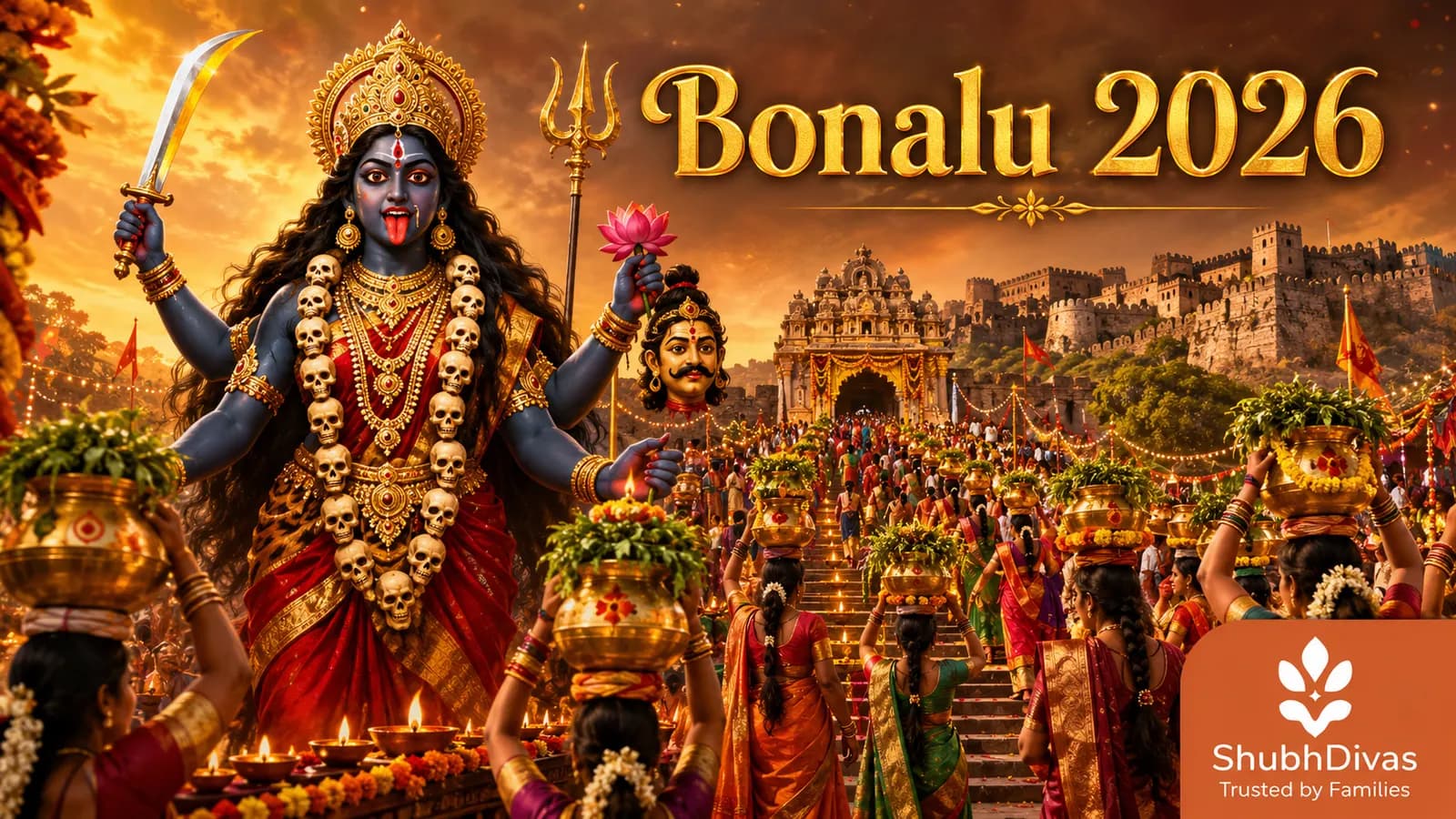
Mahakali is the fierce aspect of the Divine Mother — the Goddess of time, death, and transformation. In iconography, she is depicted with four arms, each holding a weapon or a severed head — the sword, the skull-cup, and the head of the demon Raktabija she has slain. Her skin is deep blue, her eyes are fiery red, and around her neck she wears a garland of demon skulls. She stands or dances on the prone body of Shiva, her consort, who lies beneath her feet to calm her rage after battle.
In Telangana's tradition, Mahakali is not only the cosmic goddess of the Puranas — she is native to this region. She belongs here, and Ashada is the month she comes home. The fierceness of her iconography is understood not as terror but as protection: a mother who will destroy anything that threatens her children. The devotees who carry their bonam to her door are not approaching a fearsome deity in supplication — they are welcoming their mother back from a journey, feeding her as she enters the house, and asking her to stay and protect the family through the year.
The Mahakali Mantra
The primary mantra for Goddess Mahakali — recited during Bonalu puja, at the temple, and as daily practice in the weeks surrounding the festival:
Sanskrit: ॐ क्रीं कालिकायै नमः
Transliteration: Om Krim Kalikayai Namah
Meaning: Om — the primordial sound. Krim — the bija mantra of Kali, encoding her energy in a single syllable. Kalikayai — to Kalika, the dark one, she who is time itself. Namah — I bow, I surrender, I offer myself.
This mantra is chanted 108 times with a Rudraksha mala during the Bonalu season. Chanting before the bonam is prepared purifies the offering. Chanting at the temple during the offering intensifies the puja. Daily recitation through Ashada month — from the first Sunday of Bonalu to the public holiday — is considered a complete practice in itself.
For those who cannot attend the temple in person, chanting this mantra 108 times while facing south — Mahakali's direction — with a ghee lamp lit before a Kali image or yantra, and offering red flowers or hibiscus, constitutes a valid home puja.
Frequently asked questions
Check today's Rahu Kaal
Precise panchanga for your city — Rahu Kaal, tithi, nakshatra, sunrise, and more calculated accurately.
Free · Updated daily
Find your auspicious muhurat
Personalised Vedic muhurat for your wedding, property, vehicle, or ceremony — reviewed by Acharya Suryakanth Subramaniam.
Find Muhurat →