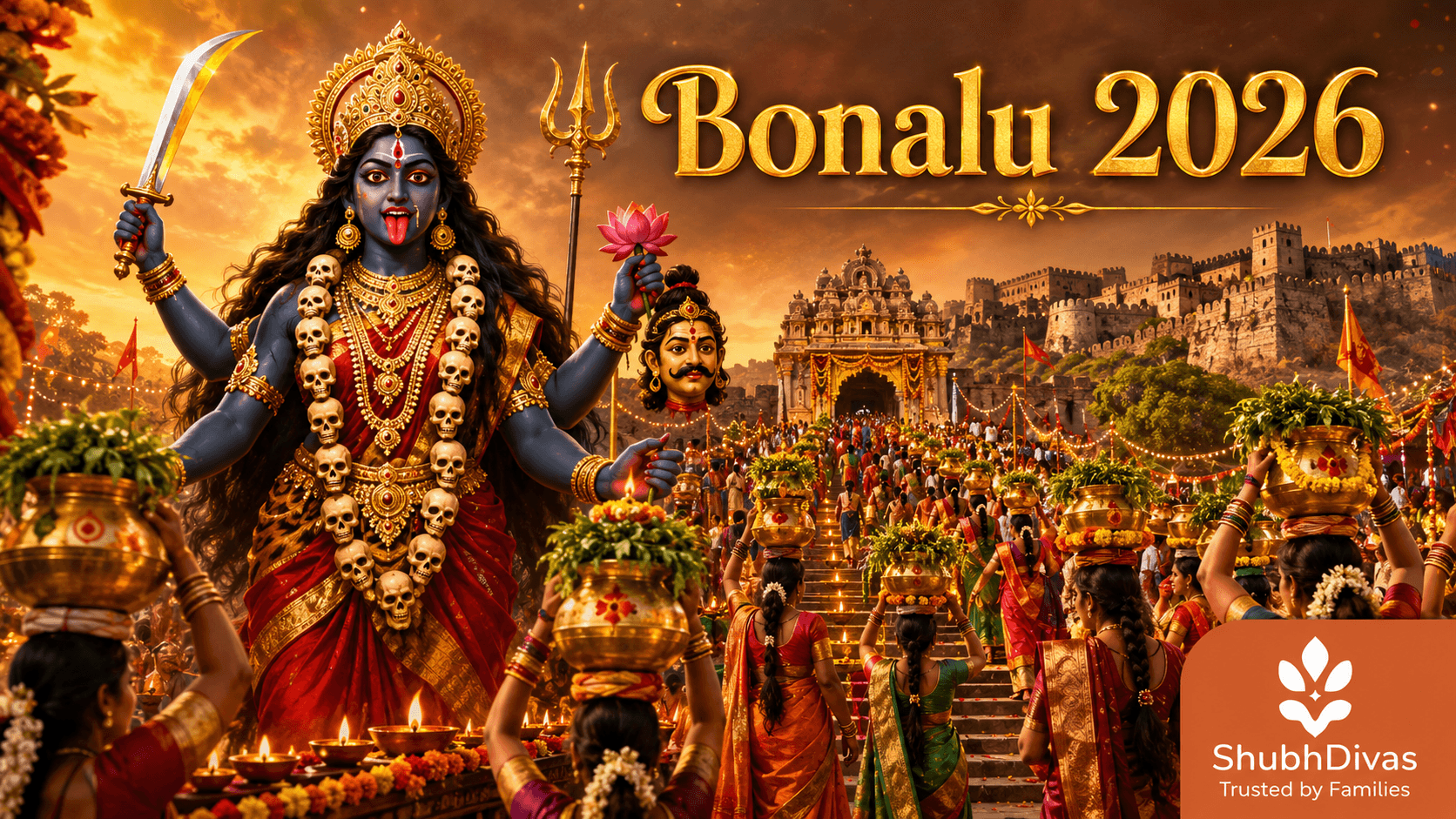

Bonalu is not a day. It is a season — six weeks in which Hyderabad transforms, the old city fills with the sound of dhol and nagara, and hundreds of thousands of women walk to the temples of Mahankali carrying terracotta pots stacked with rice, curd, and jaggery on their heads. In 2026, this season begins on Friday, July 3, with the formal commencement at Sri Jagadamba Mahankali Temple at Golconda Fort — the city's oldest Bonalu site. The four main celebration Sundays are July 19, July 26, August 2, and August 9. The gazetted public holiday falls on Monday, August 10.
This is the definitive guide to Bonalu 2026 — dates, temple schedule, significance, and what the festival involves.
Bonalu 2026 Dates at a Glance
| Event | 2026 Date | Day |
|---|---|---|
| Festival begins — Golconda Fort | July 3 | Friday |
| First main Sunday | July 19 | Sunday |
| Second main Sunday | July 26 | Sunday |
| Third main Sunday | August 2 | Sunday |
| Fourth main Sunday | August 9 | Sunday |
| Gazetted Public Holiday | August 10 | Monday |
The festival spans the Ashadha and Sravana months of the Telugu calendar — from the Ashadha Amavasya to Sravana Purnima. The panchanga anchor is Ashadha Pournami (Guru Purnima), which falls on July 29, 2026.
What Is Bonalu — The Core Tradition
The word Bonalu derives from bhojanalu — offerings of food. The primary ritual is carried out by women who walk to the Mahankali temple bearing a bonam: a vessel of freshly cooked rice, jaggery, and sometimes curd or neem leaves, decorated with turmeric, vermilion, and a lit lamp balanced on top. This vessel is carried on the head — a posture of devotional offering that simultaneously represents carrying the goddess on one's crown.
The premise of Bonalu is older than the current city. The festival is rooted in gratitude to Goddess Mahankali (an aspect of Durga / Shakti, the fierce form who protects against disease and adversity) for ending cholera epidemics that devastated Hyderabad in the 19th century. The tradition of carrying food offerings grew from that vow: when the epidemic ends, we will feed you every year. That vow has been kept continuously since.
Bonalu is not private devotion — it is performed publicly and collectively. The streets are part of the ritual. Processions form organically as women walk together. Dhol players escort the bonams. The temple priests receive the offerings and return prasad to worshippers.
Temple Schedule — Which Temple, Which Sunday
Bonalu in Hyderabad follows a defined sequence across temples. Each Sunday belongs to a specific area of the city.
July 3 — Golconda Fort (Commencement) Sri Jagadamba Mahankali Temple at Golconda Fort is where the 2026 festival begins. This is the oldest and highest-ranking Bonalu site. The fort itself provides a dramatic backdrop — the temple sits within the Golconda complex, and devotees climb the fort path carrying their bonams. The commencement ceremony here sets the ritual tone for the entire season.
July 19 (First Sunday) The first major Sunday celebrations are held at temples across the Old City, including Lal Darwaza Sri Mahakali Temple — one of the most attended sites — and Akkanna Madanna Temple. Jubilee Hills and areas of Secunderabad also see significant processions.
July 26 (Second Sunday) Secunderabad is the traditional focus of the second Sunday, particularly the Sri Ujjaini Mahakali Temple at Secunderabad — historically the most popular Bonalu venue in the city. Crowds at this temple routinely number in the lakhs.
August 2 (Third Sunday) The third Sunday covers temples in the central city — including the Kachiguda area and North Hyderabad temples. The processions here often include Pothuraju (the brother of the goddess, represented by male devotees in red costumes who lead the procession) and Ghattam (ceremonial pots carried by devotees in a trance state).
August 9 (Fourth Sunday — Concluding Celebrations) The final Sunday. Temples in the Rangareddy district and South Hyderabad areas complete the season. The Rangam — a tradition in which a woman selected as the goddess's voice delivers prophecies for the coming year — is performed at key temples as the festival concludes.
August 10 — Public Holiday The government of Telangana declares the Monday after the final Sunday a gazetted public holiday. In 2026, this falls on Monday, August 10.
The Ashadha-Sravana Window
The timing of Bonalu is not arbitrary. Ashadha and Sravana are the months immediately following the summer solstice — the beginning of the monsoon season. Historically, monsoon months in pre-modern Hyderabad brought the highest risk of waterborne disease: cholera, dysentery, typhoid. These months were also the months of the goddess's most active protection.
The selection of Sundays is equally deliberate. Sunday is Ravivara — the day of the sun — and the sun represents heat, purification, and the burning away of disease and adversity. Offering bonams on Sunday aligns the offering with the solar principle that governs health and vitality.
The panchanga calculation for Bonalu uses Ashadha Pournami (the full moon of Ashadha month) as its astronomical anchor. In 2026, Ashadha Pournami falls on July 29 — Guru Purnima. The full moon of the month sacred to Jupiter (Guru) is an additional layer of auspiciousness for this year's festival.
The Bonam — What It Contains and How It Is Prepared
The bonam is prepared fresh on the morning of the visit. A clean terracotta or brass pot is filled with:
- Rice: cooked the morning of, without salt (sattvic preparation)
- Curd: fresh, sometimes mixed with the rice
- Jaggery: the sweetness offered to the goddess
- Neem leaves: placed at the top, symbolising the goddess's fierce, medicinal nature
The outside of the pot is decorated with turmeric and vermilion. A lamp (lit with ghee) is placed at the top of the pot. In some families, the pot is covered with a coconut. The entire assembly is balanced on the head — on a cloth cushion called a podumu — and carried to the temple without letting it fall.
The preparation is considered sacred. Women often fast until they have presented the bonam and received prasad from the temple. Children carry smaller versions. In many families, the same terracotta pot is used year after year.
At the temple, the priest receives the bonam, performs the ritual, and returns a portion as prasad. This prasad — rice blessed by the goddess — is taken home and shared with all household members.
Pothuraju — The Fierce Protector
Walking ahead of the bonams in every major procession is the Pothuraju — the younger brother of Mahankali, her protector and companion. He is identified by the devotee who takes on this role, typically a hereditary responsibility within certain families, and marked with vermilion applied head to foot. He carries a whip and walks in a state of controlled trance, clearing the ritual path for the goddess.
The Pothuraju's role is to absorb and deflect misfortune. His intense, almost frightening appearance is part of the point: the darker forces that threaten the community are kept at bay by someone willing to stand between them and the devotees.
Ghattam — The Oracle Pot
One of the most visually striking elements of Bonalu is the Ghattam: a clay pot decorated to represent the goddess, carried on the head of a devotee who enters a trance state and moves in response to the goddess's presence. The Ghattam carrier moves rapidly and unpredictably, guided by the drumming and the goddess's energy, while attendants walk alongside to ensure safety.
The Ghattam is considered a living presence of the deity — moving through the streets, visiting households, and receiving offerings. Touching the Ghattam during this procession is considered exceptionally auspicious.
Rangam — The Prophecy
On the final days of the festival, the Rangam ritual takes place: a woman selected by the temple — often from a specific lineage associated with this tradition — enters a devotional trance and speaks as the voice of Mahankali. Her utterances are interpreted as the goddess's forecast for the coming year: rainfall, harvest, disease, prosperity.
The Rangam tradition is unique to Bonalu and has no equivalent in the major pan-Indian festivals. It makes explicit what Bonalu always acknowledged implicitly: that the relationship between the city and Mahankali is reciprocal, ongoing, and communicative.
How to Visit for Bonalu 2026
Arrive early. Crowds at major venues like Ujjaini Mahakali (Secunderabad) on the second Sunday (July 26) and Lal Darwaza on the first Sunday (July 19) can be enormous by 8 AM. Many families walk from their homes before dawn.
Dress appropriately. Women typically wear the traditional langa voni or saree in red or green — colours associated with Mahankali. Men wear white or coloured dhoti. Footwear is removed before entering the temple premises.
Prepare the bonam at home if you wish to participate fully. The ritual of preparation and the walk are as important as the offering itself. If you are visiting as an observer, you will be welcome — Bonalu is a public festival.
Carry water and keep mobile networks in mind. July-August in Hyderabad is monsoon season: sudden rain is common, and networks are often congested near the major temples.
The Secunderabad procession on July 26 is the most spectacular for first-time visitors — the streets near the Ujjaini Mahakali Temple fill completely, music plays from every direction, and the procession of bonams lasts for hours.
Check today's Rahu Kaal
Precise panchanga for your city — Rahu Kaal, tithi, nakshatra, sunrise, and more calculated accurately.
Free · Updated daily
Bonalu vs. Bathukamma — Two Different Seasons
Visitors to Telangana sometimes conflate Bonalu with Bathukamma. They are distinct:
- Bonalu (July–August): monsoon festival, Mahankali/Durga, disease protection, bonams (food offerings), fierce goddess energy
- Bathukamma (September–October): Dasara season, Gauri/Lakshmi, floral offerings, Saddula Bathukamma (immersion in water), gentle goddess energy
Bonalu is the older, more intense festival — rooted in a specific historical episode and maintaining a raw, direct quality. Bathukamma is more recent, more widespread, and has a gentler register. Both are uniquely Telangana. Neither is celebrated at the same scale anywhere else in India.
Frequently asked questions
Get Your Personalised Reading
Reviewed by Acharya Suryakanth Subramaniam | Classical Parashari Jyotish
Nadi Dosha Report — ₹199 →