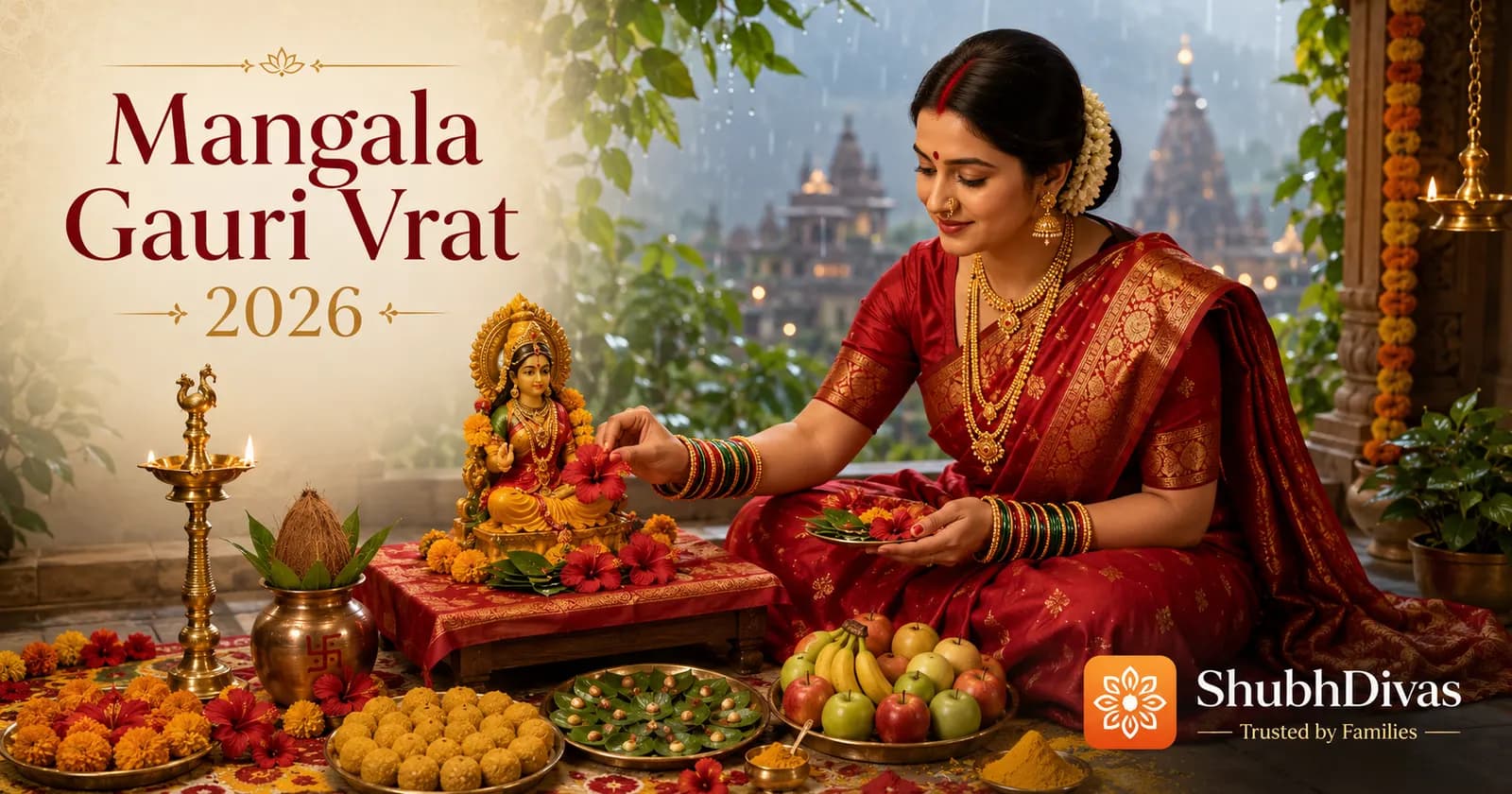

Through the holy month of Shravan, married women across India keep one of the most cherished vrats for their married life. Mangala Gauri Vrat is observed every Tuesday of Shravan in honour of Goddess Gauri — Maa Parvati — for marital happiness, the long life of one's husband, and harmony in the family. Newly married women especially begin it in their first Shravan after marriage and continue it with devotion. In 2026, the Tuesdays of Shravan fall in August, and the exact dates differ between North and South India by about fifteen days.
Here is everything you need — verified dates, the complete puja vidhi, the samagri, and the rules.
What Is Mangala Gauri Vrat
"Mangala" means auspicious, and Tuesday — Mangalwar — is the day of Mangal (Mars), the planet most closely tied to marriage, courage, and married life in Vedic astrology. On these Tuesdays of Shravan, women worship Mangala Gauri, a form of Goddess Parvati, the ideal of devotion and a happy married life.
The vrat is kept for akhand saubhagya — unbroken marital good fortune. A married woman prays for her husband's long life and health, for love and understanding in the marriage, and for the wellbeing of her children. By tradition, a woman begins Mangala Gauri Vrat from the Shravan Tuesdays following her marriage and observes it for sixteen Tuesdays, or for the Shravan Tuesdays across five years, after which she performs the concluding Udyapan ceremony.
Mangala Gauri Vrat 2026 Dates
The vrat is kept on every Tuesday of the Shravan (Sawan) month — but because North India follows the Purnimanta calendar and South and West India follow the Amanta calendar, Shravan begins about fifteen days apart in the two systems. Both observe four Tuesdays.
| Region | 1st Vrat | 2nd Vrat | 3rd Vrat | 4th Vrat |
|---|---|---|---|---|
| North India (Purnimanta — Shravan Jul 30 to Aug 28) | Aug 4 (Tue) | Aug 11 (Tue) | Aug 18 (Tue) | Aug 25 (Tue) |
| South & West India (Amanta — Shravan Aug 13 to Sep 11) | Aug 18 (Tue) | Aug 25 (Tue) | Sep 1 (Tue) | Sep 8 (Tue) |
North India covers states like Delhi, Uttar Pradesh, Bihar, Punjab, Rajasthan, Madhya Pradesh, and Uttarakhand. The Amanta dates apply to Maharashtra, Gujarat, Goa, Karnataka, Andhra Pradesh, Telangana, and Tamil Nadu.
The puja is performed in the morning after bathing. Exact sunrise and the day's auspicious window vary by city — check the ShubhDivas Panchanga for your city's sunrise and Choghadiya before you begin.
Who Should Observe the Vrat
- Newly married women — traditionally for the first five years of marriage, beginning the first Shravan after the wedding.
- Married women seeking harmony, health for their husband, and happiness at home.
- Women praying for progeny and the wellbeing of their children.
The vrat is observed for sixteen Tuesdays in all, then closed with the Udyapan ritual. Many families also have the new bride keep it at her maternal home in the first year.
Mangala Gauri Vrat Puja Vidhi — Step by Step
- Wake before sunrise and bathe. Wear clean clothes — red or yellow is preferred, along with full solah shringar (the sixteen adornments of a married woman).
- Take the Sankalp. Sit facing east or north, take water in your hand, and resolve to keep the vrat for marital happiness and your husband's long life.
- Install the deity. Place an idol or image of Mangala Gauri (Parvati) on a wooden platform over a clean red cloth. In many homes a small Gauri is shaped from turmeric, or five small mounds of turmeric are used to represent the Goddess.
- Invoke Ganesha first, then Goddess Gauri, with the avahan mantra, offering akshat (rice), flowers, and water.
- Offer the sixteens. The number sixteen is central to this vrat — offer sixteen of each: sixteen flowers, sixteen bangles, sixteen betel leaves and nuts, sixteen fruits, sixteen laddus, and sixteen wicks in the lamp where possible.
- Apply the shringar offerings — roli, kumkum, haldi, mehndi, sindoor, and red flowers to the Goddess.
- Light the deepak (a ghee lamp) and offer dhoop and incense.
- Recite the Mangala Gauri Vrat Katha, then perform the aarti, dhyaan, and pushpanjali.
- Offer the bhog — wheat-flour sweets, puran poli, laddu, or modak — and distribute it as prasad.
- Conclude by praying for akhand saubhagya, then donate the puja items and offerings to a Brahmin or a married woman. Break the fast after the evening worship.
Mangala Gauri Vrat Puja Samagri
Keep these ready before you begin:
- Idol or image of Goddess Gauri / Parvati (or turmeric to shape one)
- A wooden platform (chowki) and a clean red cloth
- Roli, kumkum, haldi (turmeric), sindoor, mehndi, akshat (unbroken rice)
- The sixteen adornments — bangles, bindi, kajal, comb, mirror, and other shringar items
- Sixteen flowers, betel leaves and nuts, fruits, and laddus
- Ghee lamp and wicks, dhoop, incense, camphor
- Naivedya — puran poli, modak, laddu, or other sweets
- A copy of the Mangala Gauri Vrat Katha
Rules and What to Avoid
- Keep a fast through the day — many women observe it as nirjala or take only fruit and milk; choose what your health allows, and consult a doctor if you are pregnant or unwell.
- Maintain purity and a calm mind — avoid anger, harsh speech, and tamasic food (onion, garlic, non-vegetarian food, and alcohol).
- The puja is for married women; once begun, it should be completed for the full sixteen Tuesdays and closed with Udyapan.
- Do not break the sequence without reason — if a Tuesday is missed, continue and make up the count, then perform Udyapan.
Mangala Gauri Vrat Katha — The Legend
Long ago there lived a wealthy merchant named Dharmapal and his wife. They had every comfort but no child, and their hearts remained heavy. After years of prayer they were at last blessed with a son — but a sage warned them that the boy was fated to die of snakebite before his sixteenth year.
As the years passed, the worried parents arranged the boy's marriage to a girl from a devout family. The girl's mother had kept the Mangala Gauri Vrat faithfully every Shravan of her life, and for that devotion Goddess Mangala Gauri had granted her the boon of akhand saubhagya — that her daughter would never know widowhood.
When the appointed hour of the boy's death arrived and the serpent came, the strength of the daughter's inherited vrat-punya stood between him and his fate. Goddess Mangala Gauri herself protected the couple; the serpent could not take him, and the boy went on to live a long and full life. From that day, married women across the land have kept the Mangala Gauri Vrat for the protection and long life of their husbands.
Mangala Gauri Mantra
Chant the Goddess's name through the puja, ideally 108 times on a tulsi or rudraksha mala:
ॐ ह्रीं गौर्यै नमः Om Hreem Gauryai Namah
And offer this beloved prayer to the Mother, which asks her for every auspicious blessing:
सर्वमंगल मांगल्ये शिवे सर्वार्थ साधिके। शरण्ये त्र्यम्बके गौरि नारायणि नमोऽस्तु ते॥
"O Gauri, auspiciousness of all that is auspicious, consort of Shiva, fulfiller of every aim, the refuge of all, three-eyed Mother — O Narayani, I bow to you again and again."
Benefits of the Mangala Gauri Vrat
- Akhand saubhagya — unbroken marital good fortune and a long, healthy life for one's husband.
- Harmony at home — love, understanding, and peace between husband and wife.
- Removal of marital obstacles — relief from delays, friction, and difficulties in married life.
- Blessings of progeny and the wellbeing of children.
- The grace of Maa Parvati, the very ideal of devotion and a happy married life.
Udyapan — Concluding the Vrat
The vrat is not kept forever. After completing it for sixteen Tuesdays — or across the Shravan Tuesdays of five years — a woman performs the Udyapan, the concluding ceremony. On the final day she holds a larger puja, feeds and offers gifts to sixteen Brahmins or married women, donates sixteen of the puja items, and formally completes her vow with gratitude to Goddess Mangala Gauri. Udyapan is usually done on the last Tuesday of the cycle or on another auspicious day chosen for it.
Mangala Gauri, Marriage, and Mangal Dosha
Because the vrat falls on Mangalwar and is dedicated to a happy married life, it is traditionally kept by women seeking relief from delays and obstacles in marriage and married life — including difficulties attributed to Mangal Dosha (the Manglik condition). The vrat is an act of devotion; alongside it, families often want clarity on what the kundali actually shows.
If marriage or marital harmony is on your mind, a precise reading helps. Check whether Mangal Dosha genuinely applies in your chart with the ShubhDivas Mangal Dosha analysis, and for marriage matching, use the ShubhDivas Kundali Milan to see the full compatibility picture — both partners' charts, all the doshas, and their cancellations.
For daily sunrise, tithi, and auspicious timing during Shravan, the ShubhDivas Panchanga is updated every day for all major Indian cities.
Frequently asked questions
Check your Kundali compatibility
Get a complete 36-point analysis — Rashi, Nakshatra, Nadi Dosha, all 8 kootas. Plain language explanation.
Free preview · Takes 2 minutes
Get Your Personalised Reading
Reviewed by Acharya Suryakanth Subramaniam | Classical Parashari Jyotish
Nadi Dosha Report — ₹99 →