
In the holy month of Shravan, one day is reserved for the serpent gods. Nag Panchami 2026 falls on Monday, August 17 — the fifth day of the bright half of Shravan — when devotees worship the Nag Devta with milk, flowers, and prayer for protection, fearlessness, and family wellbeing. It is also one of the most important days of the year for anyone seeking relief from Kaal Sarp Dosha.
Here is the verified date, the exact puja muhurat, and the complete vidhi.
What Is Nag Panchami
Nag Panchami is the worship of Nagas — the divine serpents of Hindu tradition. Snakes hold a unique place in our faith: Lord Shiva wears Vasuki around his neck, Lord Vishnu rests on the thousand-hooded Sheshnag, and the serpent is the keeper of hidden wealth and the earth's energy. On Shravan Shukla Panchami, families honour the Nagas to seek their blessings, protection from snake bite, and freedom from fear.
In astrology, the shadow planets Rahu and Ketu are the celestial serpents — the head and tail of the cosmic snake. That is why Nag Panchami is also the day to perform remedies for Kaal Sarp Dosha and Sarpa (Naga) Dosha, when all the planets fall between Rahu and Ketu in the birth chart.
Nag Panchami 2026 Date and Puja Muhurat
| Detail | 2026 |
|---|---|
| Nag Panchami | Monday, August 17 |
| Tithi (Shravan Shukla Panchami) | Begins 04:52 PM, Aug 16 → Ends 05:00 PM, Aug 17 |
| Puja Muhurat | 05:51 AM to 08:29 AM (morning) |
The morning window is considered the best time for the puja. Exact sunrise and the auspicious window shift by city — check the ShubhDivas Panchanga for your city's precise timing before you begin. The same day in 2026 also carries Simha Sankranti, when the Sun moves into Leo.
The Nagas We Worship
By tradition, the principal serpent deities invoked on this day include Ananta (Shesha), Vasuki, Takshaka, Karkotaka, Padma, Mahapadma, Shankhapala, Kulika, and the other Nagas. In many homes a simple prayer to all the Nagas — "Anant, Vasuki, Shesha, Padmanabha and the rest, accept my worship and protect my family" — is offered along with the rituals below.
Nag Panchami Puja Vidhi — Step by Step
- Wake before sunrise and bathe. Wear clean clothes. Keep the day's fast if you intend to observe one.
- Take the Sankalp. Sit facing east, take water in your hand, and resolve to perform the Nag Panchami puja for the protection and wellbeing of your family.
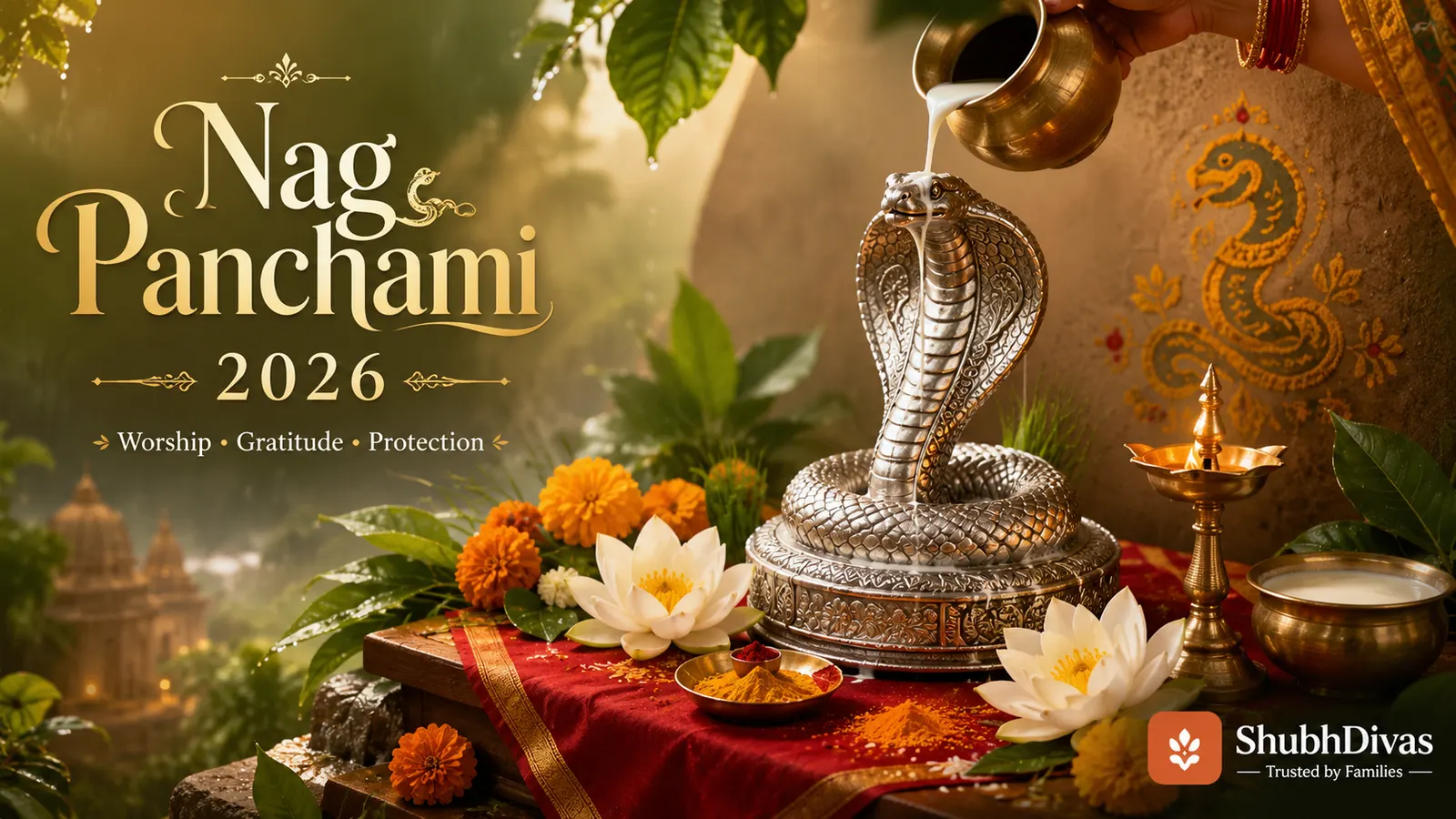
- Set up the deity. Place a silver, brass, or clay image of a serpent — or a picture of the Nag Devta — on a wooden platform. Many families draw a snake figure on the wall or doorway with turmeric, sandalwood, or cow-dung paste.
- Bathe the serpent idol with water, then with raw milk, and finally with water again.
- Offer worship. Apply haldi, kumkum, and chandan; offer akshat (rice), durva grass, and fresh flowers — lotus and other red or white flowers are favoured.
- Offer milk and bhog. Place a bowl of raw milk before the Nag Devta, and offer naivedya such as kheer, sewaiyan, or rice. (Milk is offered in worship, not poured on live snakes.)
- Light the deepak and dhoop, and recite the Nag Panchami prayer or the names of the nine Nagas.
- Perform the aarti, circle the lamp, and pray for protection from all fear, harm, and snake-related affliction.
- For Kaal Sarp Dosha relief, offer prayers to Rahu and Ketu, donate items associated with the Nagas, and — where possible — visit a Shiva temple or a Naga temple to make the offering.
- Conclude by distributing prasad and donating milk, grain, or money to those in need.
Nag Panchami Puja Samagri
- A silver, brass, or clay serpent idol, or an image of the Nag Devta
- Raw milk, water, and a clean bowl
- Haldi, kumkum, chandan, akshat (rice), and durva grass
- Fresh flowers — lotus, and red or white flowers
- Ghee lamp, wicks, dhoop, incense, camphor
- Naivedya — kheer, sewaiyan, or rice
- Turmeric or sandalwood paste to draw the snake figure
What to Avoid on Nag Panchami
Out of reverence for the Nagas and the creatures of the earth, tradition asks that on this day you avoid:
- Ploughing the field or digging the earth — the Nagas dwell in the soil.
- Cutting, chopping, or sewing — to avoid any symbolic harm.
- In many homes, frying on a hot tawa or iron pan is avoided.
- Harming or disturbing any snake — Nag Panchami is a day of protection, not provocation.
The Story of Nag Panchami
The most well-known legend behind Nag Panchami comes from the Mahabharata. King Janamejaya, whose father Parikshit had died of the serpent Takshaka's bite, vowed revenge and began the great Sarpa Satra — a sacrifice meant to draw every snake on earth into its fire and destroy the entire serpent race. One by one the Nagas were being pulled into the flames.
On Shravan Shukla Panchami, the young sage Astika — born of a Brahmin father and a Naga mother — arrived at the sacrifice and, with his wisdom and devotion, persuaded Janamejaya to halt the yagna. The serpents were saved. In gratitude, the Nagas blessed that whoever worships them on this Panchami will forever be free of the fear of snakes. That is why the day is kept as Nag Panchami.
A second beloved association is the story of Lord Krishna and Kaliya — the venomous serpent who poisoned the waters of the Yamuna. Krishna subdued Kaliya, dancing upon his many hoods, and then spared his life on the condition that he leave the river in peace. The day Krishna triumphed over the serpent is also remembered on Nag Panchami as a victory of the divine over fear and poison.
Nag Panchami Mantra
Worship the Nag Devta with the name of the serpent lord:
ॐ नागदेवताभ्यो नमः Om Naga-devatabhyo Namah
And recite the famous Navanaga Stotra, which remembers the nine great serpents:
अनन्तं वासुकिं शेषं पद्मनाभं च कम्बलम्। शङ्खपालं धृतराष्ट्रं तक्षकं कालियं तथा॥
"Ananta, Vasuki, Shesha, Padmanabha, Kambala, Shankhapala, Dhritarashtra, Takshaka and Kaliya — whoever remembers these nine Nagas morning and evening is freed from all fear of serpents and is blessed with victory everywhere."
Benefits of Nag Panchami Puja
- Protection from snakebite and freedom from sarpa bhaya — the fear of serpents.
- Relief from Kaal Sarp Dosha and Sarpa (Naga) Dosha — the most powerful day of the year for these remedies.
- Blessings of progeny — the Nagas are linked to fertility, and couples praying for children seek their grace.
- Removal of obstacles and protection of the home and family.
- Prosperity — the Nagas are the guardians of hidden wealth and the earth's treasures.
Nag Panchami Across India
The festival is kept in many beautiful regional forms. In Maharashtra, the village of Battis Shirala is historically famous for its grand serpent worship. In South India, women clean and decorate snake idols and anthills (the dwellings of serpents) and offer milk and turmeric; many also keep Garuda Panchami. In Bengal, Assam, and Odisha, the serpent goddess Manasa Devi is worshipped for protection. Across North India, families draw images of snakes on their walls and doorways with turmeric and offer milk and prayer at home.
Nag Panchami and Kaal Sarp Dosha
For anyone with Kaal Sarp Dosha in their kundali, Nag Panchami is the single most significant day of the year to perform remedies. When all seven planets are hemmed between Rahu and Ketu, the chart is said to carry the serpent's grip — often linked to recurring obstacles, delays, and sudden ups and downs in life. The worship of the Nag Devta on this day, along with Rahu–Ketu remedies, is the classical prescription.
But remedies should follow a real diagnosis. Before assuming the dosha applies, check your chart precisely with the ShubhDivas Kaal Sarp Dosha analysis — it shows whether the dosha is fully or partially formed, which type it is, and the specific remedies for your case.
For daily sunrise, tithi, and the auspicious Choghadiya during Shravan, the ShubhDivas Panchanga is updated every day for all major Indian cities.
Frequently asked questions
Check your Kundali compatibility
Get a complete 36-point analysis — Rashi, Nakshatra, Nadi Dosha, all 8 kootas. Plain language explanation.
Free preview · Takes 2 minutes
Get Your Personalised Reading
Reviewed by Acharya Suryakanth Subramaniam | Classical Parashari Jyotish
Nadi Dosha Report — ₹99 →