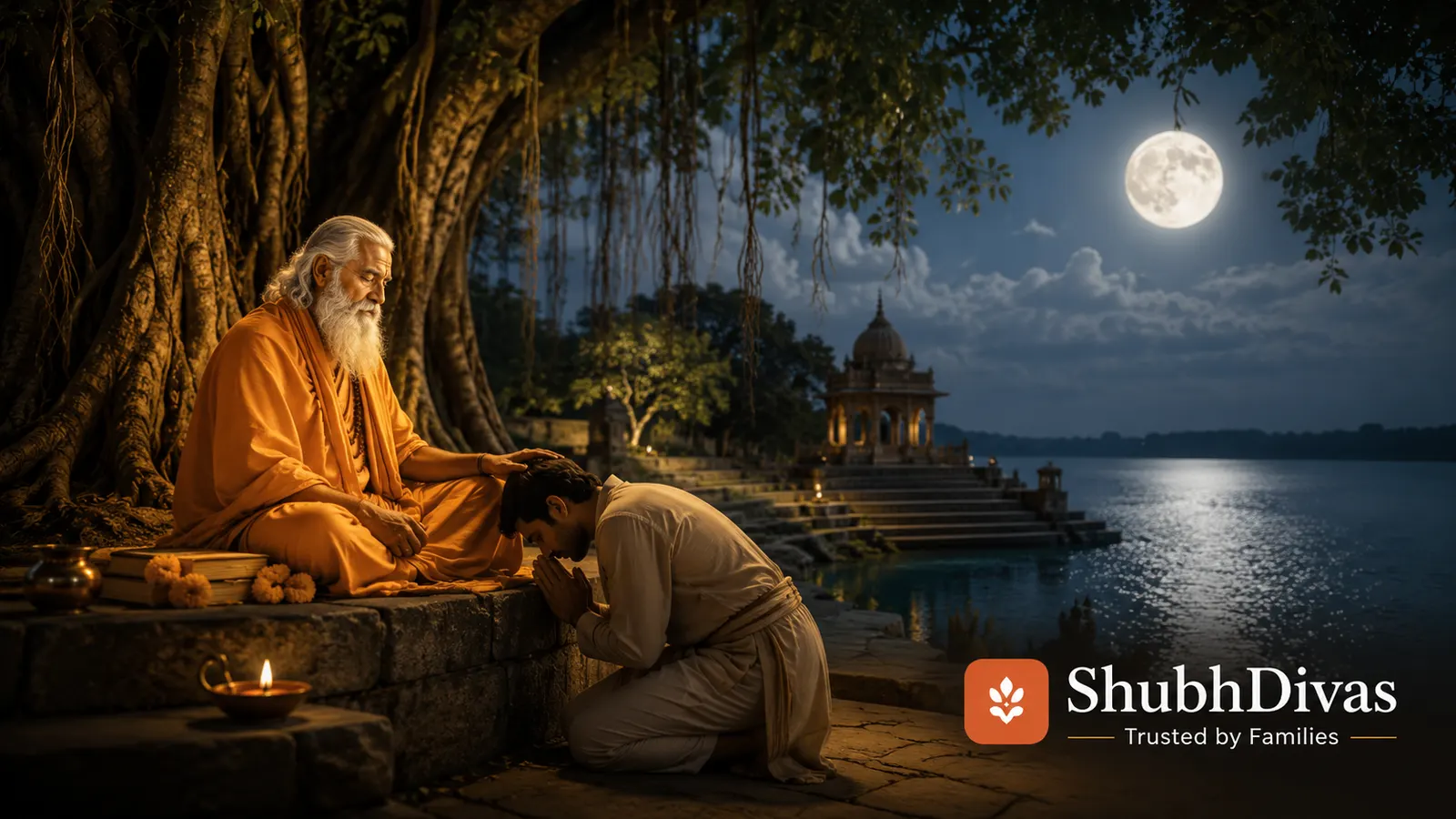

Guru Purnima 2026 falls on Wednesday, July 29 — Ashadha Purnima, the full moon of the Ashadha lunar month. It is one of the most universally observed sacred days in India — transcending the boundaries of any single tradition or community. Hindus, Buddhists, and Jains all observe this full moon as the most significant day of the year for honouring the teacher-student relationship.
The day is dedicated to Sage Veda Vyasa — the compiler of the four Vedas, the author of the Mahabharata, and the organiser of the eighteen Puranas. It is also the day the Buddha gave his first sermon, and the day Mahavira's principal disciples received their teaching. Three of the world's great wisdom traditions converge on the same full moon with the same acknowledgement: that the transmission of knowledge requires a teacher, and the teacher deserves complete reverence.
Guru Purnima 2026 — Key Details
| Detail | Information |
|---|---|
| Date | Wednesday, July 29, 2026 |
| Tithi | Ashadha Purnima (Full Moon) |
| Also called | Vyasa Purnima, Vyasa Puja |
| Purnima begins | Approximately 8:25 PM, July 28 |
| Purnima ends | Approximately 5:56 AM, July 30 |
| Day | Wednesday — auspicious for knowledge, learning, teachers |
| Follows | Devshayani Ekadashi (July 25, Chaturmas begins) |
Who is Veda Vyasa — The First Guru
The word guru comes from two roots: gu (darkness, ignorance) and ru (that which removes). A guru is one who removes darkness — not through force, but through the transmission of light.
Veda Vyasa (Krishna Dvaipayana Vyasa) is considered the original guru of the Hindu tradition — not because he was the first teacher, but because he made all teaching possible for every generation that followed him.
The Vedas existed as an oral tradition — vast, complex, and transmitted from teacher to student in an unbroken chain that could not survive without continuous personal transmission. Vyasa looked at the world of the Dvapara Yuga and saw that human lifespan and memory were diminishing. The Vedas, as they existed, were too vast for any one person to hold. So he divided them into four collections — Rigveda, Samaveda, Yajurveda, Atharvaveda — and assigned each to a principal disciple. He then composed the Mahabharata to make dharmic wisdom accessible to those who could not master the Vedas. And he composed the eighteen Puranas for those who needed narrative and story to grasp what philosophy alone could not convey.
Vyasa did not create new knowledge. He organised existing knowledge so it could survive and spread. This is why he is considered the adi guru — the original teacher — of the Hindu tradition.
Guru Purnima is called Vyasa Purnima for this reason: it celebrates not just Vyasa the person, but Vyasa the principle — the act of preserving, organising, and transmitting knowledge so future generations can access it.
Guru Purnima in Three Traditions
Hindu tradition: Guru Purnima is Vyasa Purnima — dedicated to Veda Vyasa and, through him, to every teacher in the lineage. A disciple honours the guru by performing Vyasa Puja: formal worship of the guru's pada (feet), offering, and the renewal of the guru-shishya relationship. The Brahma Sutra, traditionally attributed to Vyasa, is recited. The Guru Gita (from the Skanda Purana) is chanted.
Buddhist tradition: The Buddha gave his first discourse — the Dhammacakkappavattana Sutta, "Setting the Wheel of Dharma in Motion" — at Deer Park in Sarnath, near Varanasi, on Ashadha Purnima. He taught the Four Noble Truths and the Eightfold Path to his five former companions. This was the first turning of the wheel of Dharma — the moment when the Buddha's enlightenment became a teaching that others could follow. Buddhist communities worldwide observe Ashadha Purnima as the anniversary of this first sermon.
Jain tradition: On Ashadha Purnima, Mahavira — the 24th Tirthankara — delivered his first sermon after attaining enlightenment, and his principal disciples (called Ganadharas) received the teaching. The day marks the beginning of the transmission that would eventually become the Jain canon.
Three different moments of transmission — but the same underlying recognition: the teacher's gift of knowledge is the most significant gift a human being can give another.
The Guru-Shishya Relationship in the Hindu Tradition
The guru-shishya relationship in the Vedic tradition is not a modern teacher-student dynamic. It is closer to a spiritual adoption. The guru accepts a disciple not because of talent or payment, but because they see in the student the capacity to receive what they have to transmit.
The Taittiriya Upanishad's convocation address — spoken by a guru to departing students — articulates this:
"Speak truth. Walk in dharma. Do not neglect the study of the Vedas. After offering to the guru what he desires, do not cut the thread of the lineage. Do not deviate from truth. Do not deviate from dharma."
The guru in this tradition is not a facilitator or a service provider. The guru is a transmitter of a living lineage — a chain of knowledge that goes back to the rishis and, through them, to the source of all knowledge. Guru Purnima is the day when this relationship is formally renewed and honoured.
Vyasa Puja — How to Honour Your Guru on Guru Purnima
For those with a living guru:
- Seek darshan and offer your respects. If travel is not possible, connect by phone or video.
- Perform Pada Puja — wash the guru's feet, offer flowers, apply kumkum
- Offer dakshina — a gift to the guru. Traditionally this is money, cloth, or what the guru specifically requires. The giving of dakshina is an ancient tradition: the student's offering acknowledges that the knowledge received cannot be repaid in kind — only symbolically.
- Recite the Guru Gita or the Guru Stotram
- Renew your commitment to the practices the guru has given you
For those without a living guru:
- Set up a puja with an image or idol of Veda Vyasa, or your guru lineage's founder
- Perform the Vyasa Puja: flower offerings, Panchamrit abhishekam, dhupa, deepa, naivedya
- Recite the Guru Gita (the discourse on the guru from the Skanda Purana)
- Read from the Bhagavata Purana or Bhagavad Gita — texts attributed to Vyasa
- In the absence of a personal guru, honour the teachers who have shaped you — parents, mentors, those who gave you access to any form of wisdom
The Guru Vandana — Universal Prayer:
Gurur Brahma Gurur Vishnu Gurur Devo Maheshvarah Guruh Sakshaat Parabrahma Tasmai Shri Gurave Namah
(The guru is Brahma, the guru is Vishnu, the guru is Maheshvara (Shiva). The guru is the direct manifestation of the Supreme — I offer my salutations to that guru.)
This is the foundational prayer of Guru Purnima — recited at the beginning of any guru puja and understood as acknowledging that the guru's role in transmitting knowledge is not separate from the divine; it is the divine's way of reaching the student.
Guru Purnima During Chaturmas
Guru Purnima 2026 falls within the first week of Chaturmas (which began on July 25 with Devshayani Ekadashi). This timing is significant.
Chaturmas is the period when wandering monks in the Hindu, Jain, and Buddhist traditions halt their travels and reside in one place. In ancient India, this meant that during the four months of the monsoon, students had sustained, uninterrupted access to their teacher — the guru was present, not moving, not elsewhere. The initiation of Chaturmas on July 25 followed by Guru Purnima on July 29 creates a natural sequence: Vishnu rests, the teacher stays, and the first act of this four-month residency is the formal honouring of the guru on the full moon.
This is also why Guru Purnima is the traditional day for beginning a Chaturmas vow — the vow of four months of intensified practice is taken in the presence of or in dedication to the guru, making the commitment a relational one rather than merely a personal resolution.
Guru Purnima at Ashrams and Temples
Ashrams across India hold their most significant events of the year on Guru Purnima:
- Discourses by the guru or senior teachers
- Mass initiation ceremonies for new disciples
- Public Vishnu Sahasranama or Guru Gita recitation
- Annadanam — large-scale free meals for all who attend
- Bhajan-Kirtan that runs through the night
At academic institutions — particularly those in the traditional or gurukul model — Guru Purnima is the day when teachers are formally honoured by students. The tradition of giving a gift to teachers on this day is one of India's oldest unbroken cultural practices.
The Deeper Meaning — Why the Full Moon
Every Purnima is complete light — no shadow on the disc, the moon at its fullest. The lunar symbolism of Guru Purnima is deliberate: the guru removes all darkness from the student's mind, leaving only light. The full moon on Ashadha Purnima is the celestial embodiment of what the guru does.
The Chandogya Upanishad says: "One who has a guru knows." The tradition does not say one who has a guru is automatically enlightened. It says that the one who has a guru is on a path where knowing is possible — because the guru holds the map, knows the territory, and has already made the journey.
Guru Purnima is the annual reminder of this: the map exists, the path is real, and the teacher who knows it deserves acknowledgement.
Check today's Rahu Kaal
Precise panchanga for your city — Rahu Kaal, tithi, nakshatra, sunrise, and more calculated accurately.
Free · Updated daily
Frequently asked questions
Find your auspicious muhurat
Personalised Vedic muhurat for your wedding, property, vehicle, or ceremony — reviewed by Acharya Suryakanth Subramaniam.
Find Muhurat →