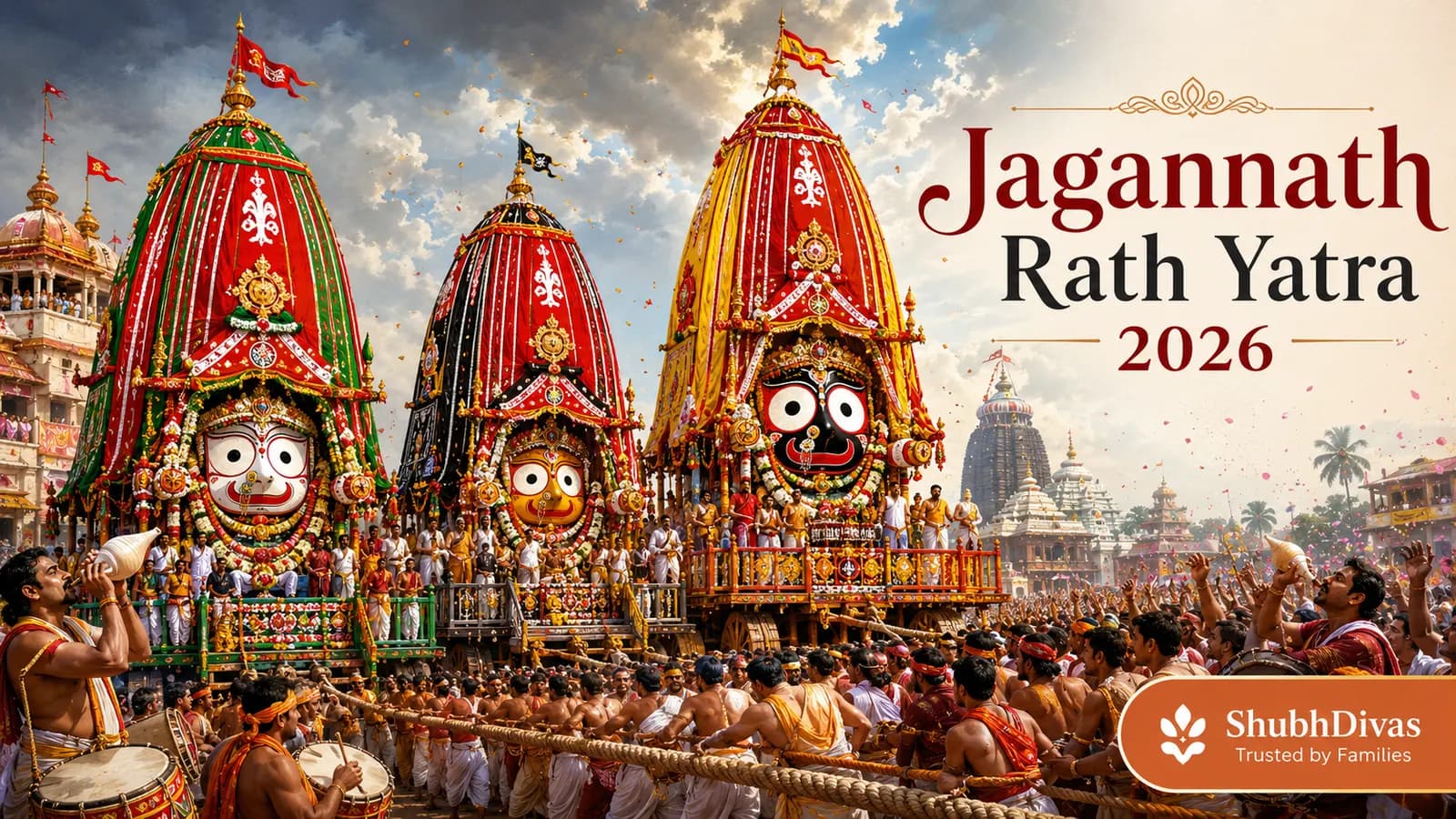

Jagannath Rath Yatra 2026 begins on Thursday, July 16 at Puri, Odisha — the most spectacular chariot festival in the Hindu world. On this day, Lord Jagannath (a form of Krishna/Vishnu), his elder brother Balabhadra, and his sister Subhadra leave the sanctum of the great Jagannath Temple, climb three towering wooden chariots, and are pulled through the streets of Puri by hundreds of thousands of devotees to the Gundicha Temple, their aunt's home, where they stay for a week before returning.
It is the one day in the year when the deities leave the temple and come out to the people — when the highest darshan, normally reserved for the inner sanctum, is given freely on the open road to anyone who comes. The festival falls on Ashadha Shukla Dwitiya, the second day of the bright fortnight of Ashadha, and is observed by millions in Puri and at Jagannath temples across India and the world.
Jagannath Rath Yatra 2026 — Key Details
| Detail | Information |
|---|---|
| Festival | Jagannath Rath Yatra (Ratha Jatra) |
| Rath Yatra (onward journey) | Thursday, July 16, 2026 |
| Tithi | Ashadha Shukla Dwitiya |
| Place | Puri, Odisha (and Jagannath temples worldwide) |
| Deities | Jagannath, Balabhadra, Subhadra |
| Destination | Gundicha Temple (≈3 km from the main temple) |
| Bahuda Yatra (return) | Around July 24, 2026 |
| Niladri Bije (final re-entry) | A day after Bahuda |
Festival dates are fixed by the Ashadha Shukla tithi and are stable; the exact ritual hours each day are set by the Puri temple administration. Confirm the daily schedule and tithi on the ShubhDivas Panchanga closer to the date.
Before the Yatra — Snana Purnima and Anavasara
The Rath Yatra does not happen in isolation; it is the climax of a sequence that begins weeks earlier. On Snana Purnima, the full moon of Jyeshtha, the deities are brought out and given a grand ceremonial bath with 108 pitchers of water — the Snana Yatra. After this elaborate bath, tradition holds that the deities "fall ill" with fever and are taken into seclusion for about a fortnight. This period is called Anavasara (or Anasara), during which the temple is closed to ordinary darshan, the deities are kept away from public view, and they are treated with herbal medicines.
It is precisely after this recovery that the deities emerge, freshly restored, for the Rath Yatra — their first public appearance after the seclusion. This is part of why the Yatra darshan is so prized: the devotees see the Lord again after a fortnight of absence, and they see him not within the temple but out on the open road. The whole arc — bath, illness, seclusion, recovery, and the triumphant ride to Gundicha — gives the festival the warmth and human intimacy that defines the Jagannath tradition, where the Lord is treated not as a distant idol but as a beloved member of the family.
The Three Chariots
The chariots are built fresh every year from specific sacred timber, with no nails or metal, by hereditary temple carpenters. Each deity has their own rath, distinct in size, colour, and name.
Nandighosa — the chariot of Lord Jagannath. The tallest of the three, standing about 45 feet, with eighteen wheels and draped in red and yellow cloth. It is crowned by the flag Trailokyamohini and guarded by Garuda. This is the chariot whose name gives us the very word "juggernaut."
Taladhwaja — the chariot of Balabhadra. The chariot of the elder brother, about 44 feet tall with sixteen wheels, draped in red and green (or blue). It carries the emblem of the palm tree (tala) and is guarded by Vasudeva.
Darpadalana (Devadalana) — the chariot of Subhadra. The smallest of the three, about 43 feet tall with fourteen wheels, draped in red and black. It carries the lotus emblem and is guarded by Jayadurga, the protective form of the Devi.
The three raths are lined up before the temple's Singhadwara (Lion's Gate) on the morning of the Yatra, ready to receive the deities.
The Rituals of the Yatra Day
Pahandi. The deities are brought out of the sanctum in a slow, swaying, rhythmic procession called Pahandi Bije — carried forward to the beat of drums and gongs, rocking from side to side, as the crowd roars Jagannath's name. Each deity is brought to their own chariot in turn: Balabhadra first, then Subhadra, then Jagannath.
Chhera Pahara. Once the deities are enthroned on the chariots, the Gajapati King of Puri — by tradition the first servant of the Lord — arrives and performs Chhera Pahara: he sweeps the chariot platforms with a golden-handled broom and sprinkles them with sandalwood water. The reigning king sweeping the floor before Jagannath is the festival's great statement of equality — that before the Lord, even a monarch is a humble servant.
The pulling of the chariots. After Chhera Pahara, the great ropes are tied, and the chariots are pulled by the gathered devotees. To take hold of the rope and help move the rath even a few feet is considered an act of immense merit — the pulling itself is the worship. The procession moves along the Bada Danda, Puri's grand avenue, toward the Gundicha Temple.
The Journey and the Return
Gundicha Temple. The Gundicha Temple, about three kilometres away, is regarded as the deities' aunt's home (and is associated with the garden where the Lord's image was first carved). The deities reach it and remain there for seven days, where they receive special offerings, including the famous Poda Pitha, a baked rice-and-jaggery cake said to be Jagannath's favourite.
Hera Panchami. On the fifth day, Goddess Lakshmi, Jagannath's consort who was left behind at the main temple, comes to the Gundicha Temple in search of him — a much-loved episode full of the affectionate, human drama that defines the Jagannath tradition.
Bahuda Yatra — the return (around July 24). After the week at Gundicha, the deities return to the main temple in the Bahuda Yatra, the homeward chariot procession, with the same grandeur as the onward journey. On the way, the chariots pause at the Mausi Maa Temple for the offering of Poda Pitha.
Suna Besha and Niladri Bije. Back before the main temple, the deities are adorned in the dazzling Suna Besha — decked in gold ornaments — for a spectacular darshan. Finally, in the Niladri Bije, they re-enter the sanctum, completing the cycle. The re-entry famously includes a tender ritual in which Jagannath must appease Lakshmi to be allowed back inside.
The Significance of Rath Yatra
The Rath Yatra carries a meaning that sets it apart from temple worship. Through the year, darshan of Jagannath happens within the temple, under its rules and rhythms. But on the Yatra day the Lord himself comes out — onto the public road, into the crowd, within reach of every hand. The scriptures hold that a single darshan of Jagannath on his chariot, or the act of pulling the rath, grants liberation and washes away the sins of many births.
This is the festival's deepest teaching: that the divine does not remain locked behind sanctum walls but journeys out to meet the devotee where they stand. It dissolves, for one day, every barrier of caste, rank, and access — king and pilgrim pull the same rope, and the Lord rides out to all of them equally.
How to Observe Rath Yatra Away from Puri
You need not be in Puri to take part. Across India and the world, Jagannath temples and ISKCON centres hold their own Rath Yatras on the same day, pulling smaller chariots through their streets. At home, you can observe the day by:
- Cleaning and purifying the home and setting up a small worship of Jagannath, Balabhadra, and Subhadra.
- Offering bhog — especially khichdi and sweets — and Poda Pitha if you can make it.
- Reading or listening to the Jagannath katha, singing the Jagannashtakam, and chanting the names of Hari.
- Watching the live Puri Yatra and taking the darshan of the deities on their chariots, which itself is held to carry merit.
- Giving daan — food and alms to the needy, in the spirit of the Lord who comes out to all.
Check today's Rahu Kaal
Precise panchanga for your city — Rahu Kaal, tithi, nakshatra, sunrise, and more calculated accurately.
Free · Updated daily
Frequently asked questions
Find your auspicious muhurat
Personalised Vedic muhurat for your wedding, property, vehicle, or ceremony — reviewed by Acharya Suryakanth Subramaniam.
Find Muhurat →