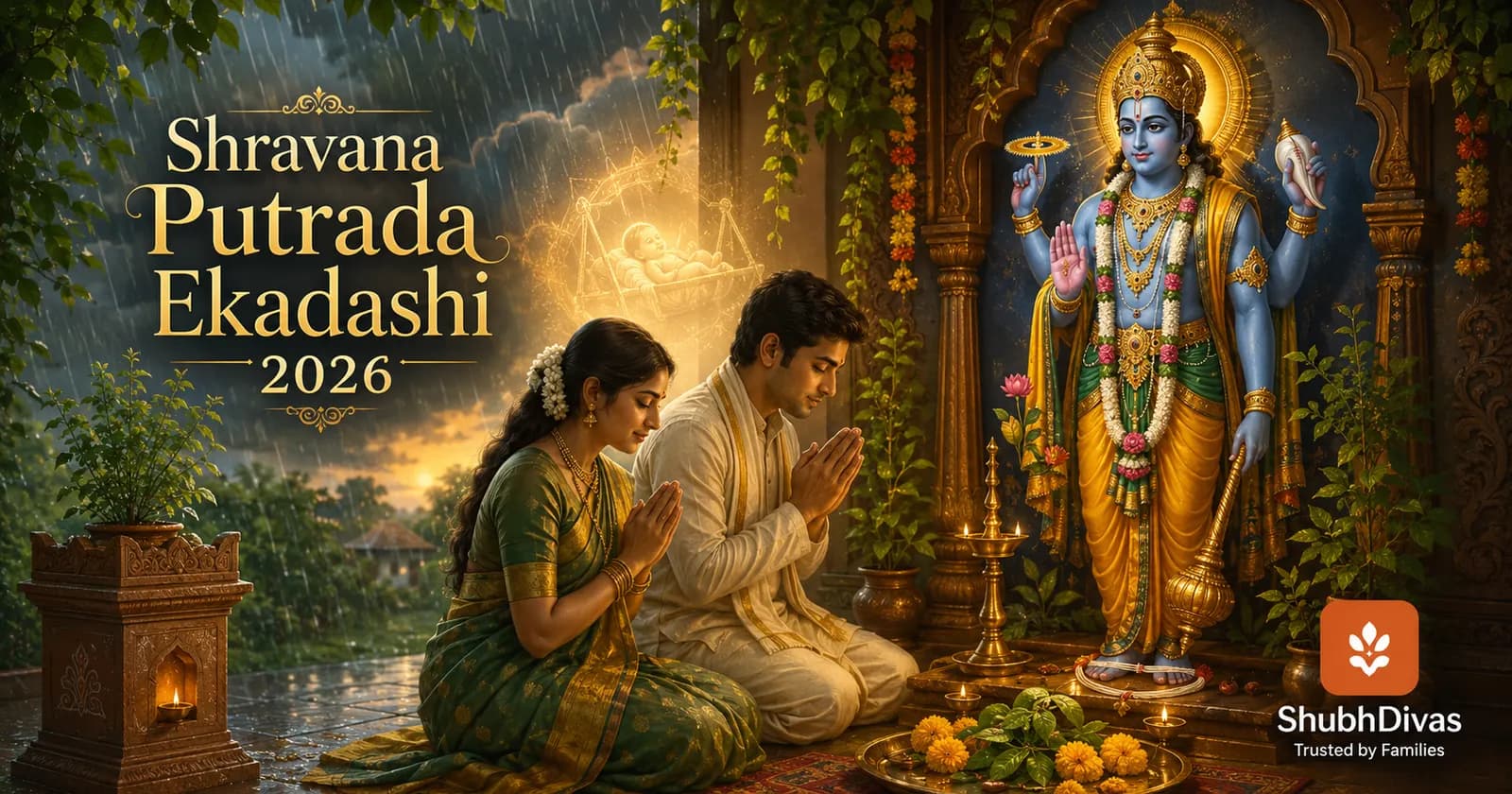

Shravana Putrada Ekadashi 2026 falls on Sunday, August 23. It is the Ekadashi of the bright fortnight (Shukla Paksha) of the Shravana lunar month — one of the two Putrada Ekadashis in the Hindu year, and the one observed within the sacred months of Sawan and Chaturmas. Dedicated to Lord Vishnu, it is kept above all for one purpose that its very name declares: Putrada, "the giver of children" — the blessing of progeny, and the wellbeing of the children a family already has.
Of the twenty-four Ekadashis in a year, Putrada Ekadashi holds a tender place. It is the fast that couples longing for a child have turned to for centuries, and the day on which parents pray for the long life, health, and good character of their sons and daughters. Here is the verified date, the Vrat Katha of King Mahijit that explains its promise, and the complete way to observe the fast.
Shravana Putrada Ekadashi 2026 — Key Details
| Detail | Information |
|---|---|
| Festival | Shravana Putrada Ekadashi (Pavitra Ekadashi) |
| Date | Sunday, August 23, 2026 |
| Lunar month | Shravana, Shukla Paksha (waxing fortnight) |
| Tithi | Ekadashi (eleventh lunar day) |
| Deity | Lord Vishnu |
| Parana (fast-breaking) | Monday, August 24, 2026 morning, after sunrise within the Dwadashi tithi |
| Significance | Blessing of children and progeny, wellbeing of one's children, family harmony, and spiritual merit |
Exact tithi start/end times and the precise Parana window shift by your city's longitude. Confirm the Ekadashi tithi and your city's Parana timing on the ShubhDivas Panchanga before observing the fast.
The Significance of Shravana Putrada Ekadashi
Every Ekadashi is sacred to Lord Vishnu, and each carries its own emphasis. Putrada Ekadashi's emphasis is the continuity of the family line and the welfare of children — a concern that, in the Vedic worldview, is not merely worldly but deeply spiritual. A child is seen as the thread through which a family's dharma, memory, and rites are carried forward, and the birth of a virtuous child is counted among the great blessings a household can receive.
There are two Putrada Ekadashis each year: Pausha Putrada Ekadashi in the winter month of Pausha (December–January), and Shravana Putrada Ekadashi in the monsoon month of Shravana. This monsoon Ekadashi is also known as Pavitra Ekadashi — "the Ekadashi that purifies" — because it falls in Sawan, the most devotional stretch of the year, and is observed with the pavitra, a sacred thread offered to the deity.
The scriptures tell that whoever observes Shravana Putrada Ekadashi with sincere faith is blessed with worthy children and, beyond that, is freed from sin and led toward higher realms after this life. Yet the fast is not only for those who seek a child. Parents keep it for the long life and good conduct of the children they already have; and many observe it simply as a Vishnu vrat within Sawan, for the peace and prosperity of the whole household. The promise of progeny is its heart, but its grace extends to the family entire.
The Vrat Katha of Shravana Putrada Ekadashi — The Story of King Mahijit
The power of this vrat is explained through a story set in the kingdom of Mahishmati, ruled by a righteous king named Mahijit. The king was just, generous, and beloved of his subjects — and yet a single sorrow shadowed his reign: he had no son. There was no heir to inherit his throne, and no one to perform the rites that a departed soul depends upon. However full his treasury and however wide his kingdom, the king felt his life to be without foundation.
For years Mahijit carried this grief in silence. At last, unable to bear it alone, he called together the learned Brahmins and elders of his realm and opened his heart to them. "I have ruled without cruelty, I have given to the needy, I have kept my duties to gods and men," he said. "Why then am I denied a child? Search the scriptures and tell me the remedy, that my house may not end with me."
The Brahmins deliberated and went into the forest to seek the counsel of the great sages who dwelt there. Among them they found the ascetic Lomasha Rishi, whose insight reached across lifetimes. When they laid the king's grief before him, Lomasha entered meditation and looked into Mahijit's past. Then he spoke: "In a former birth your king was a poor merchant. One day, on the Ekadashi tithi, tormented by the heat and by a great thirst, he came to a pond where a cow, heavy with calf, was drinking. He drove the thirsty cow away and drank the water himself, denying a helpless creature at the very moment of its need — and on a sacred day. That single act of hard-heartedness is the seed of his childlessness now."
The Brahmins asked the sage for the cure. "Let the king, his queen, and all who love him observe the fast of Shravana Putrada Ekadashi," Lomasha said, "and let them offer the merit of that fast to the king. By its power the old sin will be dissolved, and he will be blessed with a son."
The Brahmins returned and told the king all that the sage had revealed. Mahijit received the counsel with faith. When Shravana Putrada Ekadashi came, the king and queen kept the fast with complete devotion, and the people of Mahishmati kept it alongside them, offering the fruit of their own observance to their sovereign. Not long after, the queen conceived, and in time a radiant, virtuous son was born — an heir who would rule with the same justice as his father. So the katha carries its promise still: that the sincere observance of Putrada Ekadashi can lift the burden that denies a family its child.
Check today's Rahu Kaal
Precise panchanga for your city — Rahu Kaal, tithi, nakshatra, sunrise, and more calculated accurately.
Free · Updated daily
How to Observe Shravana Putrada Ekadashi — Vrat Vidhi
The Ekadashi fast is observed across three days in spirit, though the fast itself is kept on the eleventh tithi and broken on the twelfth.
Dashami (the day before). On the tenth tithi — Saturday, August 22 — eat only a single sattvik meal before sunset, avoiding grains, onion, garlic, and tamasic food. This prepares the body to enter the fast lightly.
Ekadashi (the fast — August 23). Rise before dawn (the Brahma Muhurta), bathe, and take the sankalp — the vow to keep the fast for Lord Vishnu, and, for those keeping it for a child, the prayer placed at the Lord's feet. The fast may be observed at three levels of strictness, according to your health and capacity:
- Nirjala — without even water, the strictest form.
- Nirahara / phalahara — without grains, taking only water, fruit, milk, and permitted vrat foods.
- Saatvik ekahara — a single grain-free meal for those who cannot fast fully.
Through the day, worship Lord Vishnu: bathe the image or Shaligram, offer the pavitra (sacred thread) and tulsi leaves — which Vishnu loves above all offerings — along with yellow flowers, sandal, fruit, and a ghee lamp. Recite the Vishnu Sahasranama, the Santana Gopala mantra or stotra where a child is prayed for, and read or listen to the Putrada Ekadashi Vrat Katha. The night is ideally spent in jagran — a vigil of bhajan and the chanting of Hari's name — since wakeful devotion on Ekadashi night multiplies the merit of the fast.
Dwadashi — Parana (August 24). The fast is broken the next morning, after sunrise, within the Dwadashi tithi and after the Ekadashi tithi has ended. Breaking it too early or after Dwadashi has passed diminishes the vrat, so the Parana window matters — check your city's exact timing. Break the fast with sattvik food, and it is customary to give daan (charity) — food, clothes, or grain to a Brahmin or to someone in need — and to feed the poor before eating yourself.
What to Avoid on Ekadashi
- Grains and beans — rice, wheat, lentils, and pulses are strictly avoided; this is the central rule of every Ekadashi.
- Tamasic food and drink — onion, garlic, meat, eggs, and alcohol.
- Anger, gossip, and harsh speech — Ekadashi is a day of restraint of the senses as much as of the stomach; ill conduct undoes the fast's purpose.
- Sleeping through the day — the vrat is meant to be spent in worship and remembrance, not idleness.
- Rice on Ekadashi — there is a long-standing tradition that even non-fasting family members avoid rice on Ekadashi day.
Shravana Putrada Ekadashi within Sawan and Chaturmas
Putrada Ekadashi's place in the calendar deepens its meaning. It falls in Shravana (Sawan) — the month most beloved of devotees — and within Chaturmas, the four months (July 25 to around November 20, 2026) when Lord Vishnu rests in his cosmic sleep and worldly ceremonies such as weddings and griha pravesh pause while spiritual practice takes their place. In these inward months, vrats and devotion carry special weight, and a fast kept for the sake of one's family and children joins naturally with the season's spirit of surrender and prayer. Observed well, Shravana Putrada Ekadashi is both a heartfelt petition and an act of devotion — a family turning together toward Lord Vishnu in the most sacred stretch of the year.
Frequently asked questions
Find your auspicious muhurat
Personalised Vedic muhurat for your wedding, property, vehicle, or ceremony — reviewed by Acharya Suryakanth Subramaniam.
Find Muhurat →