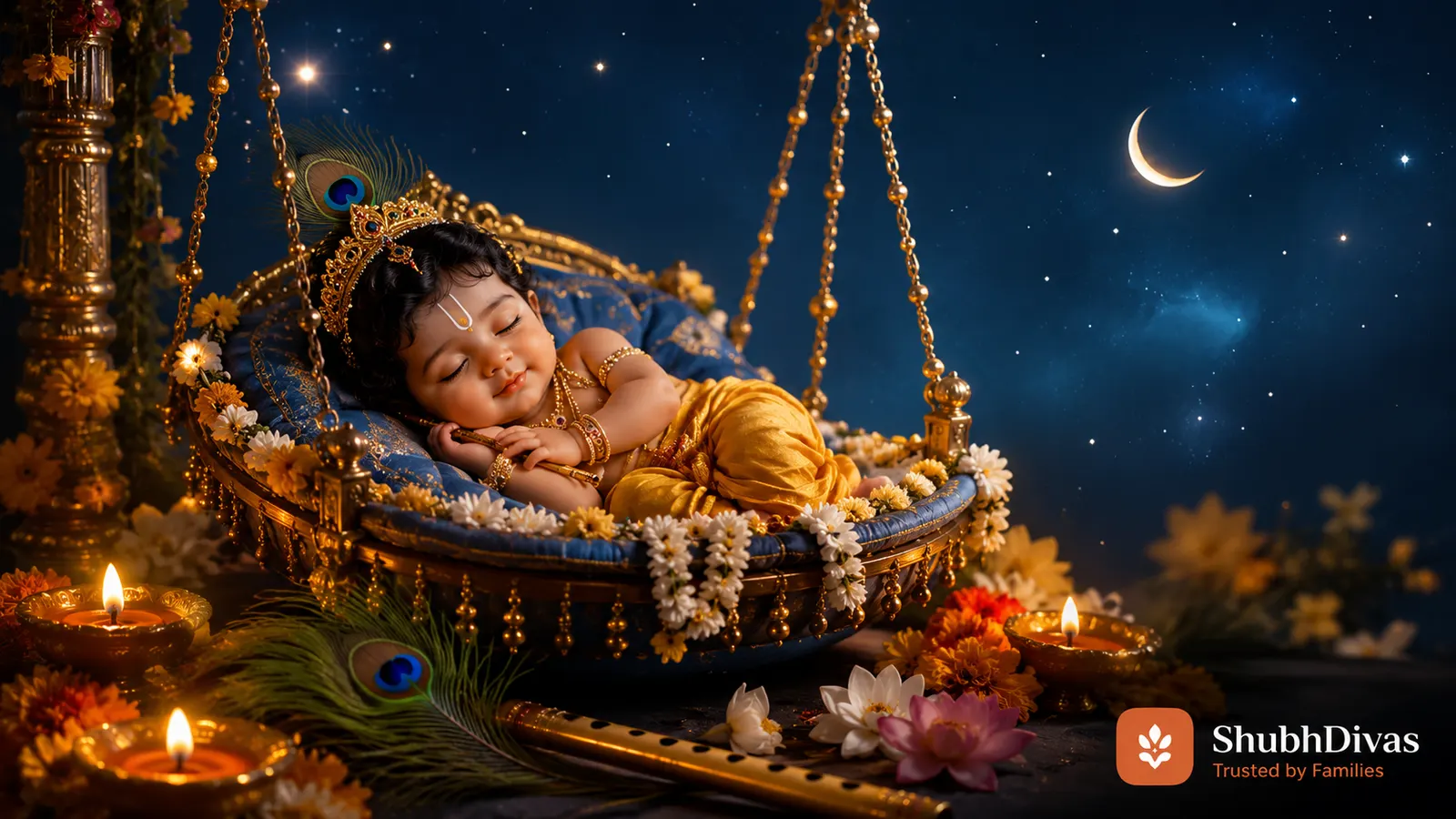

Krishna Janmashtami 2026 falls on Friday, September 4 — Bhadrapada Krishna Ashtami, the eighth day of the dark fortnight of the Bhadrapada lunar month, under Rohini Nakshatra. This is the 5,253rd birth anniversary of Lord Krishna, the eighth avatar of Vishnu, born at midnight in a prison cell in Mathura to Devaki and Vasudeva while the tyrant Kansa slept. The date follows the Smarta tradition observed by most Hindu households and major temples. Devotees following the Vaishnava and ISKCON calendar observe the festival the following day, Saturday, September 5 — the two dates arising from a difference in how the two traditions weigh the Ashtami tithi and Rohini Nakshatra when they span midnight.
The puja itself, in both traditions, happens at midnight — the Nishita Kaal, the 47-minute window that replicates the exact moment of Krishna's birth. Everything before that — the fasting, the preparation, the bhajan-kirtan through the night — is the approach. Midnight is the arrival.
Krishna Janmashtami 2026 — Key Details
| Detail | Information |
|---|---|
| Smarta date | Friday, September 4, 2026 |
| Vaishnava / ISKCON date | Saturday, September 5, 2026 |
| Tithi | Bhadrapada Krishna Ashtami |
| Nakshatra | Rohini |
| Ashtami Tithi begins | 2:25 AM, September 4 |
| Ashtami Tithi ends | 12:13 AM, September 5 |
| Nishita Kaal (midnight puja window) | 11:55 PM (Sep 4) to 12:42 AM (Sep 5) |
| Nishita Kaal duration | 47 minutes |
| Dahi Handi | Saturday, September 5, 2026 |
| Parana (fast-breaking, Dharma Shastra) | After 6:09 AM, September 5 |
| Parana (modern tradition) | After 12:42 AM, September 5 |
| Birth anniversary | 5,253rd |
Nishita Kaal timings vary by location — the window above is approximate for most of peninsular India. Verify for your city.
The Birth — What Happened at Midnight in Mathura
The Bhagavata Purana describes the birth of Krishna with a precision that makes it unlike any other mythological narrative — not just a divine event, but a divine event placed in a specific political situation, in a specific prison, with specific witnesses.
Kansa, the king of Mathura and Devaki's own brother, had been warned by a celestial voice at Devaki's wedding that her eighth child would be his destroyer. He imprisoned Devaki and her husband Vasudeva that same day, killing their children one by one as each was born. When the seventh child — Balarama — was transferred by Yogamaya from Devaki's womb to Rohini's in Vrindavan, Kansa was deceived into thinking it was a miscarriage. Then the eighth pregnancy began.
On the eighth night of the dark fortnight, under Rohini Nakshatra, at the absolute darkest point of the lunar month — Ashtami of the Krishna Paksha — the prison filled with divine light. Vasudeva and Devaki saw a four-armed Vishnu standing before them: lotus, conch, mace, discus. He then transformed himself into an infant. In that moment, all the prison guards fell into a deep sleep. The locks on the doors opened on their own. The river Yamuna, in full monsoon flood, parted to let Vasudeva cross with the infant held above his head on a basket. A serpent — Adi Shesha himself — spread his thousand hoods over the child to shield him from the rain. Vasudeva placed the infant in the home of Nanda and Yashoda in Gokul, and returned with their newborn daughter to the prison. When Kansa reached for that child, she slipped from his hands, rose into the sky, and told him: the one who will destroy you has already been born.
Every element of this story is echoed in how Janmashtami is observed. The fasting recalls the parents' imprisonment. The midnight puja at the Nishita Kaal replicates the birth moment. The abhishekam — bathing the infant Krishna — is Vasudeva's first act of care for the child in the prison. The cradle and the lullabies are Yashoda's. The entire festival is a narrative re-enactment, not merely a celebration.
Smarta and Vaishnava — Why Two Dates
The difference between September 4 and September 5 is not a dispute — it is a difference in which calendrical criterion takes precedence when the Ashtami tithi and Rohini Nakshatra don't fall cleanly within a single calendar day.
The Smarta tradition looks for Ashtami to be in force at the time of Nishita Kaal (midnight). In 2026, Ashtami begins at 2:25 AM on September 4 and extends through the night — the Nishita Kaal of September 4–5 (11:55 PM to 12:42 AM) falls while Ashtami is still active. Smartas therefore observe Janmashtami on September 4.
The Vaishnava and ISKCON tradition — particularly the Gaudiya Vaishnava sampradaya — applies greater weight to the Udaya Tithi rule and to the concurrent presence of Ashtami and Rohini at or around sunrise. Since Rohini Nakshatra and Ashtami tithi peak together in a manner that aligns more with September 5 in this calculation, Vaishnavas observe on September 5.
Both are correct within their own interpretive frameworks. In most Hindu households — particularly those without a formal sampradaya affiliation — September 4 is the observance day. Those following a Gaudiya Vaishnava lineage or an ISKCON calendar observe September 5. In households where both fall in the family, the 2026 calendar effectively gives a two-day festival.
The Nishita Kaal — The Midnight Window
Nishita Kaal is the most sacred period of Janmashtami — the 47-minute window between 11:55 PM and 12:42 AM on the night of September 4–5. This is when the puja, the abhishekam, and the ritual birth of the deity are performed.
Nishita Kaal (literally "the time of night") corresponds to the period of maximum darkness — the midnight hour that Hindu astronomy identifies as the point when the sun is furthest below the horizon and the night is most complete. That this was the moment Krishna chose to be born is read in the tradition as a theological statement: the light that dispels all darkness was born at the point of maximum darkness.
What happens during the Nishita Kaal:
- The idol of infant Krishna (Bal Gopal, Laddu Gopal) receives the midnight abhishekam — bathed in panchamrit (milk, curd, ghee, honey, sugar water), then rinsed with Ganga jal
- The conch (shankha) is blown to announce the birth
- The cradle (jhula / palna) is rocked, with devotees singing lullabies for the newborn Krishna
- The 108 names of Krishna are chanted
- Offerings from the Chappan Bhog are placed before the deity
- Aarti is performed immediately after the birth-moment puja
The midnight window is why Janmashtami is not a morning-puja festival. Families who observe it correctly are awake through the night — the day-long fast, the bhajan-kirtan from evening, the vigil through to midnight, and then the puja itself. Falling asleep before Nishita Kaal is understood in the tradition as missing the arrival.
The Rohini Nakshatra Connection
Rohini is the fourth of the 27 nakshatras — corresponding to the star Aldebaran in Taurus. In Jyotish, Rohini is the nakshatra of beauty, abundance, artistic creation, and divine grace. It is the nakshatra the Moon favours above all others, which is why it is associated with fecundity, magnetism, and the creative power of the earth.
That Krishna was born under Rohini explains much of his nature in the devotional tradition — his extraordinary physical beauty, his magnetic effect on everyone around him, his mastery of music and dance, his ease with the natural world. The cowherd universe of Vrindavan — butter, cows, rivers, forests, flute music, and the monsoon rains — is entirely Rohini territory.
For Janmashtami calendar calculations, Rohini Nakshatra's presence at the time of the Nishita Kaal is the second essential condition alongside Ashtami tithi. When both Ashtami and Rohini are simultaneously in force at midnight, the date carries the fullest sacred weight. In 2026, this conjunction falls on the night of September 4–5.
Fasting Rules — Phalahar Vrat
The Janmashtami fast runs from sunrise on September 4 through the Nishita Kaal puja. The fast is broken either immediately after the midnight abhishekam or on the morning of September 5.
Parana — when to break the fast:
The Dharma Shastra rule (the traditional parana): The fast is broken on September 5 morning, after 6:09 AM, once both the Ashtami Tithi and Rohini Nakshatra have ended before sunrise. The midnight puja marks the climax of the fast, but eating waits until morning.
The modern tradition: Many families eat the prasad from the midnight puja immediately after the Nishita Kaal concludes — after 12:42 AM on September 5. This is widely accepted.
What is permitted during the fast:
- Fresh fruits of all kinds
- Dry fruits — makhana (fox nuts) especially; also cashews, almonds, raisins
- Sabudana (sago) — prepared without table salt
- Milk, curd, lassi, buttermilk, coconut water
- Singhara atta (water chestnut flour) preparations — halwa, puri, roti
- Sendha namak (rock salt) — not table salt or sea salt
- Mishri (crystallised sugar), jaggery, fresh fruit juices
What is not permitted:
- All grains: rice, wheat, bajra, jowar — no exceptions
- All pulses and legumes
- Common table salt or sea salt
- Non-vegetarian food
- Onion and garlic (in the stricter observance)
The Bhagavata Purana records that a devotee who fasts on Janmashtami with complete faith and devotion receives merit equivalent to a full year of Ekadashi fasts — with each individual Ekadashi itself equivalent to significant pilgrimage and charity.
Chappan Bhog — The 56 Offerings
The Chappan Bhog — 56 food items offered to Krishna — is the most elaborate food offering in the Vaishnava devotional calendar. The number 56 has a specific origin in the Bhagavata Purana.
When Krishna instructed the Braj community to stop worshipping Indra and offer their devotion to the Govardhan hill instead, Indra responded by sending catastrophic rains over Vrindavan for seven continuous days. Krishna lifted the Govardhan hill on his little finger, sheltering the entire community underneath it for all seven days. During those seven days — held up on one finger, unable to lower the hill — Krishna could not eat at his regular mealtimes. The community of Vrindavan, knowing he ate 8 times a day and had missed 7 full days of meals, prepared 8 × 7 = 56 items to make up for everything he had missed the moment the rains stopped.
The Chappan Bhog in practice:
| Category | Examples |
|---|---|
| Sweets | Peda, laddu, barfi, kheer, halwa, malpua, rabri, jalebi, mohanthal |
| Savouries | Mathri, namkeen, chakli, sev, kachori |
| Milk preparations | Makhan-mishri, dahi, chhena preparations, paneer |
| Fruits | Banana, mango, grapes, coconut, pomegranate, berries |
| Dried fruits and nuts | Makhana, cashew, almond, raisin preparations |
| Pickles and condiments | Raw mango, tamarind-based |
Most households do not prepare all 56 — the tradition is explicit that the bhava (feeling and intention) of the offering matters more than the number. A small offering of fresh makhan (hand-churned butter) and mishri (crystallised sugar) — Krishna's declared favourite — offered with full love and attention is completely accepted. The Bhagavata Purana records Krishna's own statement: he does not require elaborate offerings; a leaf, a flower, a fruit, or water given with love reaches him fully.
Puja Vidhi — Complete Guide for Home Observance
The day before (September 3 — evening): Clean and prepare the puja space. Set up a decorated cradle (jhula / palna) with fabric, flowers, and ornaments. Prepare all puja materials so nothing needs to be arranged in the midnight rush.
Morning of September 4:
- Take a ritual bath before sunrise
- Make the sankalpa — state the fast and its intention before the deity at the start of the day
- Decorate the puja space with yellow marigold and white jasmine — both associated with Krishna
- Set up the Bal Gopal idol on a clean cloth; do not place it in the cradle yet — the cradle receives the deity only at the moment of the midnight birth puja
Daytime (September 4): Spend the day in bhajan-kirtan, in reading from the Bhagavata Purana (the 10th Canto narrates Krishna's complete life from birth through Mathura), and in chanting. The primary mantra practice of Janmashtami is the Hare Krishna Mahamantra:
Hare Krishna Hare Krishna Krishna Krishna Hare Hare Hare Rama Hare Rama Rama Rama Hare Hare
108 rounds of the Mahamantra on a Tulsi mala is the traditional Janmashtami japa practice. If 108 rounds are not possible, 27 or 16 rounds are accepted. The chanting is continued through the day and evening.
Evening through to Nishita Kaal (9 PM onwards): Bhajan-kirtan intensifies as midnight approaches. The entire household remains awake. Devotional songs — Meera bhajans, Surdas compositions, the Govind Bolo Hari Gopal Bolo kirtan, and regional lullabies for the newborn Krishna — fill the hours of vigil. This is the Jagran — the staying awake — which is itself considered an act of devotion equivalent to significant pilgrimage.
Nishita Kaal Puja (11:55 PM — 12:42 AM):
- Panchamrit Abhishekam — bathe the Bal Gopal idol with milk, curd, ghee, honey, and sugar water in sequence; then rinse with Ganga jal (or clean water). Wipe gently with a soft cloth
- Dress the deity in new clothes — yellow is traditional for Krishna; alternatively blue, reflecting his complexion described in scripture
- Tulsi offering — Tulsi is indispensable for all Krishna puja; place a fresh sprig before the idol
- Place in the cradle — at the stroke of midnight, place the dressed infant idol in the decorated cradle
- Rock the cradle — rock it gently while singing the birth lullaby; all family members take a turn
- Blow the conch — three times, to announce the birth
- Chant the birth mantra — Om Namo Bhagavate Vasudevaya 108 times
- Chappan Bhog — offer the prepared items before the deity with full attention
- Aarti — perform the full aarti with a ghee lamp
- Prasad distribution — distribute to all present
Breaking the fast (September 5): Per the Dharma Shastra rule: after 6:09 AM, once Ashtami and Rohini have ended. Per modern tradition: immediately after the Nishita Kaal closes at 12:42 AM. The first food taken is always the prasad from the midnight puja.
Dahi Handi — September 5, 2026
Dahi Handi is the community festival that follows Janmashtami — celebrated on the morning of September 5, 2026. A clay pot filled with curd, butter, and milk is hung at height, and teams of young men (Govindas) form human pyramids to break it — re-enacting the childhood habit the Bhagavata Purana records in vivid detail: Krishna and his friends Madhumangal and the other cowherd boys climbing on each other's shoulders to reach the butter pots that the neighbourhood women had begun hanging from the rafters specifically to keep them away from the divine thief.
Dahi Handi is most elaborate in Maharashtra and Gujarat — the festivities in Mumbai, Thane, and Pune drawing enormous crowds and Govinda teams who train for months. In the Braj region, similar butter-pot celebrations take place across temples and community spaces. The spirit is consistent: celebrating the mischievous, fully human, joyful dimensions of Krishna — the aspects the Bhagavata Purana records with particular relish and that make Krishna unlike any other avatar in Hindu tradition.
What Krishna's Birth at Midnight Teaches
Every circumstance of the Janmashtami narrative is theologically precise. Krishna is born at midnight — the darkest hour. In a prison — to imprisoned, powerless parents. Under a death sentence from birth. On the eighth day of the dark fortnight — which, by the logic of auspiciousness, is among the most inauspicious combinations possible. And yet this is when Vishnu descends.
The tradition's teaching through this event is not subtle: the divine does not wait for ideal conditions. It arrives in the darkest moment, in the most constrained circumstances, through the most unlikely entry point. The prison cell becomes the birthplace of the avatar. The tyrant's fortress becomes the site of divine incarnation. The monsoon flood becomes the path of the divine child's passage.
For the devotee observing the fast and vigil, Janmashtami is a practice in this same alertness — staying awake when everything pulls toward sleep, remaining conscious at the point of maximum darkness, being present at the exact moment when the divine arrives. The Nishita Kaal is not a ritual slot in a calendar. It is a practice in the kind of wakefulness that the tradition says made Vasudeva, in a locked prison cell, the witness to the most significant event in the universe that night.
Check today's Rahu Kaal
Precise panchanga for your city — Rahu Kaal, tithi, nakshatra, sunrise, and more calculated accurately.
Free · Updated daily
Frequently asked questions
Find your auspicious muhurat
Personalised Vedic muhurat for your wedding, property, vehicle, or ceremony — reviewed by Acharya Suryakanth Subramaniam.
Find Muhurat →