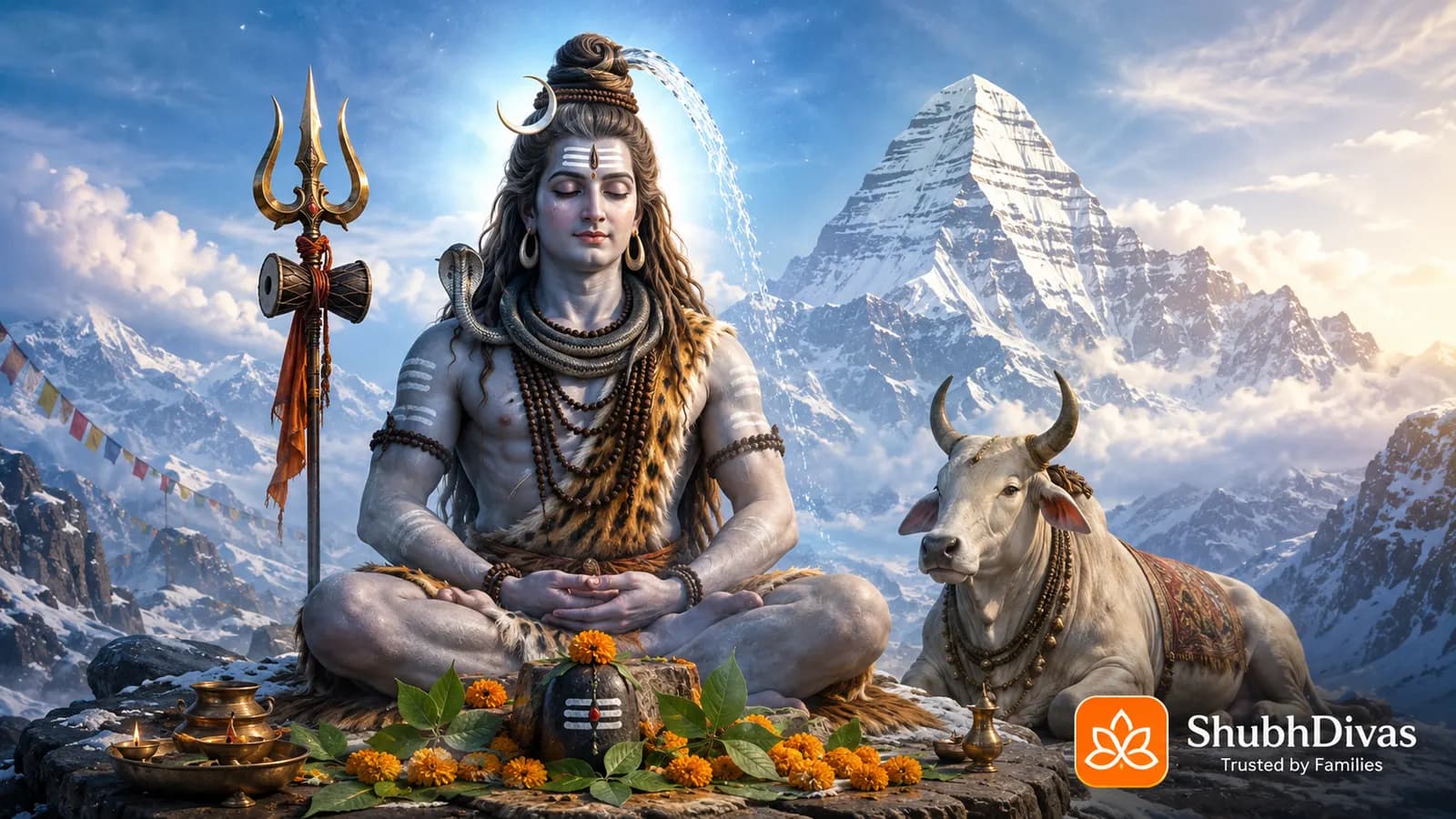

Mahesh Navami 2026 falls on Tuesday, June 23 — Jyeshtha Shukla Navami, the ninth day of the bright fortnight of the Jyeshtha lunar month. It is the annual festival dedicated to Lord Shiva in his form as Mahesh (Mahadeva — the supreme deity), observed with deep devotion especially by the Maheshwari community of Rajasthan, Madhya Pradesh, and the trading communities of Central India.
For the Maheshwari community, Mahesh Navami is more than a festival — it is their community's origin day. The legend holds that the Maheshwari varna came into existence on this day through Lord Shiva's grace. Mahesh Navami is therefore both a devotional occasion for all Shiva worshippers and a community new year for the Maheshwaris.
Mahesh Navami 2026 — Key Details
| Detail | Information |
|---|---|
| Date | Tuesday, June 23, 2026 |
| Tithi | Jyeshtha Shukla Navami |
| Navami begins | 3:39 PM, June 22, 2026 |
| Navami ends | 4:39 PM, June 23, 2026 |
| Day | Tuesday (Mangalvar — auspicious for Shiva worship) |
| Observed by | All Shiva devotees; especially Maheshwari community |
The Navami tithi is fully in force on June 23, making it the primary observance day.
The Legend — How the Maheshwari Community Was Born
Two intertwined stories explain the origin of Mahesh Navami and the Maheshwari community:
The Story of the 72 Hunters:
In ancient times, a group of Kshatriya hunters, by some accounts seventy-two in number, were living a life of violence — hunting animals and causing distress to sages who meditated in the forests. The rishis (sages) grew weary of the disruption. They cursed the hunters, turning them to stone.
The wives of the hunters — innocent of their husbands' transgressions — were grief-stricken. They prayed intensely to Lord Shiva. Shiva, moved by their devotion and the righteousness of their plea, appeared before them. He offered to reverse the curse on one condition: the hunters would have to give up hunting completely and take up a peaceful livelihood instead. The women agreed on their husbands' behalf.
Shiva released the hunters from the stone. The families, grateful for their deliverance and bound by their promise, turned to trade and business. To honour Lord Shiva who saved them, they named their community after him — Mahesh (one of Shiva's names) became the root of Maheshwari. The day this happened — Jyeshtha Shukla Navami — became the community's founding day.
The Story of King Khandelson:
A parallel legend tells of a Maheshwari king named Khandelson who was devoted to Lord Shiva but had no children. He and his queen performed intense puja and fasting on Jyeshtha Shukla Navami, praying to Shiva for a child. Lord Shiva appeared and granted them a son. The king's gratitude established the festival as an annual observance for the community — both as thanksgiving for the blessing received and as an invitation for Shiva's grace in every subsequent year.
Both legends share a common thread: Lord Shiva appearing on this day to grant the sincere requests of his devotees. This is why the day is called Mahesh Navami — the ninth tithi on which Mahesh (Shiva) manifested himself.
Who Are the Maheshwaris
The Maheshwari community is a Hindu business caste concentrated primarily in Rajasthan (Jodhpur, Bikaner, Nagaur, Barmer), Madhya Pradesh (Indore, Ujjain), and Maharashtra (Nagpur, Pune). They have historically been traders, bankers, and merchants — following the promise made to Shiva to pursue commerce rather than violence.
The community is known for its philanthropic institutions — hospitals, educational trusts, and cultural organisations — many of which were established in Shiva's name and carry the Mahesh prefix. Mahesh Navami is the day when these institutions are often inaugurated, renewed, or rededicated.
While Mahesh Navami is the Maheshwari community's central festival, the observance is not limited to them. Shaivite Hindus across caste and region observe the day as a general Shiva festival — Jyeshtha Shukla Navami is an auspicious tithi for Shiva worship regardless of community.
Rituals and Puja Vidhi
Early morning:
- Wake before sunrise and take a bath
- Wear clean, traditional clothes — white or yellow is preferred
- Decorate the home puja space with flowers; set up an idol or image of Lord Shiva, Parvati, and Ganesha
Morning puja:
- Ganesh Puja first — Ganesha is always invoked before any auspicious beginning
- Rudraabhishekam — the central ritual of Mahesh Navami. The Shivalinga is bathed with Panchamrit (milk, curd, ghee, honey, sugar water), then with plain water, then with bilva and flower offerings. For elaborate puja, the Rudra Ashtadhyayi or Sri Rudram is chanted during the abhishekam
- Bilva Archana — offer bilva leaves with each of the 108 names of Shiva (Shivaashtottara)
- Dhupa, Deepa, Naivedya — incense, lamp, and food offering. Traditional sweets associated with this festival: peda, kheer, and dry fruit sweets
- Pradakshina and Namaskara — circumambulate the Shivalinga or puja image
Community observances:
- Bhajan Sandhya — evening devotional singing sessions held at temples and community halls, running for several hours. The bhajans focus on Shiva stotras, Mahamrityunjaya Mantra, and community songs that tell the Maheshwari origin story
- Yajna (Havan) — fire ritual performed at community temples, with offerings to Shiva
- Annadanam — distribution of food to all present, as thanksgiving for Shiva's grace
- Aarti — formal arati at temple in the evening, with full distribution of prasad
- Newly married couples perform special puja together on this day, inviting Shiva's blessing on the household
Fasting on Mahesh Navami
A day-long fast is observed by many devotees, particularly women praying for children or for the well-being of their households. The fast rules:
- No grains or pulses until after the evening puja
- Fruits, milk, curd, and water are permitted
- The fast is broken after the Bhajan Sandhya and arati, with prasad as the first intake
Women who observe this fast for the specific blessing of a child traditionally fast nirjala (without water) until the evening abhishekam.
Mahesh Navami at Major Temples
Rajasthan:
- Maheshwar Mandir, Jodhpur — community ceremonies with Rudraabhishekam from 5 AM; large community gathering
- Shiva temples in Bikaner and Nagaur — Bhajan Sandhyas that run past midnight with hundreds attending
Madhya Pradesh:
- Mahakaleshwar, Ujjain — while the main festival at Mahakaleshwar is Maha Shivaratri, Mahesh Navami sees special puja by Maheshwari families from Ujjain and Indore
- Omkareshwar — one of the twelve Jyotirlingas; Mahesh Navami is an occasion for special darshan here
Maharashtra:
- Community Bhajan Sandhyas in Nagpur, Amravati, and Pune's Maheshwari localities
Mahesh Navami in Context — Other Shiva Festivals of June 2026
June 2026 is notable for its concentration of Shiva-related observances:
- June 12 — Shukra Pradosh Vrat (Jyeshtha Krishna Trayodashi)
- June 23 — Mahesh Navami (Jyeshtha Shukla Navami)
- June 27 — Shani Pradosh Vrat (Jyeshtha Shukla Trayodashi)
The Shukla Paksha period from approximately June 14 to June 28 in the Jyeshtha month is considered particularly auspicious for Shiva worship. Mahesh Navami falls at the midpoint of this ascending lunar fortnight — the ninth day — which is associated with spiritual power and divine manifestation across many traditions.
Check today's Rahu Kaal
Precise panchanga for your city — Rahu Kaal, tithi, nakshatra, sunrise, and more calculated accurately.
Free · Updated daily
Frequently asked questions
Find your auspicious muhurat
Personalised Vedic muhurat for your wedding, property, vehicle, or ceremony — reviewed by Acharya Suryakanth Subramaniam.
Find Muhurat →