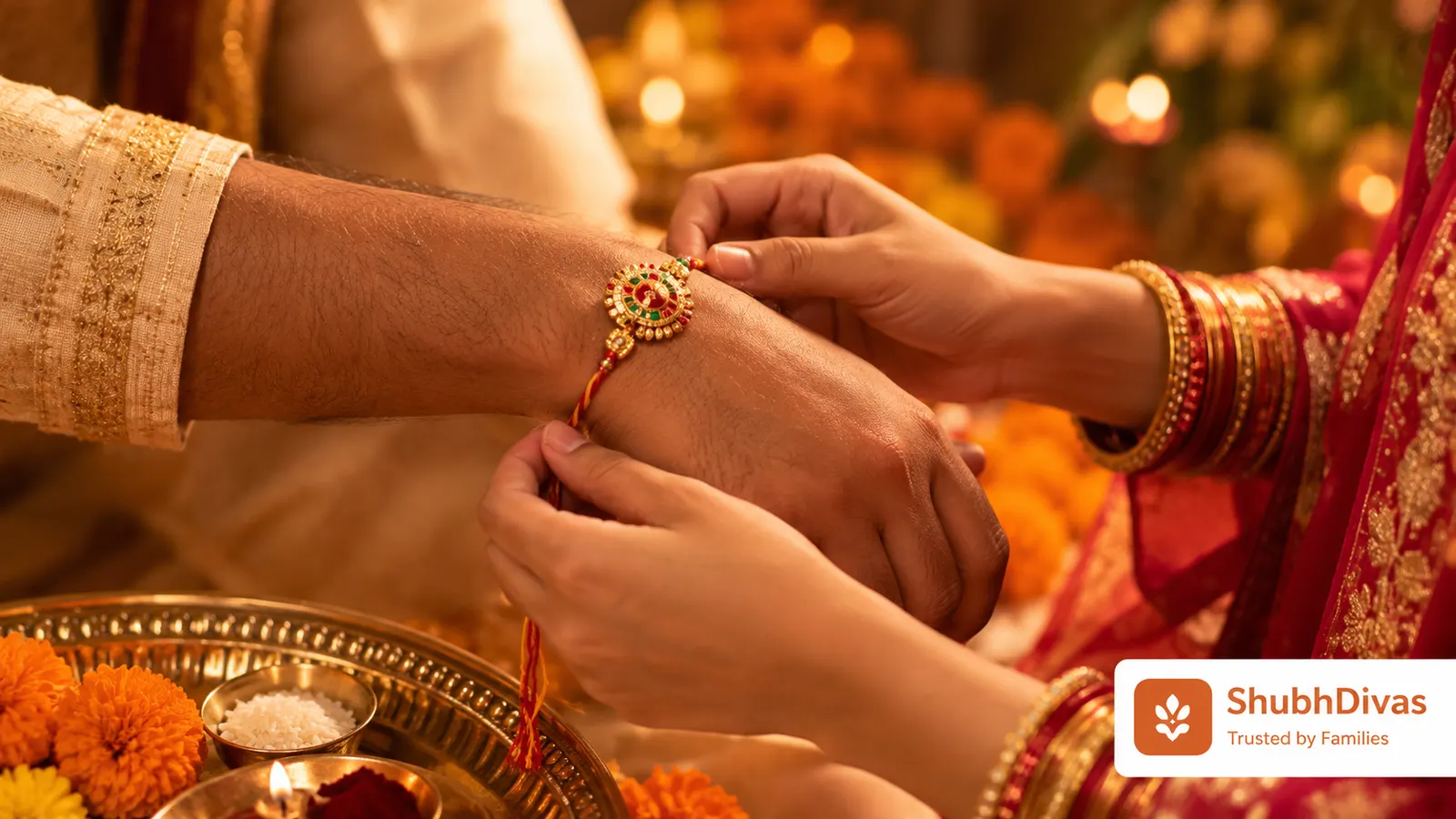

Raksha Bandhan 2026 falls on Friday, August 28 — Shravan Purnima, the full moon of the Shravan lunar month. This is the day a sister ties a Rakhi — a sacred thread — on her brother's wrist, prays for his long life and well-being, and receives in return his promise of lifelong protection. The festival is among the most widely observed in India, cutting across regional, linguistic, and sectarian boundaries in a way that very few Hindu festivals do.
But Raksha Bandhan is not simply a matter of the date. When the Rakhi is tied on August 28 matters as much as the fact that it is tied at all. The morning carries a Bhadra period — a calendrical window considered deeply inauspicious — during which the Rakhi must not be tied. Understanding the Bhadra, knowing when it ends, and tying the Rakhi in the correct auspicious window is the difference between the ritual carrying its full weight and performing it at a time the tradition explicitly cautions against.
Raksha Bandhan 2026 — Key Details
| Detail | Information |
|---|---|
| Date | Friday, August 28, 2026 |
| Tithi | Shravan Shukla Purnima (Full Moon) |
| Day | Shukravar (Friday) |
| Festival | Raksha Bandhan / Rakhi |
| Also observed as | Shravan Purnima, Narali Purnima (coastal Maharashtra), Kajari Purnima (MP, UP), Pavitropana (Gujarat) |
| Bhadra period | Morning hours of August 28 — verify exact end time for your city |
| Auspicious Rakhi window | After Bhadra ends through sunset |
| Most sacred Rakhi time | Aparahna Muhurat (afternoon) |
Exact Bhadra end time varies by location. Verify with a local panchanga for your city.
The Bhadra — Why Morning Rakhi Is Prohibited
The single most important timing rule for Raksha Bandhan is the avoidance of Bhadra. Every year, without exception, the most common mistake families make is tying the Rakhi too early in the morning during a Bhadra window — often unknowingly.
Bhadra (also called Vishti Karana) is one of the eleven Karanas in the Hindu lunar calendar — each Karana occupying half a lunar day. Bhadra is considered the most inauspicious of these windows, associated with delay, obstruction, and harm to the undertaking performed during it. In the Puranas and classical Jyotish texts, Bhadra is personified as the daughter of the Sun — a fierce presence who was placed by Brahma in the lunar calendar specifically to deter humans from performing sacred acts during her period.
For Raksha Bandhan, the ancient texts are explicit: a Rakhi tied during Bhadra brings harm to the brother. This is not a minor superstition — it is a serious calendrical rule that traditional families, particularly in Rajasthan, Gujarat, and Uttar Pradesh, follow strictly. The sister waits, no matter how inconvenient, until Bhadra has passed.
In 2026, Purnima tithi begins on August 27 evening and extends into August 28. The Bhadra period falls in the morning hours of August 28. Depending on your city, Bhadra ends somewhere in the mid-morning. After Bhadra ends, the full day is open for Rakhi tying — through the afternoon and until sunset.
For your precise Bhadra end time in your city, consult a local panchanga or a Jyotish calendar for August 28, 2026.
Auspicious Windows — When to Tie the Rakhi
After Bhadra ends on August 28, three windows carry different levels of auspiciousness:
Aparahna Muhurat — the most auspicious The Aparahna (afternoon) period — roughly from approximately 1:30 PM to 3:30 PM in most of India — is considered the most sacred time for Raksha Bandhan in the classical tradition. Aparahna is the period of the day associated with Vishnu and with completion; what is given in Aparahna carries the quality of permanence. If only one time can be chosen, choose the Aparahna window.
Pradosh Kaal — second choice The Pradosh period — the first 2.5 hours after sunset — is also considered auspicious for Rakhi tying in traditions where the afternoon was not possible. Some families with brothers working far away or in different time zones use this evening window.
Post-Bhadra morning through noon Once Bhadra ends, the remaining morning and noon hours are valid for Rakhi — not the most auspicious, but correct. Families where brothers are travelling or where logistics require an early completion can use this window without concern.
What to avoid absolutely:
- The Bhadra period in the morning — no exceptions in the traditional view
- After sunset without a specific Pradosh window
The Story Behind Raksha Bandhan
The festival has multiple mythological origins, each illuminating a different dimension of what the Rakhi thread means.
Indra and Sachi — the oldest account The Bhavishya Purana narrates an early version: in an ancient war between the gods and the asuras, Indra's army was losing. Sachi, Indra's wife, took a sacred thread that had been charged with Vedic mantras and tied it on Indra's wrist on the Shravan Purnima. Indra won the battle. The thread was not ornamental — it was protective, carrying the energy of prayer and devotion woven into a physical object. From this account comes the essential logic of Raksha Bandhan: a thread charged with the power of love and prayer, tied with intention, confers protection.
Draupadi and Krishna The Mahabharata records that when Krishna's finger was cut during the Shishupal episode, Draupadi immediately tore a strip from her silk saree and tied it around Krishna's finger to stop the bleeding. Krishna, moved by this act of spontaneous care, promised her lifelong protection — a promise he fulfilled in the Kaurava court when Draupadi was being humiliated and Krishna sent an endless supply of cloth to protect her dignity. This account establishes Raksha Bandhan as a bond of mutual care that transcends blood relation — the sister-brother bond is defined by reciprocal devotion, not merely biological connection.
Yama and Yamuna A third account from the Puranas: Yamuna, the river goddess, tied a Rakhi on the wrist of Yama, the god of death and her own brother. So moved was Yama that he declared: any brother on whom a Rakhi is tied on Shravan Purnima will be granted liberation from the fear of death. This account is the theological foundation for the custom of praying for the brother's long life — the sister is invoking the same relationship that Yamuna established with Yama himself.
The historical layer — Rani Karnavati and Humayun In the sixteenth century, Rani Karnavati of Mewar, facing an invasion she could not repel, sent a Rakhi to the Mughal emperor Humayun — appealing to the sacred bond to compel his military aid. Humayun, though Muslim and technically an adversary, was so moved by the Rakhi that he immediately marched toward Mewar. He arrived too late to prevent the tragedy — Karnavati had already performed Jauhar — but his acceptance of the Rakhi and his response to it demonstrates how deeply the custom's power was understood across religious lines. The Rakhi was not merely a Hindu ritual object; it was a recognised bond with social and political force.
The Rakhi Thread — What It Is and What It Carries
The word Raksha means protection. Bandhan means bond. Raksha Bandhan is literally the bond of protection — a physical thread that encodes a relationship and a promise.
In its simplest form, a Rakhi is a thread — a few strands of cotton or silk, red and gold in the most traditional form. In this form, it is closest to the original protective thread described in the Vedic sources: a raksha sutra or mauli thread, twisted with specific intention and tied with specific mantras. The thread is not the decoration — the thread is the vehicle. What matters is the prayer woven into the act of tying.
Modern Rakhis range from simple cotton threads to elaborate decorative pieces with beads, stones, and gold wire. The tradition does not privilege the expensive over the simple. The Rakhi that carries the most power is the one tied with the most sincerity.
What the Rakhi thread is understood to carry:
- The sister's prayer for her brother's long life, health, and protection from harm
- A visible mark of a specific relationship and its obligations
- In the classical understanding, the accumulated shakti of the sister's devotion — a real protective force that the Vedic tradition understands as transferable through a physical medium
The brother's role is equally specific: accepting the Rakhi is accepting the obligation. He promises protection — not merely as sentiment but as a commitment that the tradition takes seriously. In the ritual, this promise is made verbally at the moment the Rakhi is received.
Puja Vidhi — The Complete Raksha Bandhan Ritual
Preparation (morning of August 28):
- Both brother and sister bathe in the morning and wear fresh, clean clothes — traditionally, sisters wear red or bright colours; the brother wears dhoti or kurta
- Prepare a puja thali (plate) containing: Rakhi threads, kumkum (vermilion), roli (red powder), akshat (uncooked rice), a diya (oil lamp or ghee lamp), sweets (mithai), and a small cloth or clean surface to rest the thali
Setting up the puja space: Place the puja thali before a lamp that has been lit. Some families include a small idol of Lord Ganesha or a deity of the household tradition — the puja begins with the deity before it moves to the brother. Apply kumkum and akshat to the idol first.
The Rakhi tying ritual — performed only after Bhadra ends:
- The brother sits facing east
- The sister applies a tilak of kumkum and roli to the brother's forehead
- She places akshat (rice grains) on the tilak
- She waves the lit diya before the brother in a small aarti gesture — praying for his long life
- She ties the Rakhi on his right wrist while reciting the Raksha Bandhan mantra:
Yena baddho Balee raajaa daanavendro mahaabalah Tena tvaam anubadhnaami rakshe maa chala maa chala
Translation: With the same bond with which the mighty demon king Bali was bound, I bind you with this thread. O protection, do not waver, do not waver.
- She offers sweets — places a piece of mithai in the brother's mouth
- The brother gives his gift or shagun (money, gold, or a chosen present) to the sister and speaks his promise of protection
After the ritual: The family performs a brief puja together — lighting incense, offering flowers to the household deity, praying for the well-being of all family members. In many traditions, the sister also touches her brother's feet after the Rakhi is tied, and he blesses her in return.
The Puja Thali — What Goes on It
The puja thali for Raksha Bandhan carries specific items, each with a purpose:
| Item | Purpose |
|---|---|
| Rakhi thread | The central offering — the bond itself |
| Kumkum and Roli | Tilak applied to the brother's forehead — mark of honour and prayer |
| Akshat (uncooked rice) | Symbol of abundance and blessing |
| Diya (oil or ghee lamp) | The aarti wave before the brother |
| Sweets (mithai) | Fed to the brother — sweetness and prosperity |
| Coconut | Offered to the deity; some families include it in the thali |
| Durva grass | In some traditions, placed alongside the tilak |
The thali is first assembled, then placed before the household deity for a brief prayer before being brought to the brother.
Regional Variations — One Festival, Many Forms
Shravan Purnima is observed differently across India, though the common thread — Rakhi — is present almost everywhere:
North India (UP, Bihar, Rajasthan, Punjab, MP): The Rakhi ritual is the primary observance. The Bhadra rule is followed most strictly here. Sisters fast partially until the Rakhi is tied. The brother's gift (shagun) is expected and is often substantial.
Maharashtra — Narali Purnima: Coastal communities, particularly fishermen, celebrate this as Narali Purnima — the day they offer a coconut (naral) to the sea, mark the end of the monsoon fishing ban, and resume deep-sea fishing. The coconut offering to the sea is performed before the Rakhi ritual.
Rajasthan — Ramraksha and Shravani: Brahmins observe this day as Shravani — the annual thread renewal ceremony (Upakarmam), where the sacred thread (Yagnopavit/Janeu) is replaced. The old thread is ritually discarded, a new one sanctified and worn. This is the original Vedic observance from which Raksha Bandhan evolved.
Gujarat — Pavitropana: A specific Shaiva observance on this day, where sacred threads (Pavitraka) are offered to Shiva idols. Gujarat also observes the Rakhi custom alongside.
South India — Avani Avittam: In Tamil Nadu and Kerala, Brahmin men observe Avani Avittam — the same sacred thread renewal ceremony as Shravani in the north — on this day. Upakarmam (the Vedic recitation ceremony) follows. Rakhi as a sibling festival is less central in South India, though it is increasingly observed.
What the Festival Teaches
Raksha Bandhan is unusual among Hindu festivals in that its central act is a transfer of protection — from the divine, through the sister's prayer, to the brother, encoded in a thread. The sister is not a passive figure in this transaction. She is the one who charges the thread with intention, who performs the aarti, who speaks the mantra. The protection flows through her devotion.
The Vedic understanding of a raksha sutra is that it is not merely symbolic. A thread tied with genuine prayer and intention becomes a real vehicle of protective energy — the same principle behind the Yagnopavit, behind the nazar dhaga, behind the red thread tied on wrists at temples. The physical thread becomes a carrier of the prayer embedded in it.
For families that observe Raksha Bandhan with full ritual — the puja thali, the tilak, the mantra, the Aparahna timing — this is not sentiment dressed as religion. It is a complete Vedic protective ritual, distilled into a gesture of love between a brother and a sister, performed once a year on the most auspicious full moon of the monsoon.
Check today's Rahu Kaal
Precise panchanga for your city — Rahu Kaal, tithi, nakshatra, sunrise, and more calculated accurately.
Free · Updated daily
Frequently asked questions
Find your auspicious muhurat
Personalised Vedic muhurat for your wedding, property, vehicle, or ceremony — reviewed by Acharya Suryakanth Subramaniam.
Find Muhurat →