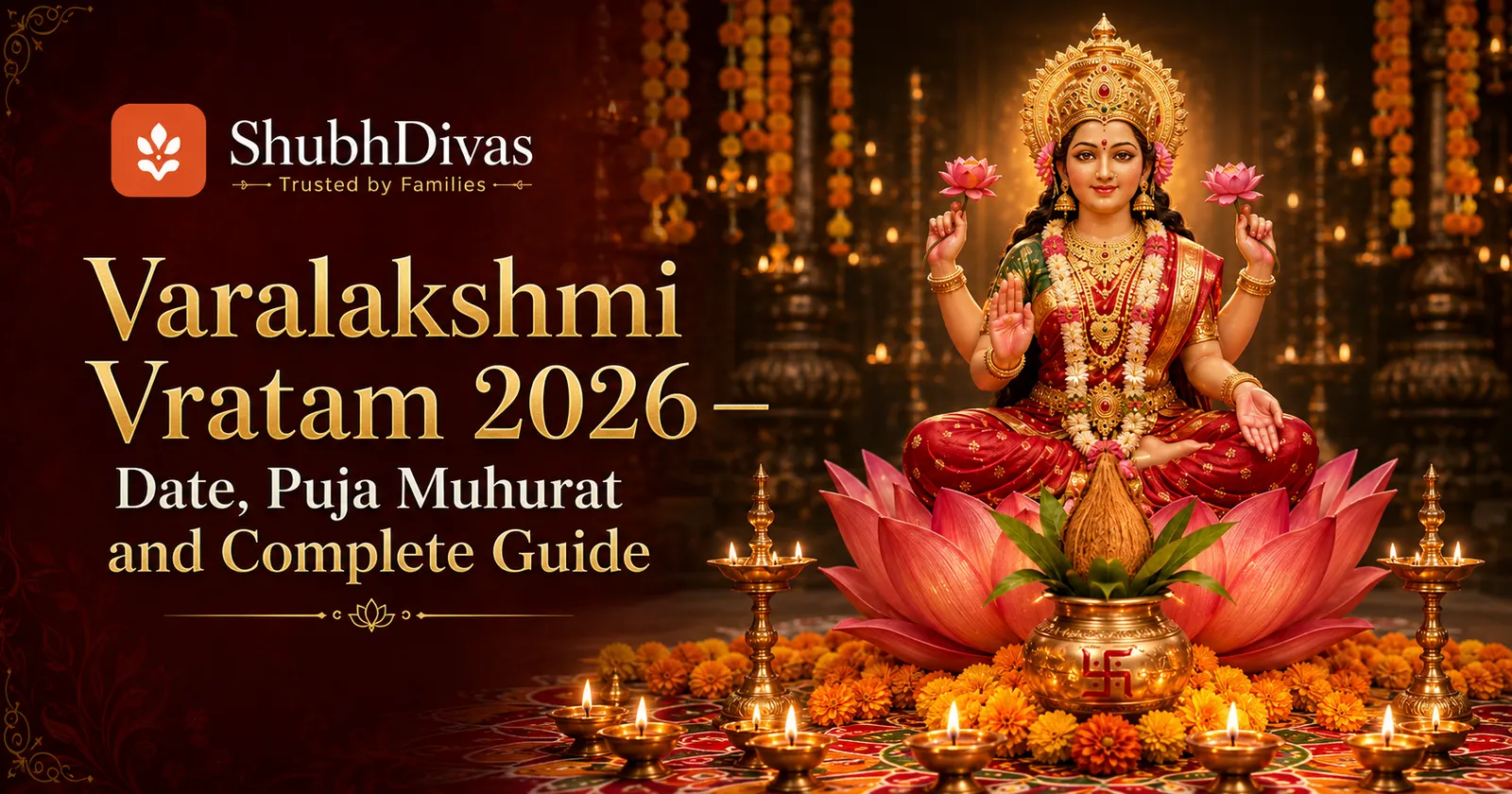

Varalakshmi Vratam 2026 falls on Friday, August 28. This is the last Friday of Sravana Shukla Paksha — the observance day determined each year by the lunar calendar, always a Friday in the bright fortnight of the Sravana month, closest to Sravana Purnima.
The festival is observed with particular devotion in Karnataka, Andhra Pradesh, Telangana, Tamil Nadu, and Maharashtra. Married women fast, prepare the Kalasha, and perform puja to Goddess Varalakshmi — an aspect of Mahalakshmi who is said to bestow all eight forms of Lakshmi's blessings on her devotees.
Varalakshmi Vratam 2026 — Date and Muhurat
| Event | Details |
|---|---|
| Date | Friday, August 28, 2026 |
| Paksha | Sravana Shukla Paksha |
| Simha Lagna Muhurat (Morning) | 06:02 AM to 07:26 AM |
| Vrishchika Lagna Muhurat (Afternoon) | 11:41 AM to 01:55 PM |
| Kumbha Lagna Muhurat (Evening) | 05:52 PM to 07:30 PM |
| Vrishabha Lagna Muhurat (Night) | 10:51 PM to 12:51 AM (Aug 29) |
The evening Kumbha Lagna window overlapping with Pradosh Kaal (the twilight hour) is widely considered the most auspicious for the primary puja. Most families perform the Kalasha worship at this time.
Muhurat timings above are for South Indian cities (Hyderabad/Bengaluru). Minor variation (±5–10 minutes) applies for Chennai, Mysuru, and other locations.
Why August 28 in 2026 — How the Date Is Calculated
Varalakshmi Vratam is not on a fixed calendar date. The rule is: the last Friday of Sravana Shukla Paksha — the bright fortnight of the Sravana (Shravana) lunar month.
In 2026, Sravana Purnima (also Raksha Bandhan) falls on Friday, August 28 itself. This means the last Friday of Sravana Shukla Paksha and Sravana Purnima coincide — making this an especially auspicious Varalakshmi Vratam. The Purnima tithi (full moon) is active on the Vratam day, which amplifies the significance of the puja.
Note on incorrect dates circulating online: Some websites show August 8, 2026 for Varalakshmi Vratam. This is wrong — August 8, 2026 is a Saturday, not a Friday, and it falls outside Sravana Shukla Paksha. August 8 was the correct date for 2025, not 2026.
About Goddess Varalakshmi
Varalakshmi is an aspect of Goddess Mahalakshmi, the consort of Lord Vishnu. Vara means boon; Lakshmi is the goddess of wealth and prosperity. Varalakshmi is the goddess who bestows boons — she grants what her devotees sincerely ask for.
The tradition holds that worshipping Varalakshmi on this day is equivalent to worshipping all eight Ashtalakshmi — the eight forms of Lakshmi who govern different dimensions of prosperity:
- Adi Lakshmi — primordial abundance
- Dhana Lakshmi — monetary wealth
- Dhanya Lakshmi — abundance of food and grain
- Gaja Lakshmi — elephants, power, and freedom from debts
- Santana Lakshmi — blessings of children
- Veera Lakshmi — courage and inner strength
- Vijaya Lakshmi — victory over obstacles
- Vidya Lakshmi — knowledge and wisdom
The Kalasha — What It Represents and How to Prepare It
The central object of Varalakshmi Vratam is the Kalasha — a pot that embodies the goddess herself. The pot is filled with symbolic items and decorated so that the goddess is installed within it for the duration of the puja.
What goes into the Kalasha:
- A clean brass or silver pot (or a new earthen pot)
- Unbroken raw rice filling the pot
- A coin placed inside
- Turmeric, kumkum (vermilion), and betel leaves
- A coconut placed at the mouth of the pot, smeared with turmeric
- Mango leaves arranged in a circle under the coconut
- A Swastika symbol drawn on the pot in turmeric or kumkum
How the pot is decorated: The exterior of the pot is coated with sandalwood paste and turmeric. Silk cloth (typically red or yellow, associated with Lakshmi) is tied around it. The face of the goddess may be drawn or a printed face affixed to the pot. Fresh flowers are used to adorn the entire setup.
The Kalasha is placed on a raised platform (peetham) covered with a clean cloth, with a small heap of raw rice underneath. This is the seat of the goddess for the day.
The Puja — What Happens on Varalakshmi Vratam Day
The night before (Thursday, August 27): The women who will observe the vrat fast or eat only one meal. The house is cleaned and the puja area prepared. Some families apply rangoli at the threshold.
Dawn on Friday (August 28): Devotees wake before sunrise and take an early head bath — this is a mandatory ritual purification before the puja. The home is cleaned, the rangoli freshened.
Morning puja (optional — Simha Lagna): The formal puja can begin in the Simha Lagna window (around 6 AM). Many families with early work schedules or with children going to school use this window.
Evening puja (most auspicious — Kumbha Lagna): Most families observe the primary worship in the evening, in the Pradosh window. The sequence is:
- Ganapati puja — Ganesha is always worshipped first, to remove obstacles from the puja
- Kalasha installation — the decorated pot is placed and the goddess invoked
- Shodashopachara — sixteen standard offerings (water, flowers, incense, lamp, food, etc.)
- Varalakshmi Ashtottara — 108 names of Varalakshmi recited
- Arati — lamp waving with the camphor flame
- Mantapa — the Kalasha is taken in procession around the house
- Prasad distribution — boiled legumes (sundal), pongal, and jaggery sweets are distributed
The yellow thread: Women tie a yellow or gold thread on their wrist during the puja — this is the Maangalya sutra thread, symbolising the protection of the marital bond and the husband's well-being. The thread is worn until it naturally falls off.
The gift exchange: Married women visit each other's homes with small gifts (typically blouses, fruits, coconuts, and puja items). The gathering of women is itself a part of the festival's social and devotional fabric.
Saturday morning (August 29) — Udyapana: The vrat formally concludes the next morning. After a bath, the Kalasha is dismantled, and the items inside are distributed as prasad. A final puja is performed to close the observation.
Who Observes Varalakshmi Vratam
The vrat is observed primarily by married women in Karnataka, Andhra Pradesh, Telangana, Tamil Nadu, and parts of Maharashtra and Uttar Pradesh. It is a personal vow made for the well-being of the husband, children, and household.
Unmarried women also observe the vrat in some families, seeking blessings for a good marriage. Men can observe it as well, though this is less common outside of specific communities.
In Andhra Pradesh and Telangana, the festival is particularly significant in areas where Vaishnavite traditions are strong. In Karnataka, it is one of the most widely observed festival observances of the year — most households in Bengaluru, Mysuru, Mangaluru, and Udupi districts observe it.
Varalakshmi Vratam and Sravana Purnima in 2026
In 2026, Varalakshmi Vratam (August 28) falls on the same day as Sravana Purnima — Raksha Bandhan. This is unusual and considered very auspicious: the full moon of the Sravana month, sacred to Lord Vishnu and Shiva, shines on the same day as Lakshmi's special vrat.
Families who observe both will perform the Varalakshmi puja in the morning or afternoon, and the Rakhi tying ritual in the evening or whenever siblings are gathered. The two observances are distinct and can be performed on the same day.
Check today's Rahu Kaal
Precise panchanga for your city — Rahu Kaal, tithi, nakshatra, sunrise, and more calculated accurately.
Free · Updated daily
Varalakshmi Vratam Prasad — What to Prepare
Traditional prasad items for Varalakshmi Vratam:
- Sundal — boiled chickpeas or black-eyed peas seasoned with coconut, mustard, and curry leaves
- Pongal — sweet rice cooked with jaggery and ghee (chakkarai pongal / bellam pongal)
- Kajjaya / Karjikaya — deep-fried pastry filled with jaggery and coconut
- Panakam — a drink of jaggery, cardamom, and water
- Kosambari — soaked moong dal salad with cucumber and coconut (Karnataka)
These are prepared fresh on the morning of August 28. The emphasis is on jaggery-sweetened items — Lakshmi is associated with sweetness and abundance.
Frequently asked questions
Find your auspicious muhurat
Personalised Vedic muhurat for your wedding, property, vehicle, or ceremony — reviewed by Acharya Suryakanth Subramaniam.
Find Muhurat →