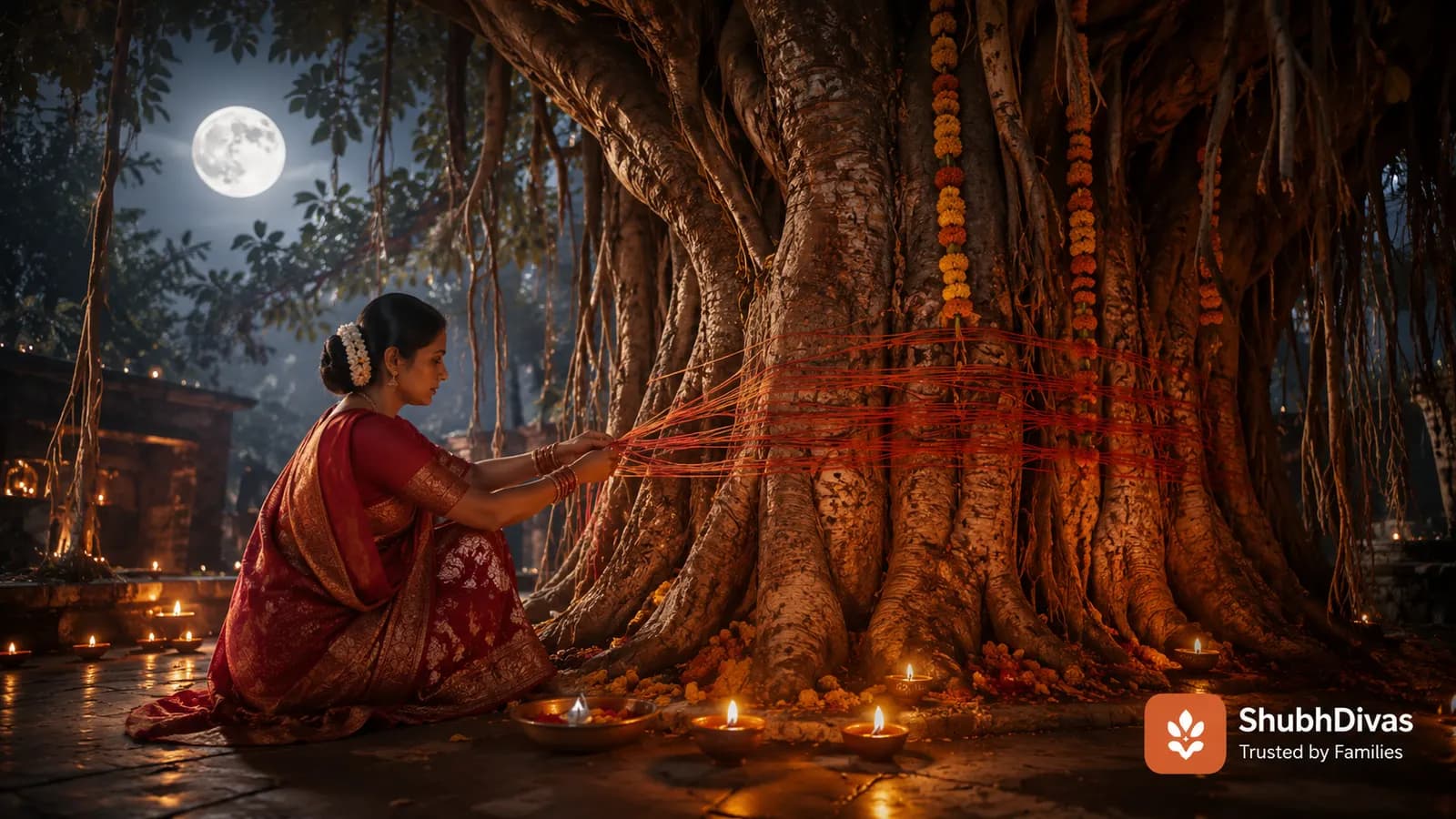

Vat Purnima 2026 falls on Monday, June 29 — Jyeshtha Purnima, the full moon of the Jyeshtha lunar month. This is the day when women in Maharashtra, Gujarat, and Goa observe the Savitri vrat — fasting, worshipping the banyan tree, and tying the sacred thread around its trunk in the tradition of Savitri, who won back her husband Satyavan from the god of death.
The story is the same as Vat Savitri Amavasya observed two weeks earlier in North India — but the calendar is different. Maharashtra and Gujarat follow the Amanta lunar calendar (month ends at new moon), placing Jyeshtha Purnima on June 29 as the vrat day.
Vat Purnima 2026 — Key Details
| Detail | Information |
|---|---|
| Date | Monday, June 29, 2026 |
| Tithi | Jyeshtha Purnima (Full Moon) |
| Purnima begins | 3:06 AM, June 29 |
| Purnima ends | 5:26 AM, June 30 |
| Observed in | Maharashtra, Gujarat, Goa |
| Also known as | Savitri Amavasya (in the regional calendar context), Vat Savitri Purnima |
Note on calendar difference: North Indian states (Uttar Pradesh, Bihar, Madhya Pradesh, Punjab) observed Vat Savitri on June 14 (Jyeshtha Amavasya). The Maharashtra/Gujarat version on June 29 is the same festival, fifteen days later, because the two calendar traditions define the Jyeshtha month differently.
The Story of Savitri and Satyavan
The Vat Purnima vrat is inseparable from one of the most celebrated stories in the Mahabharata — the story of a princess whose intellect and love were stronger than death itself.
Savitri was the daughter of King Ashwapati — a woman of extraordinary intelligence and determination. When no suitable match was found for her, she was sent to find her own husband. She chose Satyavan — a gentle, principled prince living in exile in the forest with his blind, dispossessed father. He had no wealth, no kingdom, and no prospects.
But there was a problem. The sage Narada told Savitri's father that Satyavan was marked for death — he would die exactly one year from that day. Her father begged her to choose someone else. Savitri refused. She had decided.
She married Satyavan and lived in the forest with him. She counted the days. On the anniversary — a Jyeshtha Purnima in the tradition followed by Maharashtra and Gujarat — Satyavan went into the forest to gather wood. Savitri followed him. He collapsed under a banyan tree. She held his head in her lap.
Then Yama arrived — the god of death, dark-robed, carrying his noose. He bound Satyavan's soul and began walking south. Savitri followed.
Yama tried to send her back. She kept walking.
Impressed by her devotion, Yama offered her three boons — anything except Satyavan's life. Savitri asked for her father-in-law's sight. Then for her father's hundred sons. Then — and this was the brilliance — for a hundred sons for herself.
Yama granted it. Then understood that he had made it impossible to keep his grant without returning Satyavan. He released the soul.
This is why the banyan tree is at the centre of the vrat. This is what Savitri returned to every year in the tradition's imagination — to that tree where death came and left without its prize.
What Makes Vat Purnima Different from Vat Savitri Amavasya
Both festivals honour the same story and use the same ritual form. The differences are:
| Feature | Vat Savitri Amavasya (North India) | Vat Purnima (Maharashtra/Gujarat) |
|---|---|---|
| Date 2026 | June 14 (Amavasya) | June 29 (Purnima) |
| Tithi | New moon | Full moon |
| Calendar | Purnimanta | Amanta |
| Dress | Red or yellow saree | Nine-yard Nauvari saree (Maharashtra) |
| Community | UP, Bihar, MP, Punjab, Rajasthan | Maharashtra, Gujarat, Goa |
The full moon on June 29 adds a particular luminosity to the day — the Purnima tithi is associated with fulfilment and completion, making the vrat's prayer for a husband's long life feel especially aligned with the day's cosmic mood.
The Nauvari Saree — Maharashtra's Vat Purnima Tradition
One of the most distinctive aspects of Vat Purnima in Maharashtra is the Nauvari saree (nine-yard saree). Married women wear this traditional drape for the banyan tree puja — it is the attire worn by Maharashtrian women at the most important ceremonies of their lives.
The nine yards are draped differently from the standard six-yard saree: pulled between the legs and tucked at the back (called the Kashtha or Lugade style), it allows greater mobility and is associated with the working, active tradition of Maharashtrian women. Wearing the Nauvari on Vat Purnima is an assertion of cultural identity alongside devotional intent.
For women who have not been taught this draping, the six-yard saree in red, orange, or deep yellow is fully appropriate.
Puja Vidhi — How to Observe Vat Purnima
The evening before (June 28):
- Prepare puja materials: mauli thread (red-yellow sacred thread), flowers, kumkum, turmeric, incense, a lamp, water in a pot, fruits, and sweets
- Some women soak mango leaves or banyan leaves overnight
- Fast begins at sunrise on June 29 (some women begin at sunset on June 28)
Morning of June 29:
- Early bath — before sunrise if possible. Wear the full solah shringar (sixteen adornments of a married woman): sindoor, mangalsutra, bangles, bindi, red saree
- Walk to the banyan tree — in Maharashtra this is traditionally a community event; women walk together to the nearest banyan tree, carrying decorated puja trays on their heads
- Jal arpan — pour water at the base of the banyan tree
- Turmeric and kumkum — apply to the trunk
- Flower offerings — place fresh flowers at the base and on the aerial roots
- Fruits and sweets — offer coconut, banana, and sweets
- Thread tying and parikrama — wind the sacred mauli thread around the trunk while circling the tree 5 or 7 times, chanting Savitri's prayer or "Om Namo Narayanaya" with each round
- Vrat Katha — listen to or read the Savitri-Satyavan story. This is considered essential — the vrat's merit is inseparable from the katha
- Arati — wave the lamp before the tree
- Prasad — distribute and receive prasad among the women gathered
Savitri's prayer during parikrama: Avivahita ca ya nari vidhava va bhavet sada / Satyavantam patitvena labhetat savitri vrata
Evening ritual: The fast is broken after sighting the moon rising on Purnima night — in Maharashtra, women show the full moon to their husbands before eating. This is the final ritual: the husband first, the moon second, then food.
Rasne (Tambulapatra Puja): In some Maharashtrian communities, women exchange Rasne — small puja trays containing betel leaves, coconut, a blouse piece, and small gifts — with each other after the banyan tree puja. This gift exchange is the social fabric of the festival.
What to Offer the Banyan Tree
The banyan tree (Ficus benghalensis, Vata Vriksha) does not require elaborate offerings — it receives the devotion, not the objects. Traditional offerings:
- Water — poured at the roots
- Red thread — wound around the trunk during parikrama; represents the bond of protection
- Kumkum and turmeric — the colours of marriage and auspiciousness
- Flowers — marigold, jasmine, or whatever is fresh
- Durva grass — offered in some traditions
- Coconut and banana — the standard sacred food offering
- A ghee or sesame oil lamp — lit and placed at the base
If no banyan tree is accessible, the puja can be performed with a banyan branch, a small banyan sapling in a pot, or an image of the Vata Vriksha. The intention carries the weight, not the object.
Why the Banyan Tree
The banyan (Ficus benghalensis) is one of the sacred trees of the Hindu tradition, alongside the peepal and ashoka. Its aerial roots descend from branches, take hold in the soil, and become new trunks — the tree expands without dying. There is no natural end point to a banyan. One ancient banyan can cover several acres, an entire forest within itself.
This quality of limitless continuation is what makes it the appropriate symbol for the vrat's prayer: that the husband's life extend as long and uninterrupted as the banyan's. Tying the thread around the trunk is tying a bond of protection around that life.
In the Mahabharata, the story locates Satyavan's death and Savitri's triumph under a banyan — not any tree, but specifically this one. The choice was not incidental.
Check today's Rahu Kaal
Precise panchanga for your city — Rahu Kaal, tithi, nakshatra, sunrise, and more calculated accurately.
Free · Updated daily
Frequently asked questions
Find your auspicious muhurat
Personalised Vedic muhurat for your wedding, property, vehicle, or ceremony — reviewed by Acharya Suryakanth Subramaniam.
Find Muhurat →