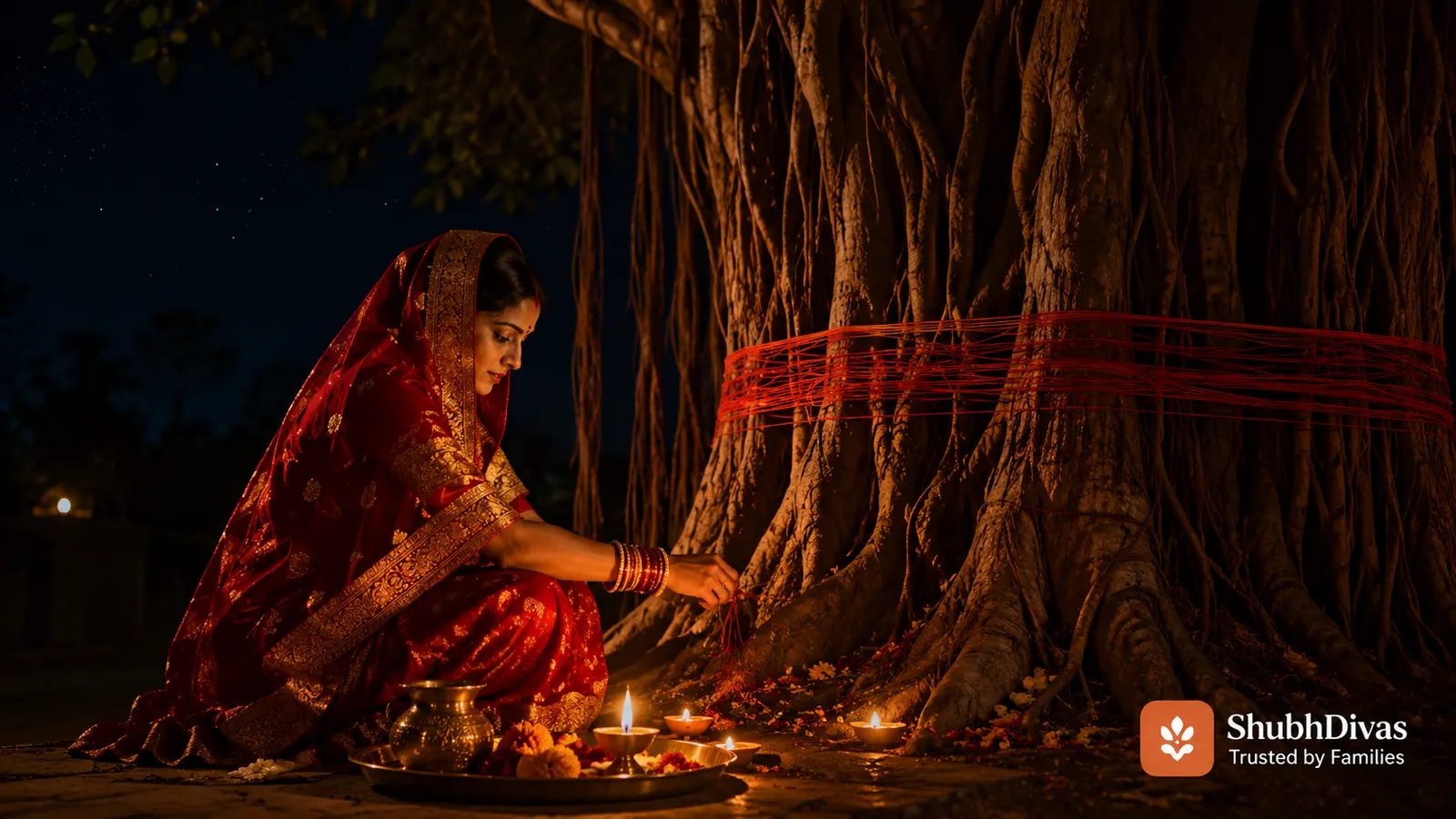

Vat Savitri Amavasya 2026 falls on Sunday, June 14 — Jyeshtha Amavasya, the new moon day of the Jyeshtha lunar month. This is the observance day followed across North India: Uttar Pradesh, Bihar, Madhya Pradesh, Punjab, Haryana, and Rajasthan. Married women fast through the day, worship the banyan tree (Vat Vriksha), tie a sacred thread around its trunk, and pray for the long life, health, and prosperity of their husbands — re-enacting the legendary devotion of Savitri, who won her husband back from the god of death.
Maharashtra and Gujarat observe a different calendar — their version, called Vat Purnima, falls on Jyeshtha Purnima: Monday, June 29, 2026. Same story, same rituals, fifteen days apart.
Vat Savitri Amavasya 2026 — Dates at a Glance
| Version | Date | States |
|---|---|---|
| Vat Savitri Amavasya | Sunday, June 14, 2026 | UP, Bihar, MP, Punjab, Haryana, Rajasthan |
| Vat Purnima (alternate) | Monday, June 29, 2026 | Maharashtra, Gujarat |
| Jyeshtha Amavasya begins | Approximately June 13 evening | — |
| Jyeshtha Amavasya ends | June 14 (during the day) | — |
The Story of Savitri and Satyavan
Vat Savitri is rooted in one of the most celebrated stories in the Mahabharata — a story about a woman whose love was strong enough to reverse the verdict of Yama, the god of death.
Savitri was a princess of extraordinary intelligence and will. Her parents were concerned — no man seemed good enough, or brave enough, for her. So Savitri was sent to find her own husband. She found Satyavan: a prince living in the forest, son of a blind king who had lost his kingdom. Satyavan was humble, gentle, and completely without wealth.
The problem: the sage Narada told Savitri's father that Satyavan would die exactly one year from that day. Her father urged her to choose someone else. Savitri refused. She knew Satyavan was the right person. She married him.
She counted the days. On the anniversary — the Jyeshtha Amavasya — Satyavan went into the forest to cut wood. Savitri followed him. Mid-morning, Satyavan collapsed at the base of a banyan tree. Savitri held his head in her lap.
Then Yama arrived. Dark, robed, with a noose — he had come to take Satyavan's soul. As he carried the soul southward, Savitri followed. Yama tried to send her back. She kept walking.
Yama, moved by her devotion and impressed by her wisdom, offered her three boons — anything except Satyavan's life. Savitri asked for her father-in-law's sight and kingdom. Then for a hundred sons for her father. Then — and this was the culmination of her strategy — for a hundred sons for herself.
Yama granted it. And then realised he could not grant Savitri sons without returning Satyavan. He released the soul.
The site where this happened — a banyan tree in the forest — is what the Vat Savitri puja commemorates each year. The banyan tree, with its roots descending from its own branches, stands as a symbol of immortality, continuity, and the eternal nature of the marital bond.
The Banyan Tree — Why It Is Central
The banyan (Ficus benghalensis, vat vriksha) is worshipped in this festival for reasons that go beyond the legend:
- Its aerial roots descend from branches and take root in the soil, allowing the tree to expand indefinitely — no natural death
- It is associated with Lord Vishnu (whose consort Lakshmi governs marital prosperity) and with the souls of ancestors
- The longevity of the banyan makes it the appropriate symbol for the wish being made: that the husband lives as long and enduringly as the tree
- The act of circling the tree while winding a thread around it is the same as tying a bond of protection around the husband's life
In areas where a banyan tree is not accessible, an idol or image of the Vat Vriksha is used for the puja instead.
Puja Vidhi — How to Perform Vat Savitri Vrat
The evening before (June 13 — Saturday):
- Fast begins at sunset or at sunrise on June 14 depending on regional tradition
- Prepare puja materials: sacred thread (mauli — yellow or red), flowers, fruits, sweets, incense, a lamp, turmeric, kumkum, water in a pot, and the Vrat Katha (story book)
- Some families soak the banyan leaves in water overnight as a ritual preparation
Morning of June 14:
- Early bath — before sunrise if possible, in clean traditional attire. Most women wear red or yellow — auspicious colours associated with marital longevity. Bangles, bindi, and sindoor are worn fully.
- Procession to the banyan tree — women walk to the nearest banyan tree, carrying the puja tray. This is often a community event with neighbourhood women going together.
- Jal arpan — pour water at the base of the tree
- Turmeric and kumkum application — apply to the tree trunk
- Flowers and fruits — offer at the base
- Parikrama with thread — circle the tree three, five, or seven times while winding the sacred thread around the trunk. Each round is accompanied by prayer for the husband's long life
- Vrat Katha — listen to or read the Savitri-Satyavan story. This is considered essential — the vrat's merit is tied to hearing the katha, not just performing the ritual
- Arati — wave the lamp before the tree
- Prasad — sweet fruits, sweets, and sometimes sweet paan (betel leaf) are distributed and shared among the women
- Saas Puja — in many traditions, the woman touches her mother-in-law's feet and receives her blessings before breaking the fast
Breaking the fast: The fast is broken after the evening puja, at sunset or after spotting the first star, with the husband's darshan — the woman touches her husband's feet before eating. The first meal after the fast traditionally includes the items offered to the tree.
What Women Wear — The Dress Code
Vat Savitri is one of the festivals where the solah shringar (sixteen elements of a married woman's adornment) is observed most completely:
- Sindoor — vermilion in the hair parting
- Mangalsutra — worn throughout the day
- Red or yellow saree — traditional silk or cotton
- Glass bangles — worn on both wrists
- Alta — red dye on the feet
- Bindi and kajal
The complete shringar is understood as an invocation of Savitri's presence — dressing as a fully adorned married woman calls in the same energy of devotion that Savitri embodied.
Vat Savitri vs. Karva Chauth — The Difference
Vat Savitri and Karva Chauth are both fasts observed by married women for their husbands' well-being — but they are distinct in every other way:
| Feature | Vat Savitri | Karva Chauth |
|---|---|---|
| Month | Jyeshtha (June) | Kartika (October–November) |
| Central ritual | Banyan tree worship | Moon worship |
| Story | Savitri and Satyavan | Veeravati story |
| Region | North India, Maharashtra | North India (Punjab origin) |
| Fasting type | Sunrise to evening/stars | Sunrise to moonrise (nirjala) |
| Significance | Devotion overcoming death | Moon's light = husband's face |
Karva Chauth is the more widely known festival outside its region, partly due to Bollywood. Vat Savitri is arguably the older and deeper of the two — its roots are in the Mahabharata, and the story of Savitri is one of the most theologically rich in all of Hindu literature.
What Satyavan's Death Represents — The Deeper Meaning
The Savitri story is not simply a folktale. Read within the Mahabharata, it is offered as an answer to the question: "What is the greatest path for a woman?" Yudhishthira, the eldest Pandava, asks this after a moment of despair. The story of Savitri is Markandeya's response.
The deeper teaching is this: Savitri does not ask Yama to bring Satyavan back to life. She never directly makes that request. Instead, she asks for boons that create the logical necessity of his return. This is described in the text as prajna — wisdom in action. Her love was complete, but the instrument of her victory was clarity of mind.
The vrat that honours her is therefore not simply a ritual for a husband's long life. It is an invocation of that same combination — love as the motive, intelligence as the method.
Check today's Rahu Kaal
Precise panchanga for your city — Rahu Kaal, tithi, nakshatra, sunrise, and more calculated accurately.
Free · Updated daily
Frequently asked questions
Find your auspicious muhurat
Personalised Vedic muhurat for your wedding, property, vehicle, or ceremony — reviewed by Acharya Suryakanth Subramaniam.
Find Muhurat →