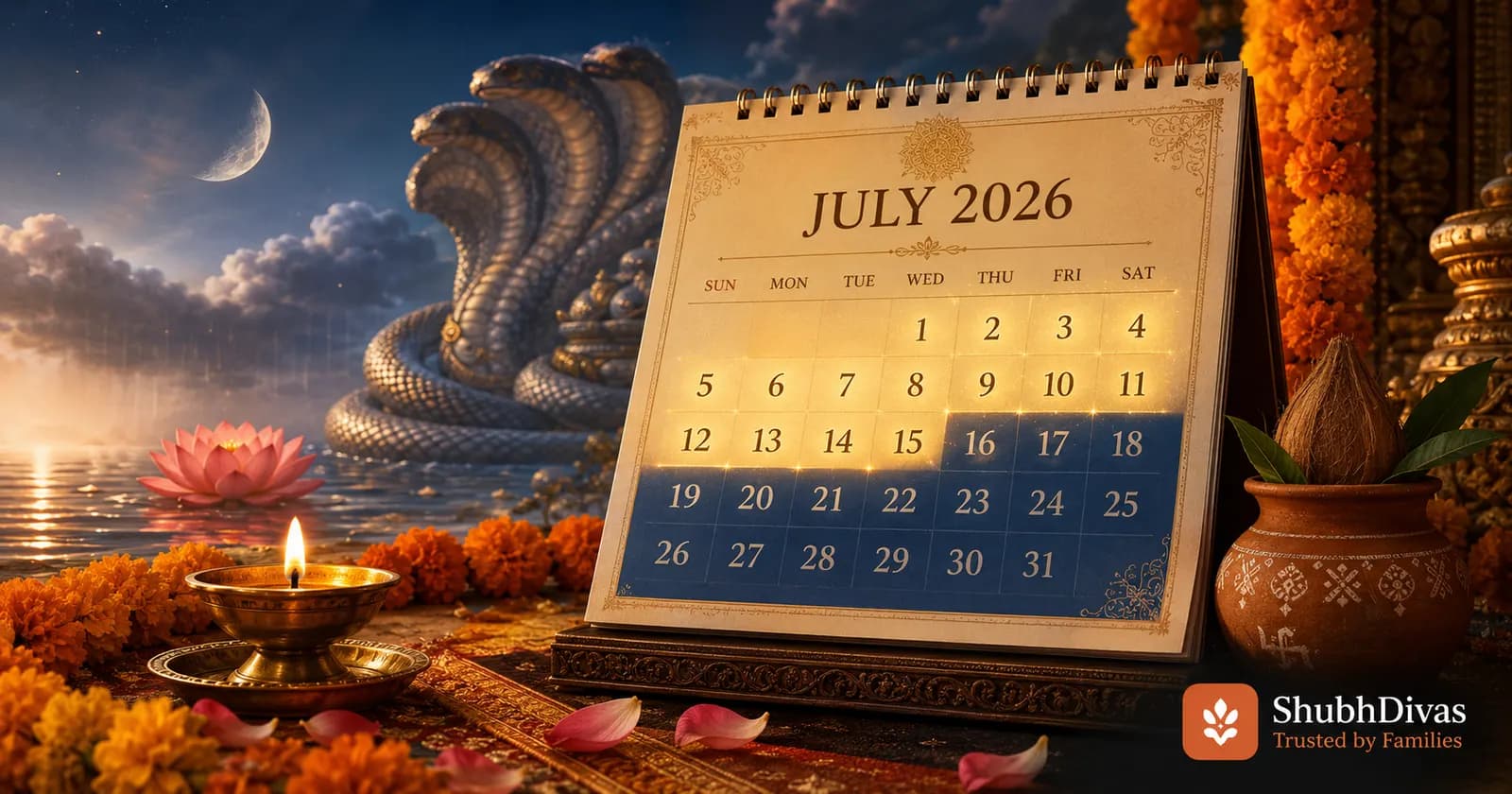


Ashadha month 2026 begins on Tuesday, June 30 and ends on Wednesday, July 29 (Ashadha Purnima — Guru Purnima). It is the fourth month of the Hindu lunar calendar, following Jyeshtha — and it arrives with the monsoon, carrying a distinct devotional energy that marks the transition from summer heat to the rains.
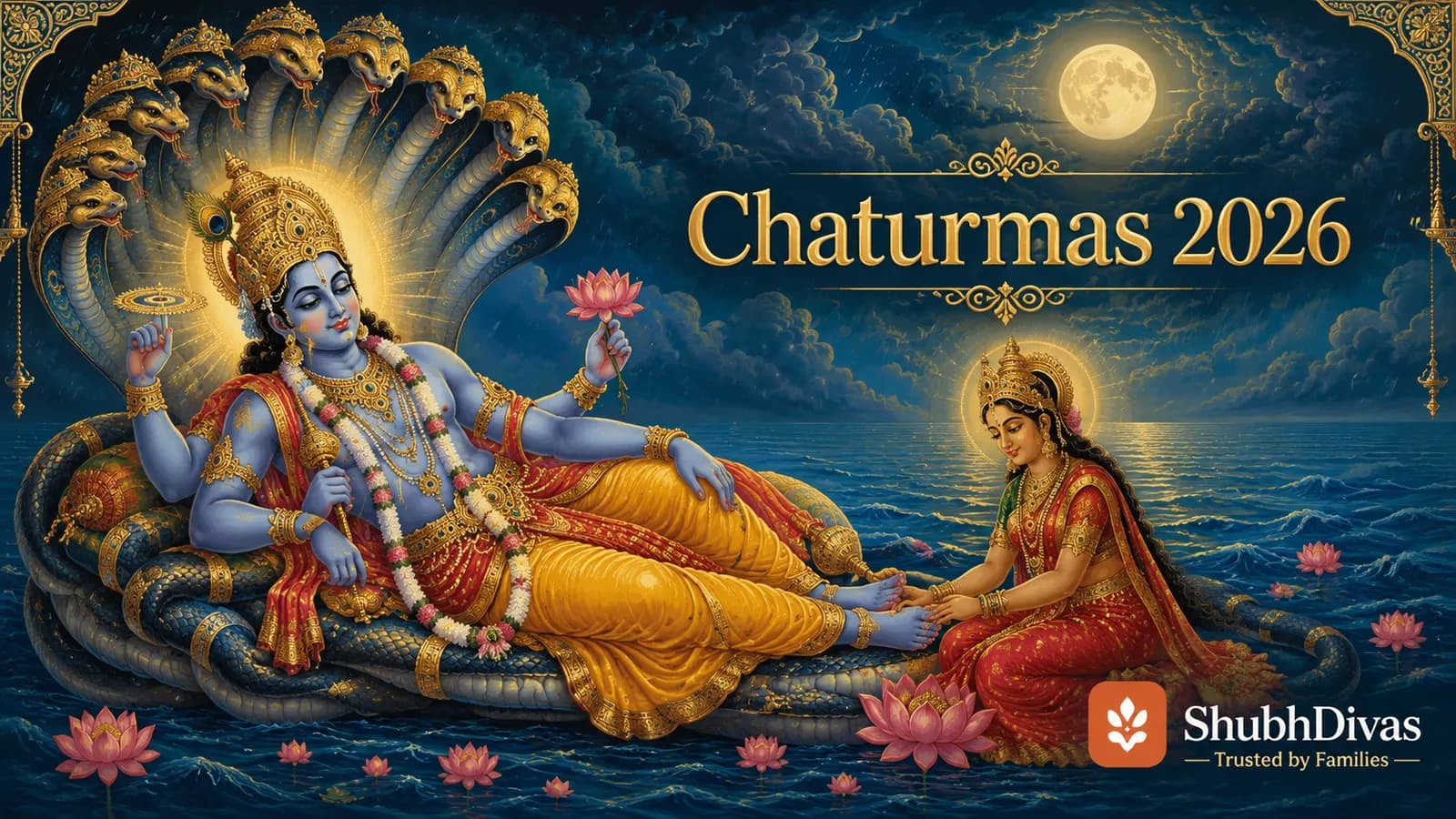
Ashadha is the month of Lord Vishnu's rest. It contains Devshayani Ekadashi — the day Vishnu reclines on the cosmic serpent Shesha and enters his four-month yoga nidra (divine sleep). It contains Guru Purnima — the full moon consecrated to all spiritual teachers. And it carries the energy of Rath Yatra at Puri — the procession where Lord Jagannath comes out to his devotees.
Ashadha Month 2026 — Quick Reference
| Detail | Date |
|---|---|
| Ashadha begins | Tuesday, June 30, 2026 |
| Ashadha Purnima / Guru Purnima | Wednesday, July 29, 2026 |
| Ashadha ends | Wednesday, July 29, 2026 (Purnima) |
| Rath Yatra 2026 | Thursday, July 2, 2026 |
| Devshayani Ekadashi | Saturday, July 25, 2026 |
| Guru Purnima | Wednesday, July 29, 2026 |
How Ashadha Begins — The Lunar Calendar Logic
The Hindu lunar calendar uses two systems. In the Amanta system (followed in Maharashtra, Gujarat, Karnataka, Andhra, Tamil Nadu), a month begins on the day after the new moon (Pratipada of Shukla Paksha) and ends on the following Purnima. In the Purnimanta system (followed in North India), a month begins on the day after the full moon and ends on the next Purnima.
For Ashadha 2026:
- In the Amanta system: Ashadha begins on June 30 (the day after Jyeshtha Purnima on June 29)
- In the Purnimanta system: Ashadha Krishna Paksha began on June 30 as well, with Ashadha Shukla beginning after the new moon on July 14
For most festival calculations, the Amanta system's start date (June 30) is the commonly referenced beginning of Ashadha.
The Character of Ashadha — Vishnu's Month
Each lunar month has a presiding deity and a devotional character. Ashadha belongs to Lord Vishnu — specifically to Vishnu entering his cosmic rest.
The agricultural and cosmic logic is this: the monsoon arrives in Ashadha. Fields are planted. Work shifts underground — the seeds planted, the rains doing their work, and the results not yet visible. Vishnu entering yoga nidra is the cosmic parallel: the divine creative force rests while the world it set in motion continues its cycle. Chaturmas — the four months of Vishnu's sleep — runs from Devshayani Ekadashi (July 25) to Devutthana Ekadashi (November) and has governed everything from monk travel schedules to wedding calendars for millennia.
Ashadha is also deeply connected to Lord Shiva through the Pradosh observances and Shravan preparations. The twin energies of Vishnu (culminating in Devshayani Ekadashi) and Shiva (whose month Shravan follows immediately) make this a hinge point in the devotional year.
Key Festivals in Ashadha 2026
Rath Yatra — July 2, 2026
Rath Yatra, the Chariot Festival of Lord Jagannath, is celebrated on the second day of Ashadha Shukla Paksha. In Puri (Odisha), this is the most important festival of the year: three massive wooden chariots — for Jagannath, Balabhadra, and Subhadra — are pulled through the main street (Bada Danda) by thousands of devotees.
The tradition of Rath Yatra is not limited to Puri. ISKCON temples worldwide hold Rath Yatra processions in cities across India and internationally. The pulling of the chariot rope is understood as a direct act of receiving the Lord's grace — no distinction of caste, gender, or religion applies.
In 2026, Rath Yatra falls on July 2 — the second Ashadha Shukla. The return procession (Bahuda Yatra) will follow approximately nine days later.
Devshayani Ekadashi — July 25, 2026
The most theologically significant day in Ashadha, Devshayani Ekadashi is covered in its own blog — but its importance to Ashadha cannot be overstated. This is the day Lord Vishnu reclines on Adi Shesha (the cosmic serpent) in the Kshira Sagara (ocean of milk) and enters his four-month sleep.
The four months that follow (Chaturmas) are traditionally considered inauspicious for new beginnings — weddings, thread ceremonies, house-warmings, and other samskaras are generally avoided until Devutthana Ekadashi in November. Ashadha contains this threshold.
Guru Purnima / Ashadha Purnima — July 29, 2026
The full moon of Ashadha is one of the most sacred days in the Hindu, Buddhist, and Jain calendars. Dedicated to Sage Veda Vyasa — the compiler of the Vedas, author of the Mahabharata, and author of the Puranas — it is the day when disciples honour their teachers with complete reverence.
Buddha gave his first sermon at Sarnath on this day. Mahavira's principal disciples received their initiation on this day. In the Hindu tradition, Vyasa is considered the guru of all gurus — the one who organised all sacred knowledge so it could be transmitted. Guru Purnima is the single day when all these traditions converge on the same acknowledgement: that the transmission of knowledge requires a teacher, and teachers deserve acknowledgement.
What to Observe During Ashadha Month
At the month's beginning (June 30 onwards):
- Begin an Ekadashi observance if you have not already — Ashadha contains two Ekadashis (Yogini Ekadashi on the dark fortnight, Devshayani Ekadashi on the bright)
- The Vishnu Sahasranama (thousand names of Vishnu) recitation is particularly auspicious throughout Ashadha
- This is the right month to begin reading the Bhagavata Purana or any Vaishnava scripture; Ashadha's energy is receptive for Vishnu devotion
During the monsoon:
- Ashadha is the first month of the four-month Chaturmas-adjacent period; many devotees begin a practice of increased satsang, scripture reading, or charitable giving that they maintain through the rains
- Nag Panchami (Shravan Shukla Panchami, August 2026) begins the major monsoon festival sequence that continues into Navaratri
Marriages and auspicious events:
- Ashadha Shukla Paksha (June 30 to July 14) is the last window before Devshayani Ekadashi (July 25) closes the season for weddings and new beginnings. Many families schedule remaining ceremonies in early Ashadha to precede Chaturmas.
- After July 25, the tradition holds that auspicious muhurats for weddings, griha pravesh (house-warming), and major samskaras are not observed until Devutthana Ekadashi (November 20, 2026).
Ashadha and the Monsoon Calendar
The alignment of the lunar Ashadha month with the monsoon season is not coincidental — it reflects the deep integration of the Hindu calendar with the agricultural and ecological cycle of the subcontinent.
The Southwest Monsoon reaches most of India between June and July. Planting happens during Ashadha. The rivers fill. The heat breaks. And the devotional calendar responds: Vishnu rests (seeds are planted, divine energy withdraws into potential), Shiva becomes active (Shravan, which follows, is his month), and the period between them — Ashadha — is a threshold.
The month of Ashadha in the Vedic tradition is also associated with rain rituals. The Varuna Puja (worship of the rain god) has traditional associations with this period. In Tamil Nadu, the Aadi month (corresponding roughly to Ashadha-Shravan) has its own rain-welcoming traditions. Across India's regions, the onset of rains in this lunar period was — and remains — the most consequential seasonal event of the year.
Check today's Rahu Kaal
Precise panchanga for your city — Rahu Kaal, tithi, nakshatra, sunrise, and more calculated accurately.
Free · Updated daily
Frequently asked questions
Find your auspicious muhurat
Personalised Vedic muhurat for your wedding, property, vehicle, or ceremony — reviewed by Acharya Suryakanth Subramaniam.
Find Muhurat →