
Every summer, a quiet but firm announcement goes through Hindu households across India: no weddings after a certain date. Families shift ceremony dates. Couples rush registrations. And then the calendar falls still for four months.
Chaturmas 2026 begins on Saturday, July 25 — the day of Devshayani Ekadashi — and ends on Friday, November 20 (Devutthana Ekadashi), spanning 118 days. These four months are not a pause in Hindu life. They are the fulcrum of the devotional year — the period when the calendar turns inward, festivals accelerate, and spiritual practice deepens. But weddings, yes, stop.
Here is the complete guide to Chaturmas 2026: exact dates, why the wedding prohibition exists, a month-by-month festival breakdown, what is and is not restricted, and how families should plan around the pause.
Chaturmas 2026 at a Glance
| Event | Date | Day |
|---|---|---|
| Chaturmas begins | July 25, 2026 | Saturday — Devshayani Ekadashi |
| Guru Purnima | July 29, 2026 | Wednesday |
| Nag Panchami | August 17, 2026 | Monday |
| Varalakshmi Vratam | August 28, 2026 | Friday |
| Raksha Bandhan | August 28, 2026 | Friday |
| Janmashtami (Smarta) | September 4, 2026 | Friday |
| Janmashtami (Vaishnava) | September 5, 2026 | Saturday |
| Ganesh Chaturthi | September 14, 2026 | Monday |
| Shardiya Navratri begins | October 11, 2026 | Sunday |
| Dussehra (Vijayadashami) | October 20, 2026 | Tuesday |
| Sharad Purnima | October 25, 2026 | Sunday |
| Chaturmas ends | November 20, 2026 | Friday — Devutthana Ekadashi |
| Tulsi Vivah | November 20–21, 2026 | Friday–Saturday |
When Chaturmas Begins and Ends in 2026
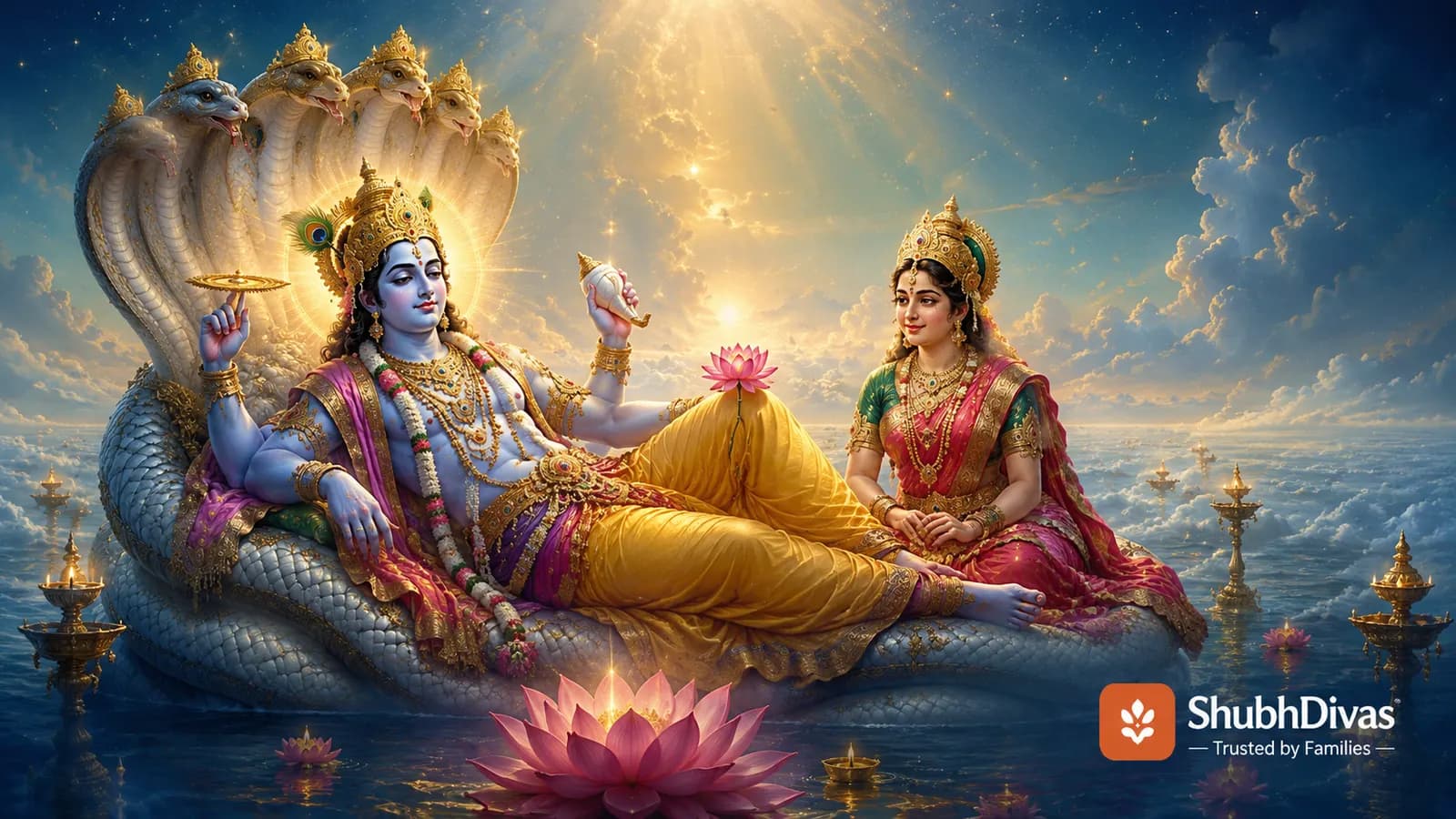
Chaturmas starts on Devshayani Ekadashi — Saturday, July 25, 2026 — the eleventh tithi of the bright fortnight of the Ashadha lunar month. This is the day when, according to the Vishnu Purana and Bhagavata Purana, Lord Vishnu reclines on the cosmic serpent Adi Shesha in the primordial ocean and enters yoga nidra — a state of transcendent rest that is neither ordinary sleep nor ordinary waking. The word devshayani means "the resting of the god."
It ends on Devutthana Ekadashi — Friday, November 20, 2026 — the eleventh tithi of the bright fortnight of Kartika. On this day, Vishnu "wakes" (devutthana = "the rising of the gods"), Tulsi Vivah is performed as the first auspicious ceremony of the reopened season, and the wedding calendar immediately resumes.
The period spans four lunar months: the remainder of Ashadha (July 25–29), then Shravan, Bhadrapada, and Ashwin — with Chaturmas ending in the first days of Kartika. The "four months" (chatur = four, masa = month) refers to the four primary months of observance, from Shravan through Ashwin, with Ashadha as the opening and Kartika as the closing frame.
In some South Indian traditions, the Chaturmas window is counted from Ashadha Purnima or from the Shukla Dvadashi of Ashadha — but the July 25 to November 20 span is the universally observed calendar across Vaishnava, Shaiva, and general Hindu households throughout India.
For a full guide to the Devshayani Ekadashi fast, puja vidhi, and the theology of Vishnu's yoga nidra, see the Devshayani Ekadashi 2026 Complete Guide.
Why Weddings Stop During Chaturmas
This is the question most families actually want answered.
The short version: in Hindu tradition, a marriage is not just a social contract — it is a samskara, a life-cycle sacrament that requires the active blessing and presence of the presiding deity. For the majority of Hindu traditions, that deity is Vishnu in his role as universal preserver and witness of sacred covenants. A marriage without this divine witnessing is considered inauspicious — not because anything will definitively go wrong, but because the timing itself is understood as part of the sacrament.
During Chaturmas, Vishnu's "accessible" form — the aspect that grants boons, witnesses oaths, and sanctions new beginnings — is in rest. The tradition does not ask whether a couple will be happy; it asks whether the ceremony is being performed at the right cosmic moment. During Chaturmas, it is not.
The more practical dimension: Chaturmas corresponds precisely to the Indian monsoon season — from mid-July through mid-November. In pre-modern India, this was the period when rivers were in spate, roads were impassable, and agricultural communities were entirely absorbed in the work of the growing season. Moving a bride and her dowry across the country in Shravan was logistically impossible. The religious prohibition and the agricultural reality reinforced each other perfectly for centuries. The rule outlasted the agricultural reason — but the spiritual logic remains compelling.
The practical answer for 2026: no traditional weddings between July 25 and November 19 inclusive. Weddings resume from November 20.
For the best vivah muhurat dates before Chaturmas closes, see:
- June 2026 Muhurat Dates — Weddings, Griha Pravesh & Business
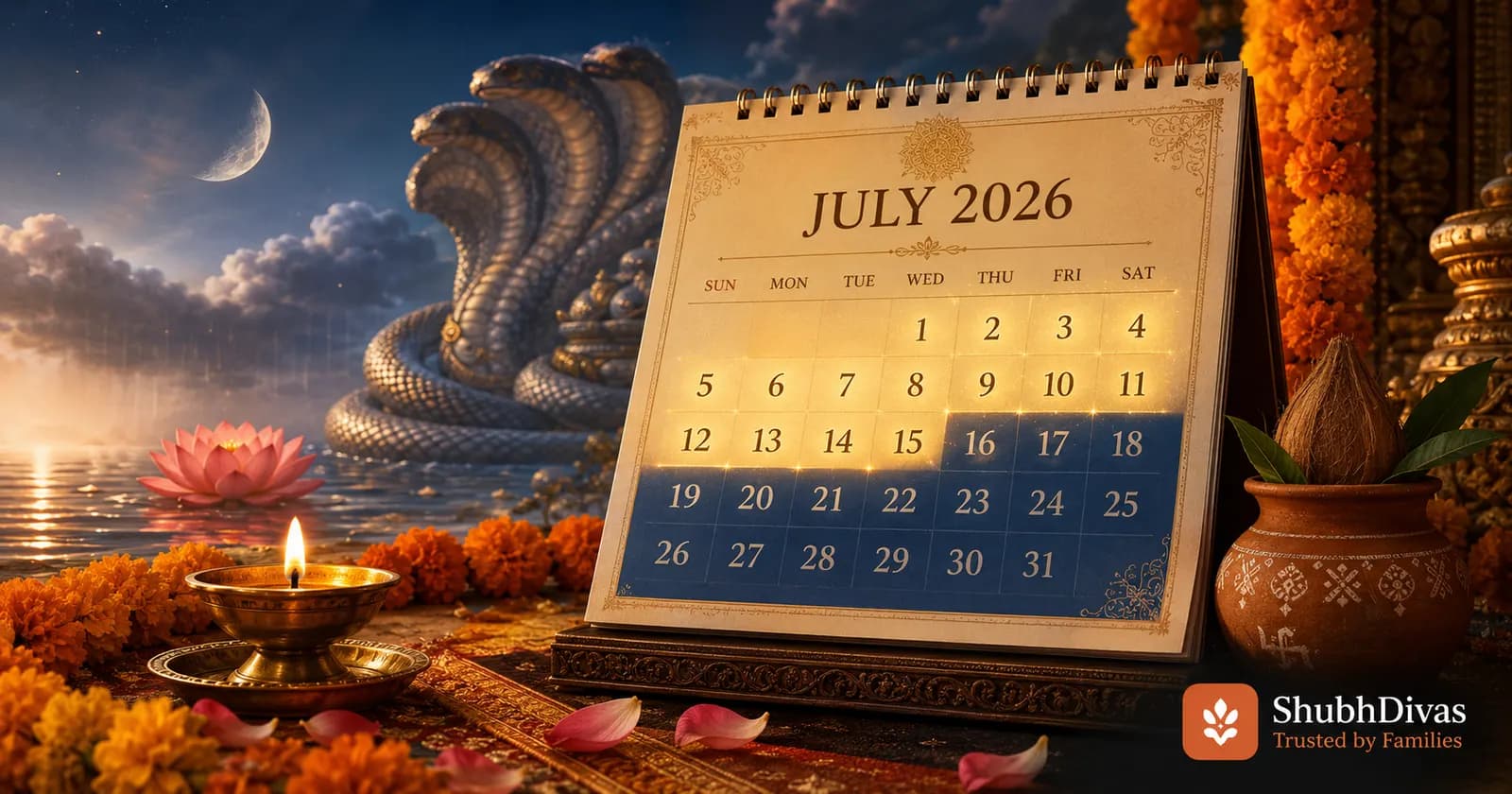
- July 2026 Vivah Muhurat — Last Dates Before Chaturmas
Month-by-Month: What Falls During Chaturmas 2026
Chaturmas is not four months of silence. It contains some of the most important festivals on the Hindu calendar. Here is what falls in each lunar month.
Ashadha Remainder — July 25–29
Chaturmas opens just days before Ashadha ends. One event defines this brief window:
Guru Purnima — Wednesday, July 29. The full moon of Ashadha is the most sacred day in the Hindu year for honouring spiritual teachers. Dedicated to Sage Veda Vyasa — who compiled the four Vedas, the Mahabharata, and the eighteen Puranas — Guru Purnima is observed in Hindu, Buddhist, and Jain traditions with equal reverence. Chaturmas also formally begins for wandering monks and sannyasis on this day: they halt their travels and settle in one place for the season, taking up intensive study and discourse.
Read: Guru Purnima 2026 — July 29 Date and Significance
Shravan (Sawan) — July 30 to August 28
Shravan is the holiest month of the Hindu year for Shiva worship. The entire month carries a heightened spiritual charge: Monday fasts (Sawan Somwar), Abhishekam at Shiva temples, the Kanwar Yatra pilgrimage, and specific observances for different communities.
Nag Panchami — Monday, August 17. The fifth day of Shravan's bright fortnight is dedicated to the Nag Devtas — the serpent deities who represent protection, fertility, and freedom from fear. Milk is offered at snake idol installations. This day is especially important for families managing Kaal Sarp Dosha.
Read: Nag Panchami 2026 — August 17 Date and Puja Vidhi
Raksha Bandhan & Varalakshmi Vratam — Friday, August 28. Shravan Purnima falls on a Friday in 2026, which creates a rare double festival. Raksha Bandhan — when a sister ties a Rakhi on her brother's wrist and he pledges lifelong protection — is observed across India on this Shravan Purnima. On the same day, South Indian communities (Karnataka, Andhra Pradesh, Telangana, Tamil Nadu) observe Varalakshmi Vratam — the Kalasha puja for Goddess Varalakshmi, a form of Lakshmi who grants boons. When Shravan Purnima falls on a Friday, both festivals coincide.
Read: Raksha Bandhan 2026 — August 28 Muhurat and Bhadra Timing
Newly married women also observe Mangala Gauri Vrat on each Tuesday of Shravan (August 4, 11, 18, and 25 in 2026) — a fast and puja to Goddess Mangala Gauri for the long life and wellbeing of the husband, observed in the first five years of marriage.
Bhadrapada — August 29 to September 26 (approx.)
Bhadrapada is the most festival-dense month of the Hindu calendar.
Krishna Janmashtami — Friday, September 4 (Smarta); Saturday, September 5 (Vaishnava/ISKCON). Bhadrapada Krishna Ashtami — the eighth day of the dark fortnight under Rohini Nakshatra — is the birth of Lord Krishna, the eighth avatar of Vishnu. The midnight Nishita Kaal puja, the Dahi Handi celebration the following morning, and the devotional intensity of this night represent the high point of Bhadrapada. This is among the most widely observed birth anniversaries in the world.
Read: Krishna Janmashtami 2026 — September 4 Date, Nishita Kaal & Puja Guide
Ganesh Chaturthi — Monday, September 14, 2026. Bhadrapada Shukla Chaturthi — the fourth day of the bright fortnight — is the birth of Lord Ganesha. The Madhyahna puja falls between 11:02 AM and 1:28 PM. The 10-day Ganeshotsav follows, culminating on Anant Chaturdashi (September 25, Friday). Public pandals, communal celebrations, and the Visarjan (idol immersion) procession mark these ten days. Maharashtra, Karnataka, Andhra Pradesh, and Telangana observe Ganeshotsav with particular intensity. The wedding prohibition does not apply to festivals; Ganesh Chaturthi is observed with full ceremony.
Jain communities observe Paryushana Parva during Bhadrapada — an 8-day intensive period (Shvetambara) or 10-day period (Digambara) of fasting, scripture study, and confession, culminating in Kshamavani (Forgiveness Day). For Jain traditions, Paryushana is the single most important period of the year and is observed with the same reverence as Chaturmas itself.
Ashwin — September 27 to October 26 (approx.)
Ashwin brings the two largest festival events of the Hindu calendar.
Shardiya Navratri — October 11–19, 2026 (Sunday to Monday). Nine nights of worship of the nine forms of Goddess Durga — Ghatasthapana on October 11, Navami on October 19 — Shailputri, Brahmacharini, Chandraghanta, Kushmanda, Skandamata, Katyayani, Kalaratri, Mahagauri, Siddhidatri. Garba and Dandiya nights in Gujarat, Kolu displays in South India, Durga Puja pandals in Bengal and beyond. Navratri in Ashwin (Shardiya Navratri) is the largest of the four annual Navratri seasons. The goddess aspect of divinity does not rest during Vishnu's rest — Navratri is fully observed.
Vijayadashami / Dussehra — Tuesday, October 20, 2026. The tenth day of the bright fortnight of Ashwin — Rama's victory over Ravana, Durga's victory over Mahishasura, Arjuna's recovery of the Gandiva from the Shami tree. Vijay Muhurat falls 2:02–2:49 PM. Ravana effigy burnings and the Mysore Dasara procession are observed on October 20; Bengal's Durga Visarjan follows on October 21. All entirely within Chaturmas.
Sharad Purnima — Sunday, October 25, 2026. The full moon of Ashwin is considered the brightest and most potent full moon of the year. Kheer (rice pudding cooked in milk with cardamom and saffron) is prepared, placed in the moonlight overnight, and consumed the following morning to absorb lunar energy. This is also Kojagiri Purnima — a night of Lakshmi puja and the question "Ko jagarti?" (Who is awake?), answered by those who keep vigil.
Chaturmas continues into the first eleven days of Kartika before ending on Devutthana Ekadashi (November 20).
What Is Prohibited During Chaturmas
The restriction list is shorter than most people expect:
- Weddings and betrothal ceremonies — the primary and most universally observed restriction
- Thread ceremony (Upanayana / Munja) — sacred thread investiture
- Griha Pravesh — house-warming and formal entry into a new home
- Mundan (first hair-cutting ceremony) — in traditional practice
- New business inaugurations — in stricter traditional observance
The rationale common to all: these are samskaras or mangala karyas — auspicious new beginnings that invoke divine blessing and require Vishnu as cosmic witness. During Chaturmas, that witnessing presence is in rest.
What Is Not Prohibited
This is where most families are surprised. Chaturmas does not pause the majority of Hindu life.
- All existing religious practices — daily puja, Ekadashi fasts, Pradosh observances — continue and are intensified
- All festivals — Ganesh Chaturthi, Janmashtami, Navratri, Dussehra, Sharad Purnima are observed with full ceremony
- Daily temple visits and devotional practice — not restricted
- Property purchases and vehicle purchases — not part of the samskara restriction in contemporary practice
- Starting employment — joining a new job is not a samskara in the traditional classification
- Charitable giving — explicitly encouraged; donations during Chaturmas are considered to carry multiplied merit
- Pilgrimage — Chaturmas is actively auspicious for pilgrimage
Regional Variations
North India (Vaishnava and Shaiva communities): The July 25 to November 20 window is followed universally. Shravan Mondays are among the most intensely observed days of the year at Shiva temples. The Kanwar Yatra — pilgrimage to collect Ganga Jal and offer it at local Shiva shrines — takes place in Shravan.
South India: Chaturmas is observed with the same wedding prohibition but different internal rhythms. Varalakshmi Vratam (August 28) is a South India-specific Chaturmas festival. Ganesh Chaturthi is observed with particular intensity in Karnataka and Andhra Pradesh. The Kolu tradition of Navratri — displaying golu dolls in a stepped arrangement — is specific to Tamil Nadu, Karnataka, and parts of Andhra Pradesh.
Maharashtra: The Wari pilgrimage to Pandharpur's Vitthal temple peaks on Devshayani Ekadashi (July 25) — hundreds of thousands of Varkari devotees converge on the temple in a procession that has been continuous for centuries. Ganeshotsav in Bhadrapada is Maharashtra's defining cultural event of the year.
Jain tradition: The most rigorous form of Chaturmas — called Paryushana — is observed by Jain monks and laity in Bhadrapada. Monks who have been travelling do not move during the monsoon period, strictly following the principle of ahimsa (non-violence), as walking in the rain risks harming insects. The laity intensifies fasting and scriptural study.
Traditional Month-Specific Food Restrictions
In traditional Vaishnava households, Chaturmas carries four month-specific dietary restrictions — one per month. These are vows taken voluntarily, not universal requirements:
| Month | Traditional Vow |
|---|---|
| Shravan | Brinjal (eggplant / aubergine) avoided |
| Bhadrapada | Curd (yoghurt) avoided |
| Ashwin | Milk avoided |
| Kartika | Pulses and lentils avoided |
These restrictions are not universally followed in contemporary India. They are observed primarily in traditional Brahmin and Vaishnava households that take a formal Chaturmas vrata on Devshayani Ekadashi. They carry the logic of seasonal eating — the monsoon season is not ideal for certain fermented, dairy, and legume-heavy foods in traditional Ayurvedic understanding.
Planning Weddings and Events Around Chaturmas 2026
If your family has a 2026 wedding in the pipeline, the scheduling logic is clear.
Before July 25: The window before Chaturmas is already narrowing. Jupiter (Guru) also goes combust around mid-July, independently closing the vivah muhurat window before Chaturmas formally begins. The verified vivah muhurat in July 2026 are concentrated in the first twelve days of the month. See July 2026 Muhurat for specific dates.
After November 20: Devutthana Ekadashi (November 20) reopens the season. The Margashirsha month (approximately November 21–December 20) is traditionally considered one of the finest months for weddings — Krishna himself says in the Bhagavad Gita "of months I am Margashirsha." The Paush month (approximately December 21–January 19, 2027) also carries good vivah muhurat.
Families planning a late 2026 or early 2027 wedding should begin identifying Margashirsha and Paush muhurat dates now, as venues book early.
On civil registrations: A civil registration at a marriage registrar is not a samskara in the traditional sense. Families that need to complete legal documentation during Chaturmas for procedural reasons generally do so as a matter of paperwork, with the actual ceremony and rituals scheduled for outside the Chaturmas window.
Use the ShubhDivas Muhurat Finder to check personalised vivah muhurat for your specific city and birth charts.
Chaturmas as a Spiritual Opportunity
For those whose plans are not directly affected by the wedding restriction, Chaturmas is an invitation rather than an impediment.
The four months are explicitly designed — in the Puranic framework — for intensified spiritual practice: completing a reading of the Bhagavata Purana or Ramayana; establishing a new daily japa or meditation practice; observing specific Chaturmas fasts (beyond regular Ekadashi); increasing charitable giving and service. The principle is consistent across traditions: outward expansion (new ceremonies, new auspicious beginnings sanctioned by Vishnu) is paused so that inward work can happen without distraction.
The festivals within Chaturmas — Janmashtami, Ganesh Chaturthi, Navratri — are not interruptions to this inward turn. They are different in character from wedding-type samskaras. They are communal celebrations of divine manifestation, not requests for divine sanction on new personal beginnings.
When Vishnu wakes on November 20, the tradition understands that what was planted during Chaturmas — in terms of practice, discipline, and spiritual intention — flowers in the newly sanctioned season.
Check today's Rahu Kaal
Precise panchanga for your city — Rahu Kaal, tithi, nakshatra, sunrise, and more calculated accurately.
Free · Updated daily
Frequently asked questions
Find your auspicious muhurat
Personalised Vedic muhurat for your wedding, property, vehicle, or ceremony — reviewed by Acharya Suryakanth Subramaniam.
Find Muhurat →