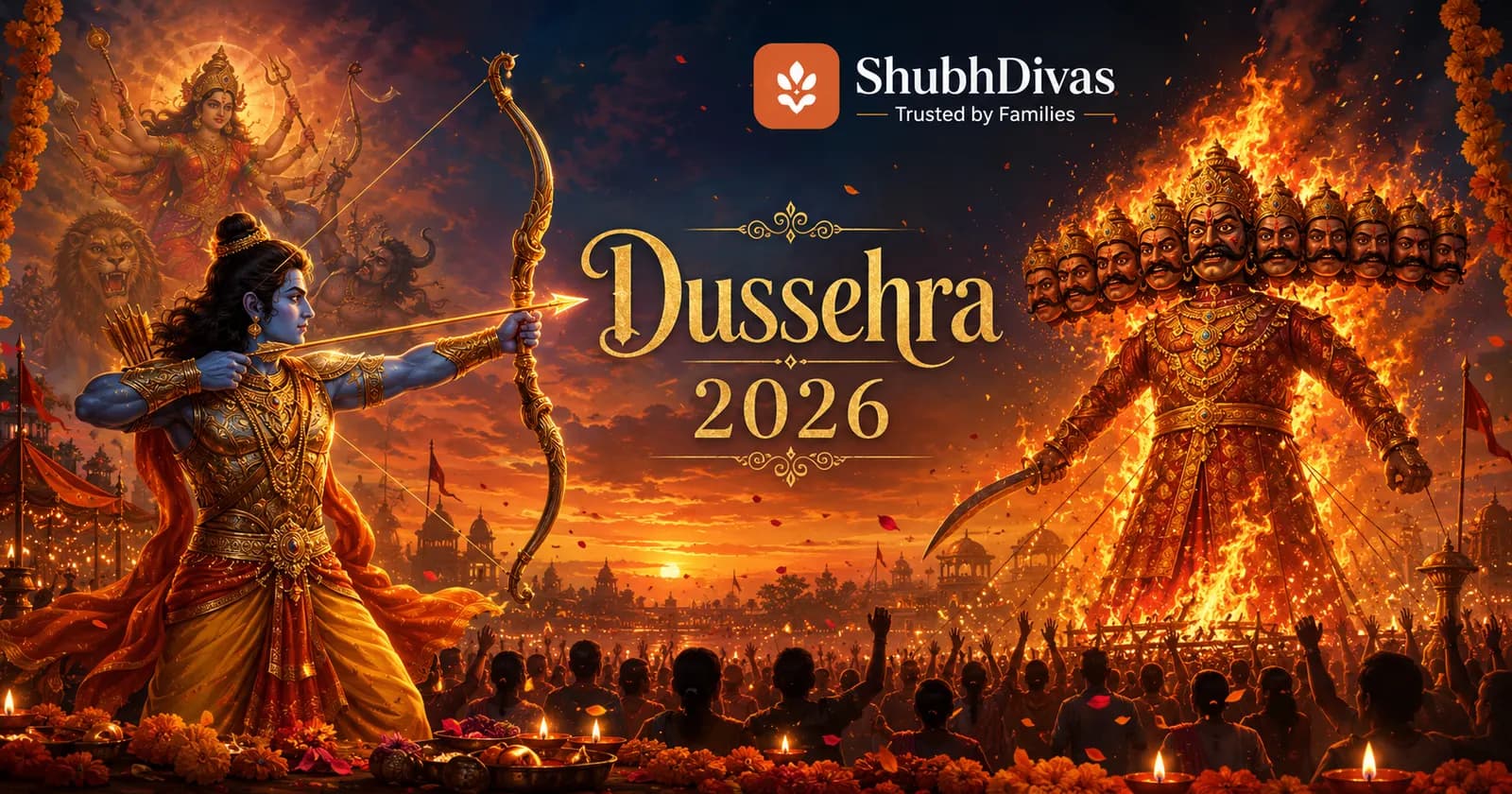

Dussehra 2026 — Vijayadashami — falls on Tuesday, October 20. It is the tenth day (Dashami) of the bright fortnight of Ashwin, the day that crowns Sharad Navratri, and one of the most auspicious days of the entire Hindu year. It celebrates a single eternal truth told through two great victories: Lord Rama's defeat of the demon king Ravana, and Goddess Durga's slaying of the buffalo-demon Mahishasura — the triumph of good over evil, of light over darkness.
Because it marks vijaya — victory — anything begun on Dussehra is believed to carry through to success. It is a rare abujh muhurat, auspicious all day without needing a narrower window, and its Vijaya Muhurat is held to be among the most powerful moments of the year. Here is the verified date, the muhurat, the rituals, and the story.
Dussehra 2026 — Date and Muhurat
| Detail | Information |
|---|---|
| Festival | Dussehra / Vijayadashami |
| Date | Tuesday, October 20, 2026 |
| Lunar month | Ashwin, Shukla Paksha (Dashami tithi) |
| Vijaya Muhurat | approx. 01:59 PM – 02:45 PM |
| Ravana Dahan | after sunset (Aparahna–Pradosh), evening of Oct 20 |
| Nature | Abujh muhurat — auspicious all day for new beginnings |
The Vijaya Muhurat and Aparahna window shift by your city's longitude. Confirm the exact Vijaya Muhurat for your city on the ShubhDivas Panchanga.
The Significance of Dussehra
Dussehra carries two victories that are really one. In the north, it is the day Lord Rama slew Ravana, the ten-headed king of Lanka who had abducted Sita — the culmination of the Ramlila performed through the preceding nine nights. In the east and much of India, it is Vijayadashami, the day Goddess Durga vanquished Mahishasura after her nine-night battle. Both tell the same truth: however mighty evil grows, dharma prevails in the end.
The ten heads of Ravana are understood as the ten inner enemies each of us carries — kama (lust), krodha (anger), lobha (greed), moha (attachment), mada (pride), matsarya (envy), and the failings of mind and ego. To burn Ravana is to resolve to burn these within. And because the day belongs to victory, it became the traditional day for kings to set out on campaigns, for warriors to worship their arms, and for every new venture, skill, and journey to begin.
The Vijaya Muhurat — the Most Powerful Window of the Day
The Vijaya Muhurat — roughly 01:59 PM to 02:45 PM on October 20 — is the single most auspicious window of Dussehra, held in the tradition to be one of the most powerful stretches of the whole year. It takes its name from vijaya, victory: any important act begun in it — a new job or business, buying a vehicle or gold, signing an agreement, starting a course of study, or setting out on a journey — is believed to be blessed with success. Where the Vijaya Muhurat cannot be used, the whole day serves, since Dussehra is abujh.
Ravana Dahan and the Rituals of Vijayadashami
- Ravana Dahan. After sunset, towering effigies of Ravana, his brother Kumbhakarna, and son Meghnad, packed with firecrackers, are set alight in grounds across North India as Rama's arrow flies — a joyous, communal burning away of evil.
- Shastra / Ayudha Puja. Warriors, and today soldiers, police, artisans, and professionals, worship their weapons, tools, vehicles, and instruments on this day — and in South India, the Ayudha Puja honours the implements of one's trade, with books and instruments worshipped as forms of Saraswati.
- Shami Puja & Apta leaves. The Shami tree is worshipped (recalling the Pandavas, who recovered their hidden weapons from it at the end of their exile), and in Maharashtra people exchange Apta leaves as "sona" (gold), offering prosperity and goodwill.
- Aparajita Puja & Seemollanghan. The goddess Aparajita ("the unconquered") is worshipped for victory, and kings would ceremonially cross their kingdom's border (seemollanghan) toward conquest.
- Vidyarambh. Because victory includes the victory of knowledge, Dussehra is a favoured day to begin a child's learning or take up a new skill or art.
Check today's Rahu Kaal
Precise panchanga for your city — Rahu Kaal, tithi, nakshatra, sunrise, and more calculated accurately.
Free · Updated daily
Why Dussehra Is an Abujh Muhurat for New Beginnings
In the Vedic calendar there are a handful of abujh (self-evident) muhurats — days so auspicious in themselves that no further muhurat calculation is needed, such as Akshaya Tritiya. Dussehra is one of them. This is why it is a favourite across India for buying a vehicle, gold, or property, launching a business, signing a deal, or starting anything new — even inside Chaturmas, when weddings and griha pravesh remain paused. If you have been waiting for the right day for a purchase or a fresh start this autumn, Vijayadashami is it (see our October 2026 auspicious dates).
Dussehra Across India
Dussehra wears many faces. Mysuru Dasara in Karnataka is a royal spectacle of illuminated palaces and caparisoned elephants. Kullu Dussehra in Himachal begins when others end, a week-long gathering of village deities. Across the north, Ramlila and the burning of Ravana draw huge crowds. In Bengal and the east, Vijayadashami is the tender farewell to Durga — the immersion of her idols and the Sindoor Khela, where married women bid the Mother goodbye until next year. Different scenes, one heart: the celebration of victory and the return of good.
Frequently asked questions
Find your auspicious muhurat
Personalised Vedic muhurat for your wedding, property, vehicle, or ceremony — reviewed by Acharya Suryakanth Subramaniam.
Find Muhurat →