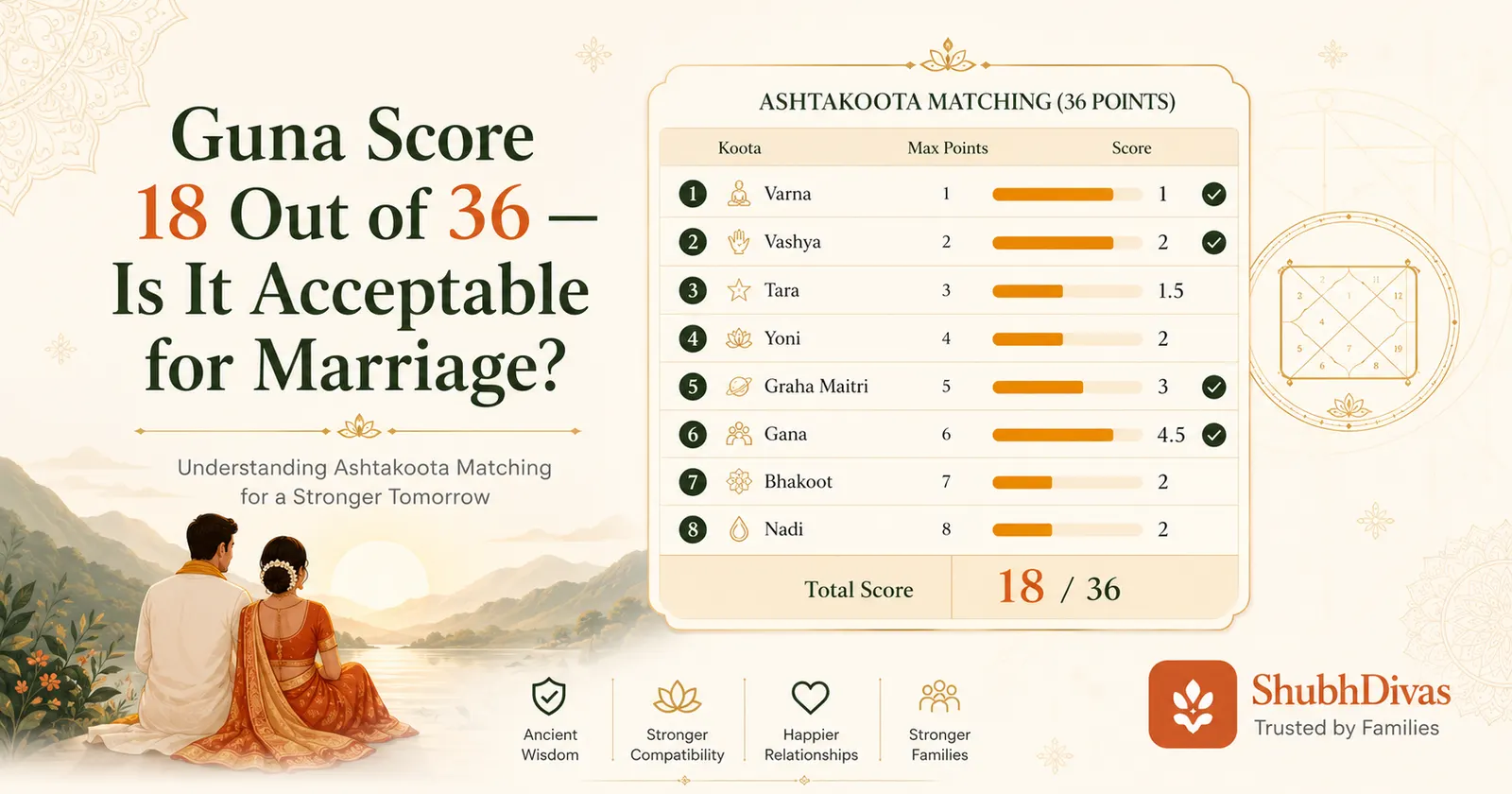

Guna Score 18 Out of 36 — Right at the Minimum
A score of 18 is exactly the traditional threshold in Ashtakoota kundali matching — half of 36. Many families treat 18 as the minimum acceptable score, meaning this match sits right on the line.
The important thing to understand is that 18 is not a failing score. It is the starting point, not the bottom. Whether it is genuinely acceptable depends almost entirely on which kootas are contributing those 18 points — not the number itself.
Why 18 is the Traditional Minimum
The Ashtakoota system assigns 36 total points across 8 categories of compatibility. The traditional minimum of 18 — exactly half — reflects the idea that a couple should be compatible in at least half the measured parameters for the marriage to have a sound foundation.
This threshold is referenced in classical Vedic astrological texts and is widely followed across North Indian and South Indian traditions, though different communities weigh it differently.
The Same Rule Applies Here — Breakdown Matters More Than Total
A score of 18 means 18 points are present somewhere across the 8 kootas. The composition of those 18 points is what determines the actual quality of the match.
An 18 that is strong: Nadi Koot: 8/8 ✅ Bhakoot Koot: 7/7 ✅ Gana Koot: 3/6 ⚠️ Graha Maitri: 0/5 ❌ Yoni Koot: 0/4 ❌ Tara Koot: 0/3 ❌ Vashya Koot: 0/2 ❌ Varna Koot: 0/1 ❌ Total: 18/36
This is a fundamentally sound match. The two most important kootas — Nadi (8 points, health and progeny) and Bhakoot (7 points, prosperity and emotional connection) — are both perfect. The missing points come from less critical categories.
An 18 that needs attention: Nadi Koot: 0/8 ❌ (Nadi Dosha present) Bhakoot Koot: 0/7 ❌ (Bhakoot Dosha present) Gana Koot: 6/6 ✅ Graha Maitri: 5/5 ✅ Yoni Koot: 4/4 ✅ Tara Koot: 3/3 ✅ Vashya Koot: 0/2 ❌ Varna Koot: 0/1 ❌ Total: 18/36
This is a more complex picture. Both major doshas are present, and the score of 18 comes entirely from the lower-weighted kootas. This combination deserves careful examination by a qualified astrologer.
The Three Kootas to Check First
Nadi Koot (8 points): If this is 8/8, your score of 18 has a strong foundation regardless of what else is low. If it is 0/8, check cancellation conditions immediately — same nakshatra different pada, same rashi, or same nakshatra lord all cancel Nadi Dosha.
Bhakoot Koot (7 points): A score of 7/7 here alongside a strong Nadi means 15 of your 18 points come from the two most important kootas. That is a genuinely good match despite the low total. A score of 0/7 means Bhakoot Dosha — check for the same rashi lord cancellation condition.
Gana Koot (6 points): Full marks here (6/6) indicate temperament compatibility — you and your partner have fundamentally compatible natures. Zero here means a Deva-Rakshasa mismatch, which affects day-to-day harmony more than the other doshas.
When 18 is Perfectly Acceptable
A score of 18 is a sound basis for marriage when:
- Nadi Koot is 8/8 (no Nadi Dosha)
- Bhakoot Koot is 7/7 (no Bhakoot Dosha)
- The remaining 3 points come from any combination of the other kootas
- Both individual charts have strong 7th houses and well-placed Venus
In this configuration, the match is astrologically sound. The score of 18 reflects incompatibility in secondary factors — not in the core parameters that classical astrology considers most critical.
When 18 Needs a Closer Look
A score of 18 warrants careful attention when:
- Either Nadi Dosha or Bhakoot Dosha is present and uncancelled
- Both are present simultaneously
- The individual charts also show weak 7th houses or afflicted Venus
- The couple will be entering challenging dashas at the time of marriage
In these cases, the score of 18 is not automatically a rejection — it is a signal that a full chart analysis by a qualified Jyotishi is the right next step before proceeding.
Practical Steps for a Score of 18
Step 1 — Get the full koota breakdown. Ask for the exact score in each of the 8 categories, not just the total. This single step will tell you whether your 18 is strong or concerning.
Step 2 — Check for major doshas. If Nadi Dosha is present, check the cancellation conditions (nakshatra, pada, rashi). If Bhakoot Dosha is present, check if the rashi lords are the same.
Step 3 — Examine the individual charts. A Jyotishi examining both full charts — 7th house, Venus, Jupiter placement, dasha periods — will give you a far more complete picture than the guna score alone.
Step 4 — Consider the relationship holistically. For couples who know each other well, a score of 18 with no major doshas and strong individual charts is not an obstacle. Many astrologers will approve this match without hesitation.
Begin with your kundali compatibility check on ShubhDivas to get the full koota breakdown and see exactly where your 18 points are coming from.
Frequently asked questions
Get a complete Kundali Milan Report
Ashtakoota Guna Milan, Nadi + Mangal + Rajju Dosha with cancellations, Navamsa compatibility, overall score 0–100, and 5 auspicious wedding muhurat dates. ₹199.
₹199 · Delivered within 24 hours
 Acharya Suryakanth Subramaniam | Parashari Jyotish
Get Your Personalised Reading
Reviewed by Acharya Suryakanth Subramaniam | Classical Parashari Jyotish
Nadi Dosha Report — ₹99 →