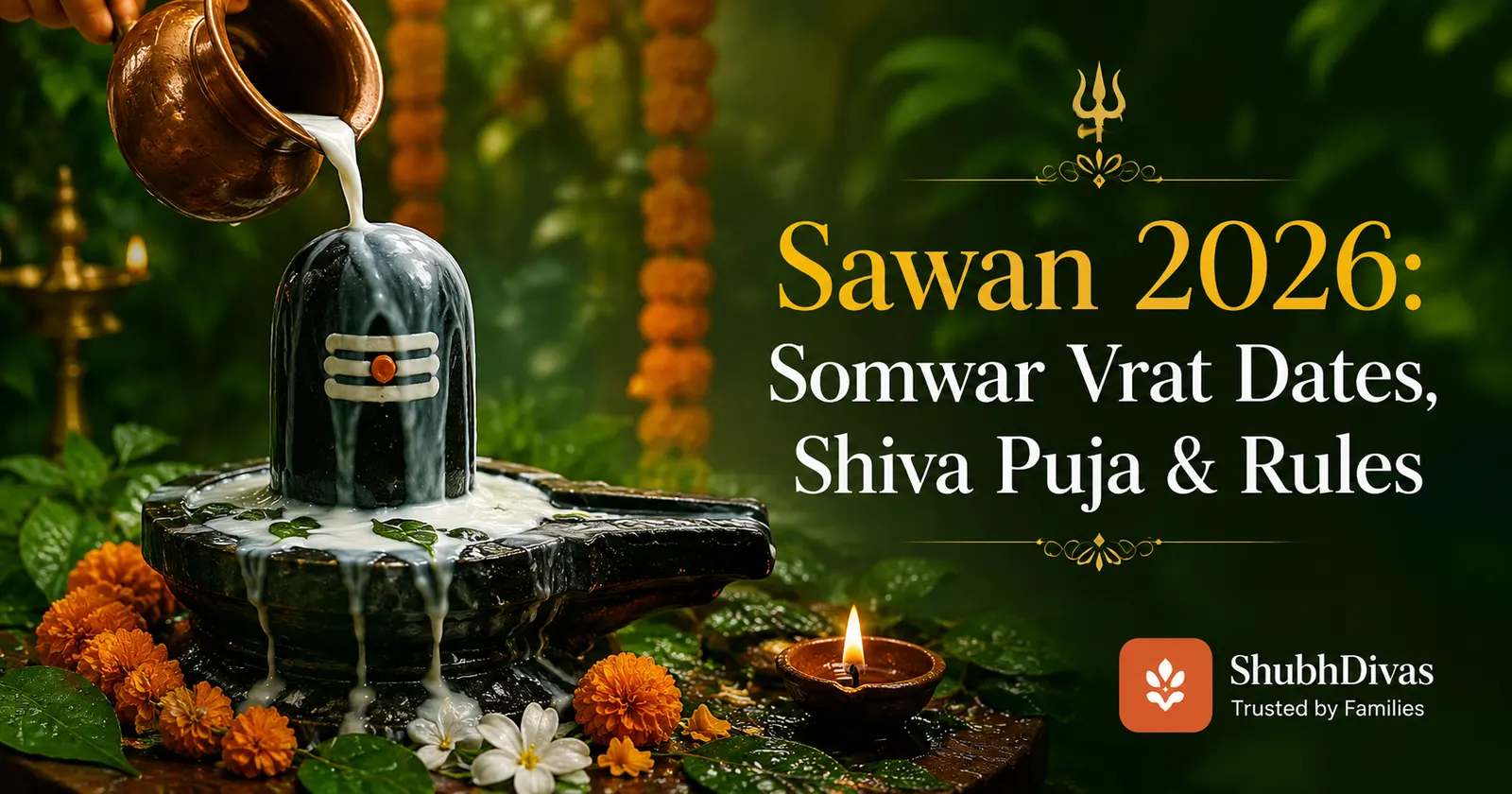

The first Shravan Somwar of 2026 falls on Monday, August 3 — the opening Monday of Sawan (Shravana), the holiest month of the Hindu year for the worship of Lord Shiva. Of all the days dedicated to Shiva, the Mondays of Sawan are considered the most powerful: Monday (Somwar) is Shiva's own weekday, and falling within his own month multiplies its grace many times over. Devotees keep the Shravan Somwar Vrat — a Monday fast — to seek Shiva's blessings for health, a good marriage, family well-being, and the removal of obstacles.
This is the vrat that fills temples with the sound of Har Har Mahadev, the lines of devotees pouring water and milk over the Shivalinga, and the whole month's devotional rhythm. Here are all four Somwar dates for 2026, the complete vrat vidhi, and how to observe it. (For the full month's festivals and rules, see our Sawan 2026 guide.)
Shravan Somwar 2026 — All Four Dates
| # | Shravan Somwar | Date (2026) |
|---|---|---|
| 1st | First Monday | Monday, August 3 |
| 2nd | Second Monday | Monday, August 10 |
| 3rd | Third Monday | Monday, August 17 |
| 4th | Fourth Monday | Monday, August 24 |
These dates follow the North Indian (Purnimanta) reckoning of Shravana, which begins on July 30, 2026. In some southern and western regions Shravana begins later, so the Somwar count can differ — confirm your regional calendar on the ShubhDivas Panchanga.
Alongside the Mondays, married women also keep the Mangala Gauri Vrat on the Tuesdays of Sawan (worshipping Goddess Gauri/Parvati) — the two run side by side through the month.
Why Shravan Somwar Is So Powerful
Several streams of meaning converge on these Mondays:
- Monday belongs to Shiva. The Moon (Soma) adorns Shiva's head, and Somwar is universally his day — so a Monday vrat is always Shiva-directed.
- Sawan is Shiva's month. During the churning of the ocean (Samudra Manthan), Shiva drank the Halahala poison to save creation, holding it in his throat (becoming Neelkanth, the blue-throated). This happened in Shravana, and the devas poured Ganga water over him to cool the poison's heat — which is why abhishekam with water is the central rite of the month.
- The monsoon setting. Shravana is the heart of the rains, when the earth is green and cool — a season the tradition turns toward devotion, fasting, and inner practice rather than worldly ventures (it falls within Chaturmas).
Together these make the Shravan Mondays the single best window in the year to begin or deepen Shiva worship.
Shravan Somwar Vrat Vidhi — How to Observe
- Wake early and bathe. Rise in the Brahma Muhurta, bathe, wear clean (ideally white or green) clothes, and take the sankalp to keep the Somwar vrat.
- Visit a Shiva temple or set up a home shrine. Many begin the day with darshan at a Shiva temple.
- Perform Jalabhishek / Rudrabhishek. Bathe the Shivalinga with water, then (optionally) the panchamrit — milk, curd, ghee, honey, and sugar — and water again. Offer bilva (bel) leaves, white flowers (aak/dhatura where customary), sandal paste, bhang or fruit, and a ghee lamp. Bilva leaves are Shiva's most beloved offering.
- Chant Shiva's mantras. Recite "Om Namah Shivaya", the Mahamrityunjaya Mantra, or the Rudrashtakam. A Rudrabhishek with the Rudram is especially meritorious on these days.
- Keep the fast. Observe a single-meal or fruit (phalahar) fast through the day; some keep nirjala. Break it after the evening Shiva puja.
- Read or hear the Somwar Vrat Katha and conclude with aarti.
What to Eat on the Shravan Somwar Fast
The fast is sattvik and grain-free. Permitted foods typically include:
- Fruits, milk, curd, and dry fruits.
- Vrat staples — sabudana (tapioca) khichdi or vada, kuttu (buckwheat) or singhara (water-chestnut) flour dishes, samak rice, boiled potatoes with sendha namak (rock salt).
- Avoid regular grains, rice, wheat, lentils, onion, garlic, and non-vegetarian food.
Most devotees take one such meal in the evening after the puja; the exact strictness depends on your family tradition and capacity.
Who Keeps the Shravan Somwar Vrat — and What It Grants
The vrat is kept by men and women alike, but it has a special place for the unmarried: girls traditionally keep the Shravan Somwar (and the related Solah Somwar — sixteen Mondays) praying for a good husband, as Parvati herself won Shiva through penance in this season. Married couples keep it for marital harmony and family welfare; others for health, peace of mind, and relief from obstacles, Saturn-related difficulty, or the desire for progeny. At its heart, the vrat is an act of surrender to Mahadev — Bholenath, the simple-hearted lord who is famously pleased by sincere devotion more than by elaborate ritual.
Solah Somwar Vrat & Rules to Keep It Right
Many devotees use Sawan to begin the Solah Somwar Vrat — sixteen consecutive Mondays of Shiva worship. Because Sawan's Mondays are the most auspicious, starting the count from the first Shravan Somwar (August 3, 2026) is especially favoured. The sixteen-week vow is completed with an udyapan (concluding ceremony) on the final Monday, where prasad — traditionally a sweet churma of wheat flour, ghee, and jaggery — is prepared and shared.
A few rules help the vrat carry its full merit:
- Resolve the count in advance. Decide before you begin whether you are keeping one Monday, the four of Sawan, or the full Solah Somwar — and complete what you vow.
- Use sendha namak (rock salt) in any vrat food; avoid regular salt and grains.
- Keep the day sattvik in conduct too — truthful speech, restraint, and avoiding anger; the vrat is of the mind as much as the stomach.
- Wear clean clothes (white or green are favoured) and avoid black on the day.
- Don't break the fast before the evening Shiva puja and the Vrat Katha.
- Offer bilva leaves the right way — the smooth side down, in odd numbers, fresh; never offer wilted or torn leaves.
The spirit matters more than perfection: Shiva is Bholenath, moved by sincerity. A simple Jalabhishek with a clear heart pleases him as much as an elaborate rite.
Check today's Rahu Kaal
Precise panchanga for your city — Rahu Kaal, tithi, nakshatra, sunrise, and more calculated accurately.
Free · Updated daily
Frequently asked questions
Find your auspicious muhurat
Personalised Vedic muhurat for your wedding, property, vehicle, or ceremony — reviewed by Acharya Suryakanth Subramaniam.
Find Muhurat →