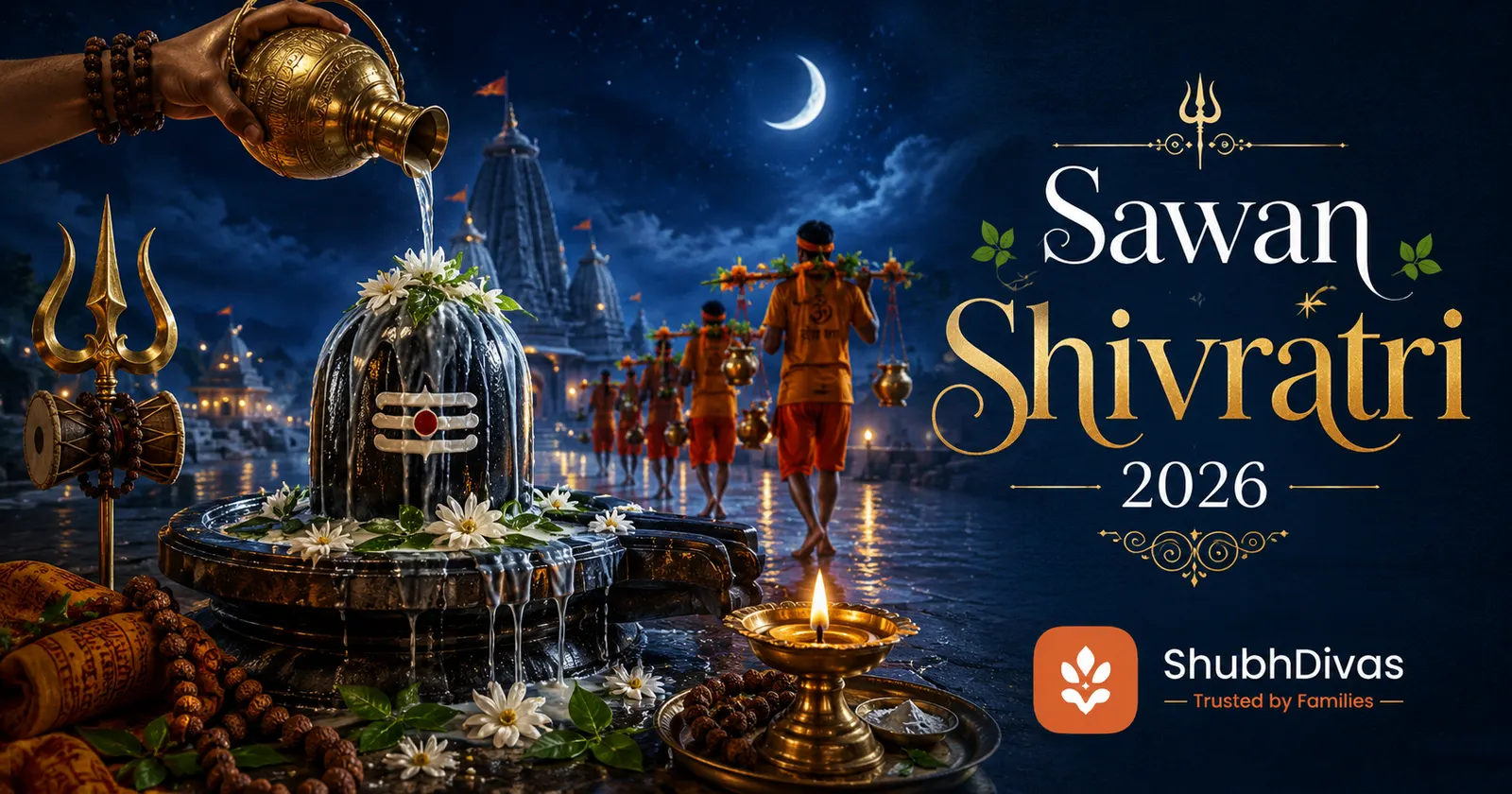


Of all the months in the Hindu calendar, Shravan carries the heaviest devotional charge. Sawan 2026 begins on Thursday, July 30 and ends on Friday, August 28 — thirty days during which every Monday becomes a fast, every Shivalinga receives abhishekam, and the sound of Om Namah Shivaya fills temples from Kashi to Rameswaram. For Shaivites, this is the year's most sacred month. For families across North and Central India, it is the month that defines the devotional rhythm of the entire year.
Sawan falls within Chaturmas — the four months when Lord Vishnu rests in yoga nidra. But Lord Shiva does not rest. Shravan is explicitly the month of Shiva's heightened presence and accessibility. The monsoon rains that fall during Shravan are considered Shiva's own tears of compassion. Every drop that falls is a form of his grace.
Here is everything you need for Sawan 2026: the start date, all four Somwar vrat dates, the complete puja vidhi, fasting rules, and every festival within the month.
Sawan 2026 — At a Glance
| Event | Date | Day |
|---|---|---|
| Sawan begins | July 30, 2026 | Thursday |
| 1st Sawan Somwar | August 3, 2026 | Monday |
| 2nd Sawan Somwar | August 10, 2026 | Monday |
| Sawan Shivratri (Maas Shivratri) | August 11, 2026 | Tuesday |
| Hariyali Amavasya | August 12, 2026 | Wednesday |
| Hariyali Teej | August 15, 2026 | Saturday |
| 3rd Sawan Somwar + Nag Panchami | August 17, 2026 | Monday |
| 4th Sawan Somwar | August 24, 2026 | Monday |
| Varalakshmi Vratam | August 28, 2026 | Friday |
| Sawan ends (Raksha Bandhan) | August 28, 2026 | Friday — Shravan Purnima |
When Sawan 2026 Begins and Ends
Shravan begins the day after Guru Purnima — the full moon of Ashadha (July 29). In the Purnimanta calendar followed across North India, a new lunar month begins on the day after Purnima. So Sawan 2026 starts on Thursday, July 30 — the first day of the Krishna Paksha of Shravan.
Sawan ends on Shravan Purnima — Friday, August 28 — which in 2026 is also Raksha Bandhan and Varalakshmi Vratam. The full moon of Shravan closes the month with a triple celebration.
The month spans 30 days covering both the Krishna Paksha (dark fortnight, July 30 – August 12) and the Shukla Paksha (bright fortnight, August 13 – August 28). Sawan falls entirely within Chaturmas — the four sacred months when weddings and new auspicious beginnings are paused. All Shiva worship, festivals, and vrats continue in full.
Why Is Sawan Sacred to Lord Shiva
The Puranas give several interwoven reasons why Shravan is Shiva's month.
During the Samudra Manthan — the churning of the cosmic ocean — the first thing to emerge was the terrible poison Halahala, capable of destroying all creation. Neither the Devas nor the Asuras could bear it. Lord Shiva consumed the poison to save the universe, holding it in his throat (giving him the name Nilakantha — the blue-throated one). The Devas, out of love and gratitude, immediately began pouring cooling water over Shiva's head to soothe the burning. The month when this happened was Shravan — and the practice of pouring water (abhishekam) on the Shivalinga during Shravan is a direct re-enactment of this cosmic act of relief.
A second reason: the Sun is in Cancer (Karka Rashi) during Shravan — the sign ruled by the Moon, and the Moon is Shiva's ornament (Chandrashekhara). The lunar energy of this period is considered to heighten Shiva's presence and make his blessings more accessible than at any other time.
A third reason is more intimate: Parvati, it is said, fasted every Monday of Shravan to win Shiva as her husband. The Sawan Somwar fast for women seeking an ideal husband — or praying for the long life of an existing one — carries this exact precedent. When Parvati observed the fast and Shiva relented, all of Shravan became the month of their reunion.
All 4 Sawan Somwar Vrat Dates 2026
There are four Sawan Somwars in 2026, falling on each Monday of the month:
| Vrat | Date | Tithi |
|---|---|---|
| 1st Sawan Somwar | Monday, August 3 | Shravana Krishna Panchami |
| 2nd Sawan Somwar | Monday, August 10 | Shravana Krishna Dwadashi |
| 3rd Sawan Somwar | Monday, August 17 | Shravana Shukla Panchami (Nag Panchami) |
| 4th Sawan Somwar | Monday, August 24 | Shravana Shukla Dwadashi |
The 3rd Sawan Somwar (August 17) coincides with Nag Panchami — one of the most auspicious double alignments in Shravan. Worshipping Shiva and the Nag Devta together on the same Monday brings the combined blessings of both.
Sawan Somwar Vrat — Puja Vidhi
The Sawan Somwar fast is among the most widely observed vrats in India. The procedure is consistent whether observed for the first time or the fortieth year.
Morning:
- Wake before sunrise. Bathe with clean water, ideally with sesame or ganga jal mixed in.
- Wear clean white or light-coloured clothes. Avoid black.
- Take the sankalp — a formal resolve to observe the fast for a specific intention, in the name of Lord Shiva.
- Prepare the puja with the following samagri.
Puja Samagri:
- Bilva patra (bel leaves) — the single most important offering to Shiva
- Raw milk, water, honey, curd, ghee, sugar — for panchamrit abhishekam
- Dhatura (thorn apple flowers/fruit) and aak flowers
- White flowers — lotus or chameli if available
- Haldi, kumkum, chandan paste, akshat (unbroken rice)
- Incense, camphor, ghee lamp
- Fruit and sweets for naivedya
Abhishekam: 5. Pour water over the Shivalinga first — slowly, in a continuous stream. 6. Follow with panchamrit (milk, curd, honey, ghee, sugar) — the complete ritual bath. 7. Wash with water again to complete the abhishekam.
Worship: 8. Apply chandan paste to the Shivalinga. 9. Offer bilva patra — place three-leafed bilva leaves at the base or atop the Shivalinga. Bilva offered to Shiva is said to give the merit of performing a thousand Ashwamedha yagnas. 10. Offer dhatura, aak, and white flowers. 11. Light the deepam and dhoop. 12. Recite Om Namah Shivaya 108 times, or recite the Shiva Panchakshara Stotram. 13. Perform the aarti.
Fast rules:
- The complete fast is nirjala (no water) from sunrise to sunset, but most devotees observe phalahar — fruit, milk, and non-grain food only through the day.
- One meal is taken after the evening aarti at sunset or after moonrise.
- Salt (sendha namak / rock salt only), fruits, sabudana, singhare ka atta, milk, and dry fruits are permitted. Regular grains and pulses are avoided.
- Those with health conditions, elderly, pregnant, or unwell individuals should take a phalahar fast rather than nirjala.
Shiva Panchakshara Mantra
The five-syllable mantra is the foundation of all Sawan worship:
ॐ नमः शिवाय Om Namah Shivaya
Each syllable corresponds to one of the five elements and one of Shiva's five aspects — Na (earth, Shiva as Brahman), Ma (water, Shiva as Vishnu), Shi (fire, Shiva as Rudra), Va (air, Shiva as Maheshvara), Ya (sky/ether, Shiva as Sadashiva). Reciting the five syllables is reciting the entirety of Shiva's cosmic form.
Recite it 108 times at minimum on each Sawan Monday — with a mala (rudraksha is most appropriate), or simply counted on the fingers.
Festivals During Sawan 2026
Sawan Shivratri — Tuesday, August 11
The monthly Shivratri (Maas Shivratri) falls on the Krishna Chaturdashi of every month. In Sawan, this Maas Shivratri carries special significance — it is Shiva's night within his own month. Observe a night vigil, perform the four prahar pujas (every three hours through the night), and recite the Shiva Sahasranama or Shiva Mahimna Stotram. Temples remain open through the night.
Hariyali Amavasya — Wednesday, August 12
The new moon of Sawan — called Hariyali Amavasya — is dedicated to ancestral prayers (Pitru Tarpan) and the planting of trees. Hariyali means greenness: the monsoon-soaked earth is at its most fertile, and the tradition of planting saplings on this day is an acknowledgement of that abundance. Families visit Shiva temples, offer prayers for ancestors, and plant trees — especially Peepal, Banyan, or Tulsi — as an act of merit.
Hariyali Teej — Saturday, August 15
Shravana Shukla Tritiya — the third day of the bright fortnight — is Hariyali Teej. Married women and young girls dress in green, swing on jhulas (swings) hung from trees, sing monsoon songs, and fast for the wellbeing of their husbands. The festival celebrates the reunion of Parvati and Shiva and is one of three major Teej festivals in the Hindu calendar (the others being Kajari Teej and Hartalika Teej). In 2026, Hariyali Teej falls on India's Independence Day — August 15, Saturday. Hariyali Teej falls during Sawan — read our complete guide to Hariyali Teej 2026.
Nag Panchami — Monday, August 17
The fifth day of Shravana Shukla Paksha is Nag Panchami — worship of the serpent deities. In 2026, it falls on the 3rd Sawan Somwar, creating a double auspicious alignment: Shiva worship on Monday plus Nag Devta worship on Panchami, both combined. Read the complete Nag Panchami puja vidhi and significance.
Mangala Gauri Vrat — Four Tuesdays
Newly married women observe the Mangala Gauri Vrat on each Tuesday of Shravan for the first five years of marriage. The vrat is dedicated to Goddess Mangala Gauri (a form of Parvati) for the health, long life, and prosperity of the husband. The four Mangala Gauri Tuesdays in 2026 are: August 4, August 11, August 18, and August 25.
Kanwar Yatra
The Kanwar Yatra is one of India's largest annual pilgrimages. Devotees — called Kanwariyas — travel on foot to the Ganges to collect Ganga Jal (sacred water) in decorated containers (kanwars) and carry it back to offer at their local Shiva temple. The pilgrimage takes place through the month of Sawan, with the final offering made on the last Monday, or on Sawan Shivratri. Kanwariyas travel in orange and saffron, chanting Bol Bam ("Speak, Shiva!"), through UP, Bihar, Uttarakhand, Delhi, Haryana, and Rajasthan. The scale of the yatra — tens of millions of participants in active years — makes it one of the largest annual human gatherings on earth.
Shravan and the Jyotirlinga Temples
The twelve Jyotirlinga temples across India see their highest footfall of the year during Sawan. Somnath (Gujarat), Kashi Vishwanath (Varanasi), Mahakaleshwar (Ujjain), Omkareshwar (MP), Kedarnath (Uttarakhand), Bhimashankar (Maharashtra), Trimbakeshwar (Nashik), Rameshwaram (Tamil Nadu) — each receives millions of devotees during the month. If temple travel is possible during Shravan, any of the Jyotirlingas carries particular spiritual significance.
Regional Traditions in Sawan
North India (UP, Bihar, Rajasthan, Delhi): Sawan is the dominant devotional period of the year. Every neighbourhood temple holds daily abhishekam and aartis. The Kanwar Yatra is at its most intense in UP and Bihar. Sawan Somwar fasts are observed by virtually every Hindu household.
Maharashtra: Sawan Mondays are observed but Sawan's most significant festival is Nag Panchami, followed by the month-long Shravana Maas puja. The Kanwar Yatra is less prominent than in the North.
South India: The month is observed as Aavani (in Tamil) or Shravana (in Kannada/Telugu). Nag Panchami is especially important. The Varalakshmi Vratam on the last Friday of Shravan (August 28 in 2026) is the defining women's festival of the month in Karnataka, Andhra, Telangana, and Tamil Nadu.
Gujarat: Shravan is observed with Shiva worship but without the Kanwar Yatra tradition. The Jal Jhilani Ekadashi (Shravana Shukla Ekadashi) — a Vaishnava festival — falls within the month and is widely observed by Gujarati communities.
Check today's Rahu Kaal
Precise panchanga for your city — Rahu Kaal, tithi, nakshatra, sunrise, and more calculated accurately.
Free · Updated daily
Frequently asked questions
Find your auspicious muhurat
Personalised Vedic muhurat for your wedding, property, vehicle, or ceremony — reviewed by Acharya Suryakanth Subramaniam.
Find Muhurat →