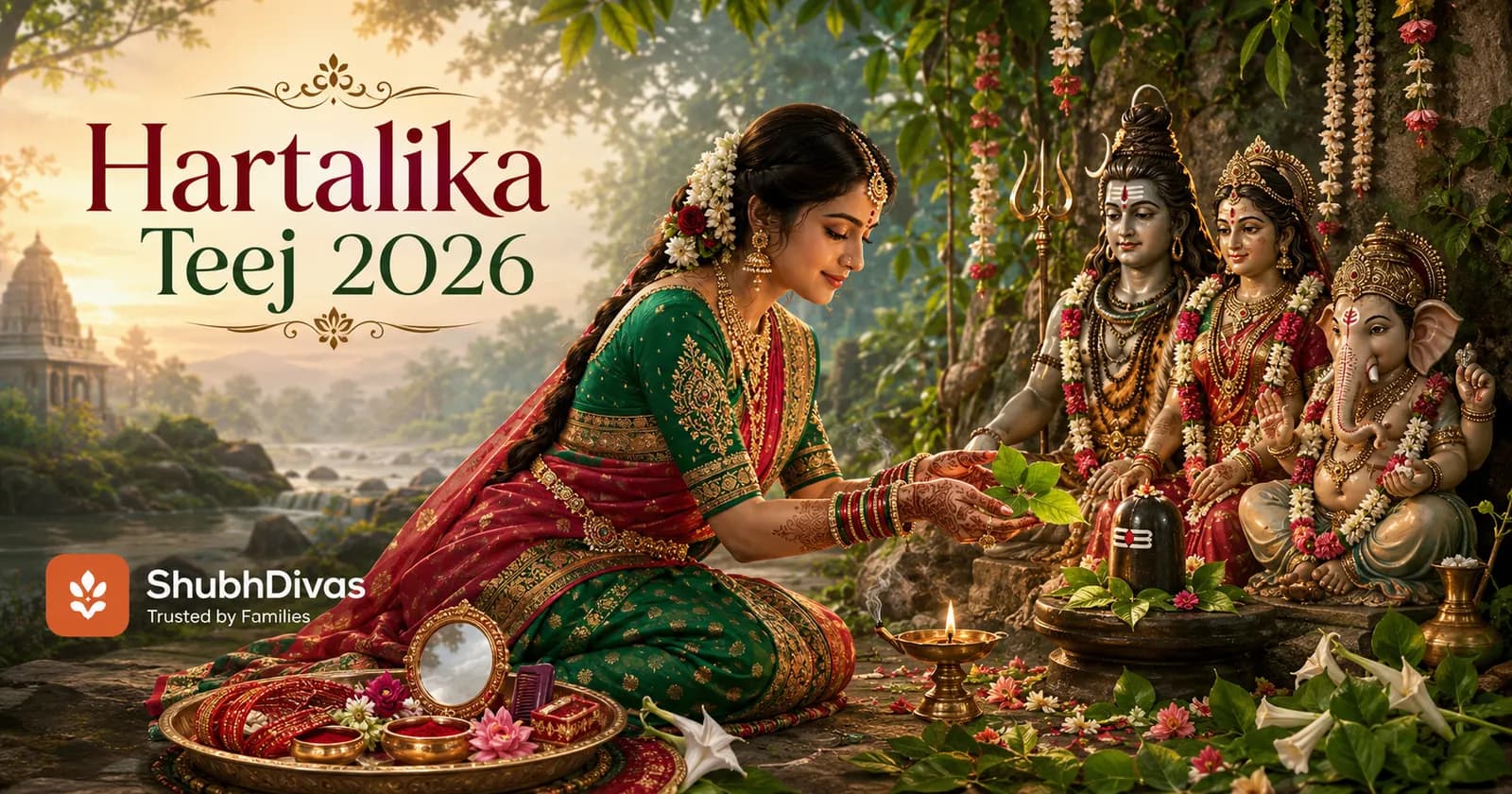

Hartalika Teej 2026 falls on Monday, September 14. It is the Tritiya (third tithi) of the bright fortnight (Shukla Paksha) of the Bhadrapada lunar month — the third and strictest of the three Teej festivals, following Hariyali Teej and Kajari Teej. Kept above all by married women for the long life and wellbeing of their husband and for marital bliss, it is also the fast of unmarried girls who pray, as Parvati once did, to win a husband of their own devotion.
Hartalika Teej is famous for its severity: a nirjala vrat kept without food or even water, often through a sleepless night of worship. Its name tells its story — harat (abduction) and aalika (female friend) — for it recalls how Parvati's friend carried her away to the forest so she could complete the penance that won her Lord Shiva. Here is the verified date, the Vrat Katha, and the complete way to observe it.
Hartalika Teej 2026 — Date and Muhurat
| Detail | Information |
|---|---|
| Festival | Hartalika Teej |
| Date | Monday, September 14, 2026 |
| Lunar month | Bhadrapada, Shukla Paksha (waxing fortnight) |
| Tithi | Tritiya (third lunar day) |
| Deity | Goddess Parvati & Lord Shiva |
| Pratahkala (morning) puja muhurat | approx. 06:04 AM – 07:06 AM |
| Pradosh (evening) puja | the twilight window is also observed |
| Fast | Nirjala — without food or water, with a night vigil |
The Tritiya tithi runs from 07:08 AM on Sep 13 to 07:06 AM on Sep 14. Timings shift by your city's longitude — confirm the Pratahkala muhurat for your city on the ShubhDivas Panchanga before the vrat.
Is Hartalika Teej on September 13 or 14 in 2026?
Because the Tritiya tithi begins on the morning of September 13 and ends on the morning of September 14, you will see both dates online — and both have a basis.
The observance rule for Hartalika Teej favours the day on which Tritiya is present at sunrise, which is September 14 (the Tritiya tithi runs until 07:06 AM that morning), and the puja is done in the Pratahkala just after dawn. This is why DrikPanchang and most panchangs place Hartalika Teej 2026 on Monday, September 14 — the same day as Ganesh Chaturthi. However, since Tritiya prevails through the daytime of September 13, some regional traditions observe the vrat then, especially where it is kept with a Pradosh (evening) puja. Follow your family's and community's panchang; where there is no fixed custom, September 14 is the widely accepted date.
The Significance of Hartalika Teej
Of the three Teej festivals — Hariyali, Kajari, and Hartalika — all honour the union of Parvati and Shiva, the ideal of married devotion, but Hartalika is the culmination and the most austere. It commemorates the penance by which Parvati won Shiva as her husband after lifetimes of longing, and so married women keep it for the constancy of their own marriage and the long life of their husband, while unmarried girls keep it in prayer for a worthy spouse.
What sets Hartalika apart is its discipline. The fast is nirjala — taken without even a sip of water — and traditionally held through the day and a night of vigil (jagran), spent singing bhajans and worshipping through the four prahars of the night. Nothing is offered to the fast's severity but devotion; and by that devotion, the tradition promises, the blessings of an unbreakable saubhagya are earned.
The Vrat Katha of Hartalika Teej
The story is told by Lord Shiva himself to Parvati, to remind her of how their union came to be.
In a former life, Parvati was born as the daughter of the mountain king Himalaya, and from her girlhood her heart was set on Shiva alone. To win him, she withdrew to the forest and undertook a fierce penance — living on air and fallen leaves, enduring heat and cold, worshipping a Shivling she fashioned with her own hands from sand. Her austerity was so great that the earth trembled with it.
Meanwhile the sage Narada came to Himalaya with a proposal: that Parvati be given in marriage to Lord Vishnu. Himalaya, honoured, agreed. But when Parvati learned of it, she was stricken — her vow was to Shiva, and to no other. She confided her grief to her dearest friend (sakhi), who, unwilling to see her forced into a marriage against her heart, carried her away (harat) to a hidden cave in the deep forest so that she might continue her penance undisturbed. There, on the Bhadrapada Shukla Tritiya, Parvati worshipped the sand Shivling through the day and kept a waterless fast and a night-long vigil.
Moved at last by the purity and constancy of her devotion, Lord Shiva appeared and granted her wish — accepting her as his eternal consort. When Himalaya found his daughter and understood all that had passed, he too consented, and Parvati and Shiva were wed. So the katha carries its promise still: that the woman who keeps the Hartalika vrat with sincere heart is blessed, as Parvati was, with the constancy and grace of a devoted marriage.
Check today's Rahu Kaal
Precise panchanga for your city — Rahu Kaal, tithi, nakshatra, sunrise, and more calculated accurately.
Free · Updated daily
How to Observe Hartalika Teej — Puja Vidhi
Before the fast. On the night before, many women take a light sattvik meal; some begin the nirjala fast from the evening prior. On the morning of the vrat, rise before dawn, bathe, adorn yourself in the solah shringar — new clothes (often green or red), bangles, bindi, mehndi, and sindoor for the married — and take the sankalp to keep the fast for your husband's long life (or, for the unmarried, for a good husband).
The puja. In the Pratahkala (or Pradosh), prepare an idol of Lord Shiva, Goddess Parvati, and Ganesha fashioned from sand or clay, and set a small Shivling among them. Worship the divine couple with belpatra (bilva leaves), flowers, sandal, dhatura, fruit, and a ghee lamp; offer Parvati the tokens of saubhagya — bangles, sindoor, comb, mirror, and mehndi — in a shringar thali. Recite the Hartalika Teej Vrat Katha and the Shiva-Parvati mantras.
The night vigil. Traditionally the vrat is kept through a jagran — the night divided into four prahars, each with its own worship of Shiva, spent awake in bhajan and remembrance rather than sleep.
Breaking the fast. The nirjala fast is broken the next morning (September 15) after the sunrise puja and arati, once the observance is formally concluded. It is customary to give daan — clothing or the shringar articles to a Brahmin or a needy married woman — as part of the vrat's merit.
What to Keep in Mind
- The fast is nirjala and demanding — those who are pregnant, unwell, or unable should keep it according to their capacity (a fruit-and-water fast) rather than risk their health; devotion, not severity, is its heart.
- Keep the day in restraint of speech and temper, not only of food — a vrat is undone by anger and harsh words.
- Because Hartalika falls within Chaturmas, it is a season of festivals, not ceremonies — weddings and griha pravesh remain paused (see our September 2026 auspicious dates).
Hartalika vs Hariyali vs Kajari Teej
The three Teejs are easily confused; here is how they differ in 2026:
- Hariyali Teej — Shravana Shukla Tritiya (Aug 15): the festive "green" Teej at the height of the monsoon.
- Kajari Teej — Bhadrapada Krishna Tritiya (Aug 31): the folk-song Teej, broken at moonrise.
- Hartalika Teej — Bhadrapada Shukla Tritiya (Sep 14): the strictest, a nirjala fast with a night vigil and the sand Shiva-Parvati puja.
Frequently asked questions
Find your auspicious muhurat
Personalised Vedic muhurat for your wedding, property, vehicle, or ceremony — reviewed by Acharya Suryakanth Subramaniam.
Find Muhurat →