
A match looks perfect on paper. Good family, good job, everyone is excited, and when someone quickly checks the kundali matching numbers they seem reasonable. Then the family pandit opens the Jathaka and checks one specific thing. He looks up and says, quietly: "Rajju porutham illai." And the room, just moments ago warm and hopeful, changes. The family says they need to think about it. Then they say no. What just happened? If you are not from a South Indian family — or if you are, but this is the first time you've heard this explained in plain language — this is your guide to rajju porutham explained simply and fully.
What Is Rajju Porutham?
The South Indian marriage compatibility system is called Dasha Porutham — ten specific checks that a family pandit performs when two Jathakas (birth charts) are brought together. Each porutham examines a different dimension of compatibility: health, temperament, progeny, longevity, and so on. The ten checks are evaluated individually, and the overall picture guides a family's decision.
Rajju Porutham is one of these ten. But calling it "one of ten" undersells it significantly. Within the Dasha Porutham system, Rajju carries a weight that no other porutham carries. Most of the other nine are considered important but negotiable — a mismatch in one or two of them is something many families will accept if the overall picture is strong. Rajju is different. For a large number of traditional South Indian families, a Rajju mismatch is not negotiated around. It is a no.
The Difference Between North and South Indian Systems
Before going further, it helps to understand why rajju porutham in english is so hard to find explained well. Most astrology content in English is written for North Indian audiences, where the dominant system is Ashtakoota Milan — eight kootas scored against each other, totalling 36 points. Nadi Dosha, which many readers will have heard of, is the most weighted factor in that system. The recommendation is usually that a score above 18 out of 36 is acceptable, though families vary on exactly where they draw the line.
The South Indian system is structured entirely differently. It is not a scoring system at all. Each of the ten poruthams either matches or it does not — there is no partial credit, no aggregate score to rely on. This makes it feel more absolute than Ashtakoota to outsiders, and in practice, for Rajju specifically, that is exactly how most families treat it.
When a North Indian and South Indian family meet for a rishta — which happens increasingly in urban India — this difference causes genuine confusion. Which system applies? The honest answer is that both families should apply their own tradition. The North Indian family checks their Ashtakoota. The South Indian family checks their Dasha Porutham, including Rajju. Incompatibilities from either system deserve an honest conversation, not automatic rejection but not quiet dismissal either.
The Five Rajju Groups
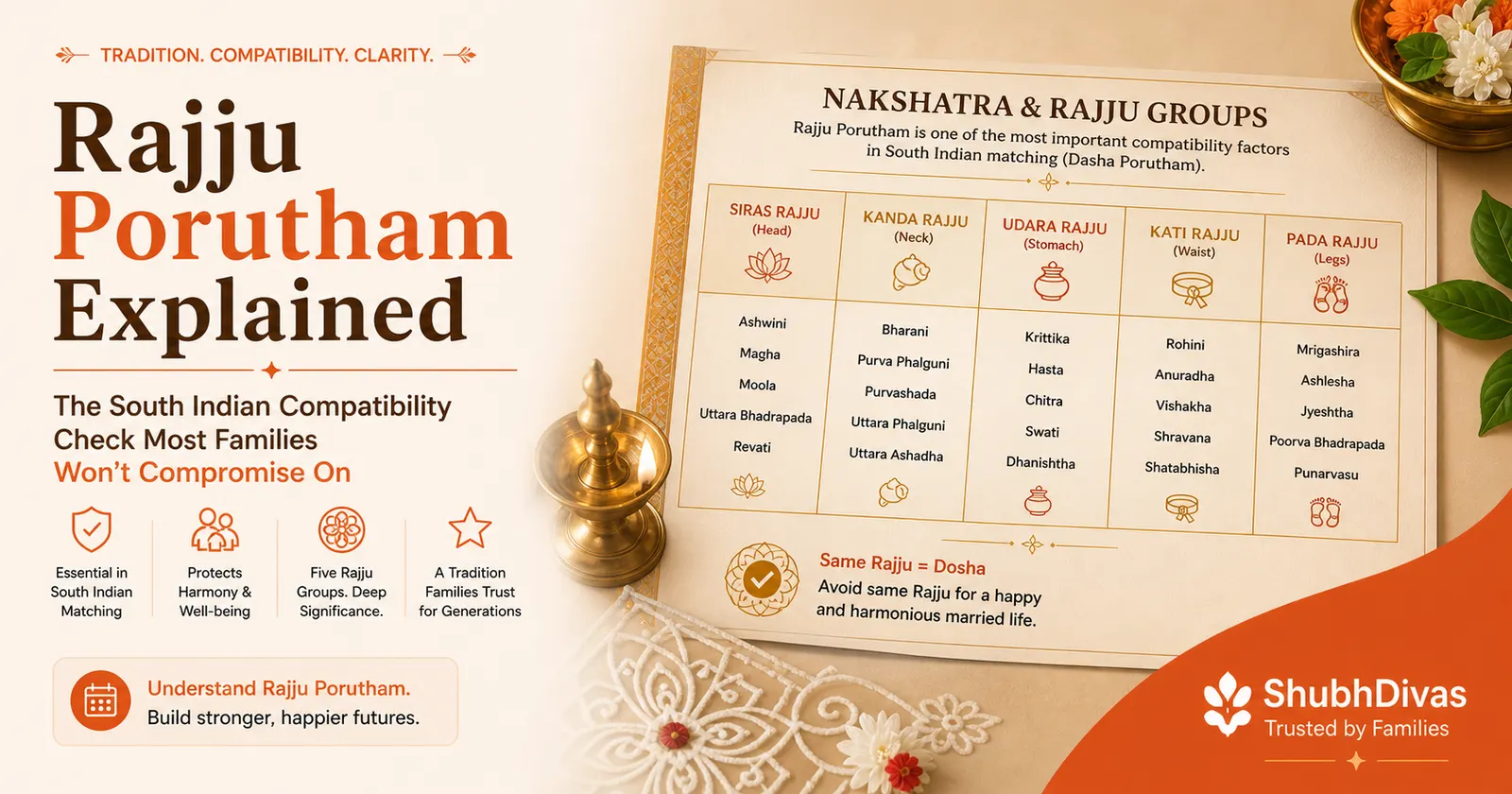
This is the technical heart of rajju porutham explained. Every one of the 27 Nakshatras belongs to one of five Rajju groups. Each group is named after a part of the body — Shiro (head), Kantha (neck), Udara (stomach), Kati (hips), and Pada (feet). If both the bride's birth Nakshatra and the groom's birth Nakshatra fall within the same group, Rajju Porutham does not match. That is the entire rule. Its simplicity is part of what makes it so final.
Shiro Rajju — the Head. The Nakshatras Mrigashira, Chitra, and Dhanishtha belong here. Traditional belief holds that same Shiro Rajju is considered particularly inauspicious for the husband's longevity and wellbeing.
Kantha Rajju — the Neck. Rohini, Hasta, and Shravana form this group. This is considered the most serious Rajju mismatch of all — traditionally believed to be inauspicious for both partners, not only one.
Udara Rajju — the Stomach. Krittika, Uttara Phalguni, and Uttara Ashadha are grouped here. Same Udara Rajju is traditionally associated with financial difficulties in the marriage.
Kati Rajju — the Hips. Bharani, Purva Phalguni, and Purva Ashadha belong to this group. Kati Rajju mismatch is traditionally linked to separation between partners.
Pada Rajju — the Feet. This is the largest group by far, containing fifteen Nakshatras: Ashwini, Ashlesha, Magha, Jyeshtha, Mula, Revati, Punarvasu, Vishakha, Purva Bhadrapada, Pushya, Anuradha, Uttara Bhadrapada, Ardra, Swati, and Shatabhisha. Because Pada Rajju is so large, it is statistically the most common group for both partners to share — which is why Rajju concerns come up as often as they do in practice.
Rajju Porutham is considered the most critical of the 10 South Indian poruthams. Unlike other poruthams where mismatches are sometimes overlooked when the broader picture is strong — same Rajju is rarely compromised on in traditional South Indian families. Kantha Rajju (neck) is considered the most serious of the five groups.
Why Same Rajju Is Considered Serious
It is worth sitting with why this belief exists, rather than either dismissing it or accepting it without understanding. The traditional reasoning is not superstition for its own sake — it reflects a worldview in which human beings carry energetic constitutions that interact with those around them, particularly in the closest of relationships.
Each Rajju group is associated with a part of the body that, in traditional Vedic thinking, governs a particular domain of life — vitality, communication, sustenance, stability, movement. When two people share the same Rajju, the tradition holds that the same energy is amplified in both, rather than complemented and balanced. The specific outcome predicted depends on which group is shared, which is why Kantha Rajju is treated more seriously than Pada Rajju by many pandits.
These beliefs are held sincerely by millions of families. Presenting them clearly and respectfully is the only honest way to explain rajju porutham in english — not as relics to be gently mocked, and not as absolute scientific truths, but as a living tradition that shapes real decisions in real families across Tamil Nadu, Andhra Pradesh, Kerala, and Karnataka every day.
How Rajju Compares to Nadi Dosha
For readers who have come to this post from the North Indian side of things, the closest parallel is nadi dosha — the most weighted factor in Ashtakoota Milan, where same nadi between two partners results in zero points for the highest-value koota. The emotional weight is similar: both are considered fundamental compatibility concerns, both are given the highest authority within their respective systems, and both cause families to pause or reject matches that look strong in every other way.
But they are calculated entirely differently. Nadi Dosha is based on the nadi classification of a person's Nakshatra — three nadis across 27 Nakshatras — and is specifically associated with progeny and physical health compatibility. Rajju groups the same 27 Nakshatras into five categories based on body-part symbolism and evaluates energetic complementarity more broadly. A couple can have nadi dosha in the North Indian Ashtakoota system while having perfectly matching Rajju in the South Indian system, and vice versa. The two concerns are independent of each other.
What Families Actually Do
In practice, families handle same Rajju in three distinct ways, and being honest about all three is more useful than pretending there is one correct response.
Families who are strict about tradition will not proceed with the match regardless of other factors. For them, the pandit's assessment of same Rajju is the end of the conversation, and that is a legitimate position that deserves respect.
Families who are more flexible will consult multiple pandits and look for minority opinions or specific exceptions. Some pandits will accept cancellations in particular circumstances — certain planetary placements in the chart, or specific Nakshatra padas that carry reduced Rajju intensity. These opinions vary significantly by pandit and by regional tradition within South India itself. What holds in one family's community may not hold in another's.
Intercommunity couples — and increasingly, couples where one partner is from a North Indian family and one from a South Indian family — face an additional layer of complexity. Which system governs the match? The only reasonable answer is transparency: both families check their own system and discuss any concerns openly with each other, rather than quietly applying a standard the other family doesn't know about.
The Rational Perspective
Rajju Porutham carries real cultural weight, and it deserves to be taken seriously by anyone navigating a South Indian rishta — even if, personally, you hold a more rational worldview. The families you are dealing with hold these beliefs sincerely. Understanding what Rajju is and what same Rajju means allows you to have more honest, less confused conversations.
Many couples who share a Rajju group have gone on to build strong, long marriages. The system was designed as guidance for a decision — not as an absolute verdict about what a particular couple's life will look like. The modern approach that works best for most families is to be fully informed, consult a pandit your family trusts and respects, and then make a decision that both families can stand behind — one rooted in understanding rather than either blind acceptance or uninformed dismissal.
The goal of any compatibility check — whether it is Rajju Porutham, Nadi Dosha, or any of the other poruthams — is to support a good decision, not to create anxiety.
Frequently asked questions
A Note From ShubhDivas
We built ShubhDivas because accurate, honest information about these traditions is genuinely hard to find in English — and when families are making one of the most important decisions of their lives, they deserve better than vague reassurances or poorly explained technical content.
We present the Dasha Porutham system — including Rajju — as it actually works, not softened and not amplified. We respect families who hold strictly to these traditions, and we respect those who take a more informed, flexible approach. Neither position makes someone a bad Hindu or a bad parent. Both positions deserve accurate information to reason from.
What ShubhDivas never replaces is the judgment of a pandit who knows your family, your community's specific tradition, and the full picture of both charts in front of them. We complement that conversation — we don't substitute for it.
Find your auspicious muhurat
Get a personalised Vedic muhurat for your wedding, property purchase, or any important activity.
Free · Takes 2 minutes
Get a detailed Nadi Dosha Report
Both partners' Nadi identified, all 5 classical cancellation conditions checked, severity score 1–10, and Nadi Nivarana puja recommendations. ₹99.
₹99 · Delivered within 24 hours
 Acharya Suryakanth Subramaniam | Parashari Jyotish
Get Your Personalised Reading
Reviewed by Acharya Suryakanth Subramaniam | Classical Parashari Jyotish
Nadi Dosha Report — ₹99 →