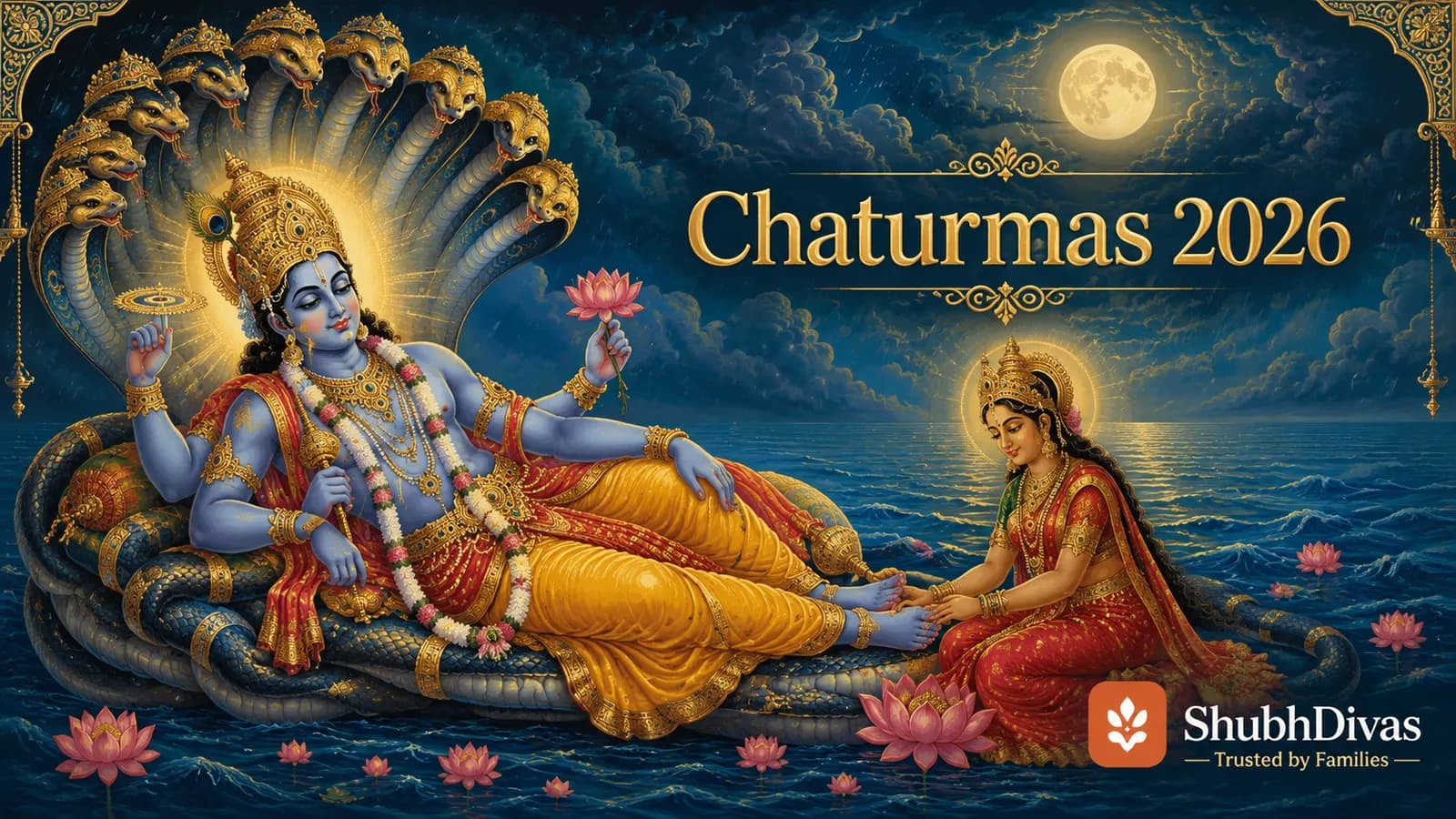

Devshayani Ekadashi 2026 falls on Saturday, July 25 — Ashadha Shukla Ekadashi, the eleventh day of the bright fortnight of the Ashadha lunar month. This is one of the most consequential days in the Hindu calendar — the day Lord Vishnu enters his cosmic sleep (yoga nidra) and Chaturmas, the four-month sacred period, begins.
From this day until Devutthana Ekadashi on November 20, 2026, the tradition holds that Vishnu rests on Adi Shesha in the Kshira Sagara (cosmic ocean of milk). During these four months, auspicious ceremonies are traditionally avoided, spiritual practice is intensified, and the devotional year enters its most introspective phase.
Devshayani Ekadashi 2026 — Key Details
| Detail | Information |
|---|---|
| Date | Saturday, July 25, 2026 |
| Tithi | Ashadha Shukla Ekadashi |
| Also called | Shayani Ekadashi, Padma Ekadashi, Maha Ekadashi |
| Chaturmas begins | July 25, 2026 |
| Chaturmas ends | Devutthana Ekadashi, November 20, 2026 |
| Duration | 4 months (approximately 118 days) |
The Cosmic Event — What Happens on Devshayani Ekadashi
The Vishnu Purana, Bhagavata Purana, and Padma Purana all describe the same cosmic event:
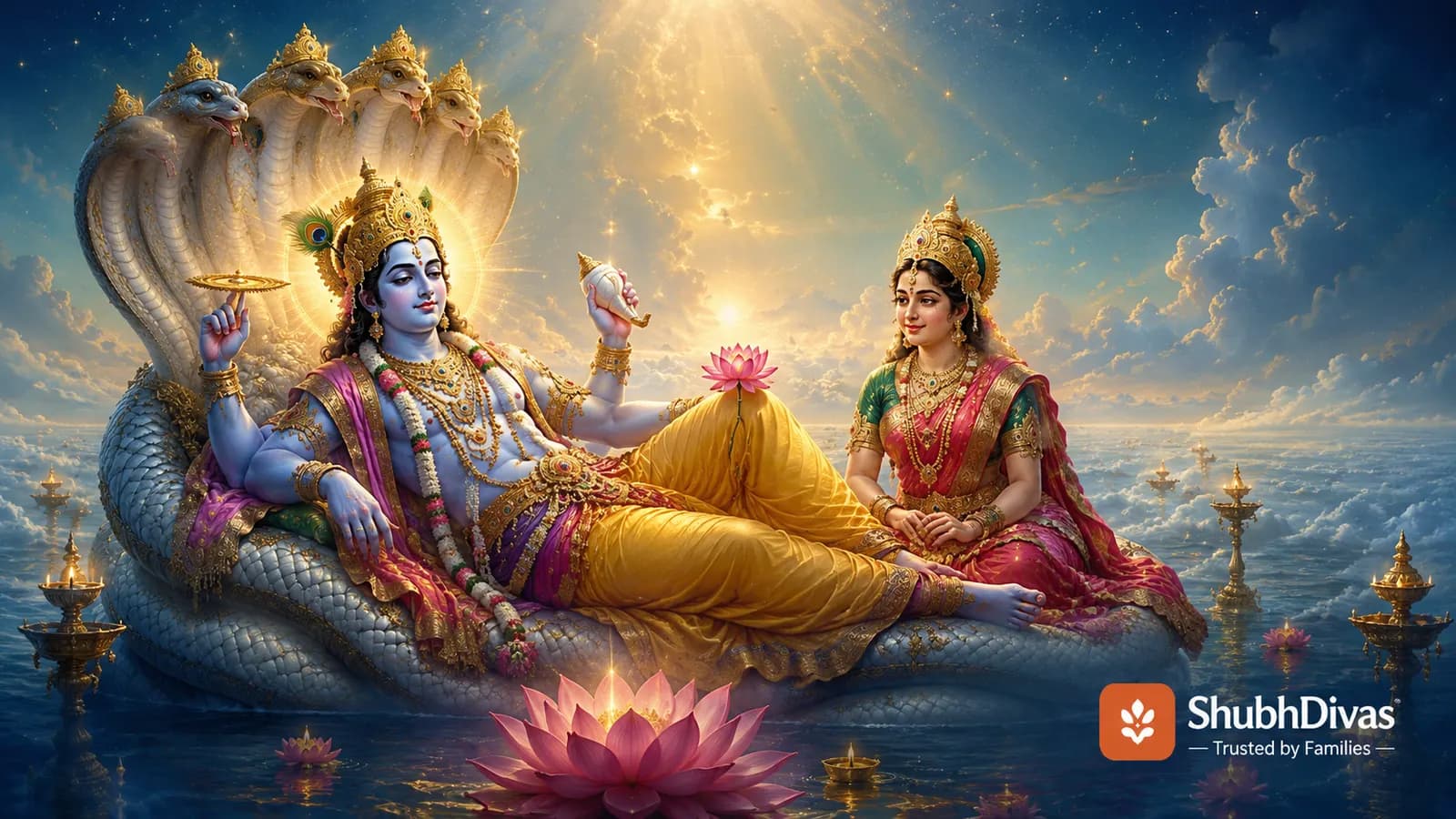
On Ashadha Shukla Ekadashi, Lord Vishnu — the preserver and sustainer of the universe — reclines on Adi Shesha, the thousand-hooded serpent who floats on the primordial ocean (Kshira Sagara). Vishnu enters yoga nidra — not ordinary sleep, but a state of transcendent consciousness that is simultaneously rest and all-pervading awareness. His consort Lakshmi sits at his feet.
This is not absence. The tradition is explicit: Vishnu does not stop sustaining the universe during Chaturmas. The world continues; dharma continues; Vishnu's presence continues. But the accessible form of Vishnu — the aspect that responds to prayers, grants boons, and actively intervenes — withdraws into this four-month contemplation.
The significance for human life is both practical and spiritual:
- Practically: auspicious beginnings that require divine sanction (weddings, investitures, new businesses) are not started during Vishnu's sleep. The groom's party must obtain Vishnu's blessing for a marriage — and if Vishnu is resting, the blessing is not available in the same way.
- Spiritually: Chaturmas is intended as a period of inward practice. Without the active support for outward expansion and new beginnings, the energy naturally turns inward — toward scripture, fasting, devotional practice, and the cultivation of qualities that will bear fruit when Vishnu wakes.
Chaturmas — The Four Sacred Months
| Month | Approximate Dates 2026 | Significance |
|---|---|---|
| Ashadha (remainder) | July 25–29 | Devshayani Ekadashi; Guru Purnima |
| Shravan | July 29–Aug 27 | Shiva worship; Nag Panchami; Raksha Bandhan |
| Bhadrapada | Aug 27–Sep 25 | Ganesh Chaturthi; Onam; Janmashtami |
| Ashwin | Sep 25–Oct 24 | Navaratri; Dussehra |
| (Kartika begins — Chaturmas ends Nov 20) | — | Devutthana Ekadashi |
The four months of Chaturmas span the entire monsoon season and post-monsoon period. In ancient India, this was the period when wandering monks and sannyasis would halt their travels and reside in one place, teaching and studying. This custom — called Chaturmas vrata for monks — is still observed in Jain, Buddhist, and Vaishnava traditions. Jain monks particularly observe the Paryushana restrictions during this period.
What Is Prohibited During Chaturmas
Auspicious events traditionally avoided from July 25 to November 20:
- Weddings and engagement ceremonies — this is the primary restriction families manage around
- Thread ceremonies (Upanayana/Munja) — sacred thread investiture
- Griha Pravesh — house-warming and entry into a new home
- New business inaugurations (in the stricter tradition)
What is not prohibited:
- All existing religious practices continue normally
- All Ekadashi fasts continue
- Festivals continue — Navaratri, Ganesh Chaturthi, Dussehra all fall within Chaturmas and are observed fully
- Personal vows, daily puja, and charitable giving continue and are in fact intensified
The logic is not restriction for its own sake. The tradition understands Vishnu's sleep as a time when the outward-facing, world-expanding energy of existence is temporarily withdrawn. New beginnings seeded now won't receive the same divine sanction. The four months are for consolidation, practice, and preparation — not for launches.
Vaishnava Chaturmas Vrata
Many Vaishnava devotees take on specific additional practices for the four months of Chaturmas:
- Specific fasting days: beyond regular Ekadashi, some devotees add Monday fasts (for Shiva), or fasts on auspicious Purnima days
- Dietary restrictions: traditionally, the four months had month-specific food restrictions — avoiding brinjal in Shravan, curd in Bhadrapada, milk in Ashwin, and pulses in Kartika. These are observed by traditional households.
- Scripture reading: completing the Bhagavata Purana (the Saptah reading) during Chaturmas is considered especially meritorious
- Increased alms-giving: charitable giving during Chaturmas is believed to carry multiplied merit
- Celibacy vow: some householders take a celibacy vow for the duration of Chaturmas
Devshayani Ekadashi Puja Vidhi
Fasting: Devshayani Ekadashi is one of the most important Ekadashi fasts of the year. The full Ekadashi fast:
- No grains, no pulses, no non-vegetarian food from sunrise on July 25
- Fruits, milk, curd, nuts, and water are permitted
- Nirjala (completely waterless) Ekadashi fast carries the highest merit but is not required
- The fast is ideally begun from the evening of July 24 (Dashami) — avoiding grains from that evening
Puja on July 25:
- Early bath before sunrise
- Set up a Vishnu puja — idol or image of Vishnu (preferably the Sheshashayi form — Vishnu reclining on Shesha); Vishnu Sahasranama Stotram book
- Panchamrit abhishekam — bathe the idol with milk, curd, ghee, honey, and sugar water
- Tulsi offering — tulsi leaves are indispensable for any Vishnu puja; offer with each of the 108 names
- Yellow flowers — associated with Vishnu's radiance
- Vishnu Sahasranama recitation — chant the thousand names of Vishnu; this is the central mantra practice of Devshayani Ekadashi
- Ashtottara Archana — offer 108 names with flowers if Sahasranama is not possible
- Dhupa, Deepa, Naivedya — incense, lamp, and fruit offering
- Read or listen to the Devshayani Ekadashi Vrat Katha from the Bhavishya Purana
- Donate to a Brahmin or charity — food, cloth, or money; Ekadashi donations carry special merit
Breaking the fast (Dwadashi, July 26): The Ekadashi fast is broken on Dwadashi (July 26) morning, ideally within a specific window after sunrise. Before eating, perform a brief puja, offer tulsi to Vishnu, and break the fast with the prasad. Grains can be eaten on Dwadashi morning — the first full meal after breaking the fast is traditionally rice or wheat-based.
The Night of Devshayani Ekadashi — Jagran
Many devotees observe a Jagran — an all-night vigil — on Devshayani Ekadashi night (the night of July 25). The vigil is spent in devotional singing (bhajan-kirtan), scripture recitation, and Vishnu nama japa. The tradition holds that staying awake through this night in devotion to Vishnu carries merit equivalent to significant pilgrimage.
This is not a requirement for the fast or the puja — it is an additional practice taken on by those who wish to mark the beginning of Chaturmas with particular intensity.
Devshayani Ekadashi at Vaishnava Temples
At Vaishnava temples across India — particularly at Vrindavan, Mathura, Puri, Tirupati, and Udupi — Devshayani Ekadashi is marked with special ceremonies. The Sheshashayi form of Vishnu (reclining on Shesha) is decorated and displayed. Processions are held. The commencement of Chaturmas is formally announced by temple authorities.
At the Jagannath Temple in Puri, the period immediately following Rath Yatra (July 2) is the build-up to Devshayani Ekadashi — Lord Jagannath is considered an aspect of Vishnu, and his entry into Chaturmas sleep is observed with specific rituals.
At Vrindavan, Devshayani Ekadashi marks the beginning of the Jhulanotsava season — the tradition of swinging the deity's idols on decorated swings, which continues through Janmashtami in Bhadrapada.
Devshayani Ekadashi and Devutthana Ekadashi — The Full Arc
The Chaturmas narrative has a beginning and an end that form a complete arc:
- Devshayani Ekadashi (July 25): Vishnu sleeps. Weddings stop. Spiritual practice intensifies.
- Devutthana Ekadashi / Prabodhini Ekadashi (November 20, 2026): Vishnu wakes. Tulsi Vivah is performed (the symbolic marriage of Tulsi to Vishnu). The wedding season immediately reopens. The world resumes its outward expansion.
The tradition uses this arc deliberately — the four months of inwardness make the outward resumption more meaningful. The weddings that happen after Devutthana are consecrated by both the divine awakening and the accumulated spiritual energy of Chaturmas.
Check today's Rahu Kaal
Precise panchanga for your city — Rahu Kaal, tithi, nakshatra, sunrise, and more calculated accurately.
Free · Updated daily
Frequently asked questions
Find your auspicious muhurat
Personalised Vedic muhurat for your wedding, property, vehicle, or ceremony — reviewed by Acharya Suryakanth Subramaniam.
Find Muhurat →